Ignoring product placement in 2026 could cost your business more than you think. With global spending on product placement expected to hit $41.5 billion, this strategy is proving to outperform traditional ads in reach, recall, and ROI. Here’s why it matters:
- Higher ROI: Product placement delivers up to 38% better returns compared to conventional TV ads.
- Consumer Behavior: 75% of viewers search for brands they see in shows or movies, and 57% of those searches lead to purchases.
- Ad Avoidance: With ad-blocking and skipping at record levels, product placement ensures your brand is seen.
- AI Integration: Tools like virtual product placement let brands insert products digitally, cutting costs and boosting efficiency.
The future of marketing lies in blending your brand into the content consumers already love. If you’re not prioritizing product placement, you’re falling behind competitors who are.
The Financial Costs of Ignoring Product Placement
Lost ROI Opportunities
Overlooking product placement can mean leaving serious money on the table. Here’s why: 75% of U.S. consumers search for a brand online after spotting it in a show or movie, with 57% of those searches leading to a purchase. That’s a direct path from visibility to revenue – something traditional ads often struggle to achieve.
When it comes to return on investment, product placement outshines regular TV ads by 38%. The numbers speak for themselves: standout placements, where products are seamlessly woven into the storyline, boast an average Net Placement Value (NPV) of $412,400. In comparison, standard background placements generate an NPV of $299,803. This figure represents what you’d need to spend on conventional ads to match the exposure product placement provides.
Real-world examples highlight just how impactful this strategy can be. In 2025, ramen brand immi partnered with Shopify Collabs and achieved over $200,000 in affiliate sales through 4,400+ orders driven by referrals. Similarly, fashion label Weinsanto showcased a lace gown in Netflix‘s Emily in Paris, leading to instant sellouts. Remarkably, this single product now accounts for 15% of the brand’s total turnover. Ignoring product placement doesn’t just mean lost revenue – it also forces brands to spend more on traditional ads that often fail to resonate.
Higher Spending on Expensive Advertising Channels
Sticking to traditional advertising can feel like throwing money into a black hole. Why? Consumers are actively dodging ads – ad-skipping and ad-blocking are at record highs. Yet, many brands still invest heavily in costly commercial productions, which include location scouting, film crews, and actors. Industry insiders describe these expenses as "monumental".
The effectiveness of traditional ads pales in comparison to product placement. A standard 30-second TV spot achieves just 32% brand recall, whereas on-screen product integrations push recall to 81%. Worse, traditional ads often require hefty investments for reshoots or redesigns to cater to different markets. In contrast, AI-driven product placement can localize a single video asset almost instantly by adjusting labels or background elements. Brands that embrace personalization through AI see 40% more revenue from these efforts than their competitors.
Traditional ads also miss out on entire viewer demographics. Platforms like Netflix and Disney+ – which don’t allow commercials – are home to massive audiences. That’s why 91% of marketers consider product placement essential for reaching these non-ad-supported viewers. In 2023 alone, virtual product placement in the U.S. was valued at $6.6 billion, making up 63% of the total U.S. product placement market. Ignoring this growing opportunity means not only spending more but also failing to connect with key audiences.
Missed Brand Awareness and Engagement Opportunities
Beyond the financial impact, overlooking product placement can seriously weaken a brand’s connection with its audience and diminish its relevance in modern culture.
Weaker Audience Connection
Traditional ads often interrupt the viewing experience, leading many people to skip or block them entirely. Product placement, on the other hand, feels more organic. When a character casually uses a product within a storyline, it blends seamlessly into the narrative, making it feel like a natural part of the scene rather than an intrusive ad.
This subtle integration creates a psychological bond that standard commercials can’t achieve. For instance, spotting a familiar brand in a favorite show triggers a "dopamine hit" in the brain, thanks to pattern recognition. Even more fascinating, viewers unconsciously associate character traits with the brands they see. If a charismatic hero drinks a particular beverage, that brand starts to embody the same cool, confident qualities in the viewer’s mind.
The stats reinforce this idea: 63% of U.S. consumers feel positively about seeing brands featured in TV content, and 47% actually enjoy it when their favorite brands are woven into the storyline. Compare that to traditional ads, which are increasingly viewed as disruptive. Brands that rely solely on conventional advertising miss out on this deep emotional connection, especially when 82% of consumers are more likely to stay loyal to brands that align with their values through meaningful content integrations.
This emotional connection doesn’t just feel good – it drives measurable results in recall and reach.
Lower Reach and Brand Recall
Here’s a telling figure: 93% of U.S. marketers believe product placement is crucial for staying culturally relevant. By not embracing it, brands risk being left out of important cultural conversations.
The difference in recall is striking. When a product is simply shown on-screen, brand recall hits 53%. But when it’s both shown and mentioned? That number jumps to 81%. Branded content outperforms traditional formats, generating 86% brand recall compared to 65% for pre-roll ads. Plus, it’s 22 times more engaging than standard display ads.
Then there’s the issue of reach. Brands that stick to traditional TV spots miss out on millions of potential viewers who use non-ad-supported platforms. Product placement bridges this gap, boosting overall brand awareness by more than 85%. That’s a level of visibility that traditional ads simply can’t match – especially when your audience never even sees them.
How AI is Changing Product Placement
Artificial intelligence is transforming the way brands integrate products into video content, offering a level of efficiency and creativity that was previously unimaginable. Instead of requiring months of planning or physical props, AI now allows brands to seamlessly add products during post-production.
Using computer vision, AI identifies natural spots for product integration – like tables, walls, or even a character’s hand. Advanced 3D modeling then creates digital replicas of the products, ensuring they blend into the scene perfectly. The system fine-tunes lighting, angles, and motion, making these virtual products look as if they were always part of the original footage.
AI doesn’t stop there. By employing natural language processing, it matches the tone and dialogue of the scene, avoiding any awkward or out-of-place moments. It even enables real-time adjustments, tailoring product placements based on factors like viewer demographics, search history, or current mood.
This leap in technology paves the way for platforms that make product placement more accessible and efficient than ever before.
PyxelJam‘s AI Video Production for Product Integrations

PyxelJam is leading the charge by using AI to simplify and enhance product placement. By eliminating the need for traditional film crews, actors, or physical sets, PyxelJam allows brands to create professional-quality videos with products integrated right from the start – or added seamlessly during post-production. This approach not only reduces costs and production times but also opens up creative possibilities that would be difficult or expensive to achieve through conventional methods.
The platform relies on computer vision to analyze video frames, identifying ideal surfaces for integration by considering factors like perspective and lighting. For brands with existing video content, this technology can breathe new life into old footage by turning it into fresh marketing opportunities. New campaigns also benefit, as adjustments can be made without the need for costly reshoots. It’s no surprise that organizations using AI in digital marketing are expected to see a 29.9% boost in user engagement by 2026.
Examples of AI-Driven Product Placement Success
Real-world campaigns highlight just how impactful AI-driven product placement can be. Take Tecate, for example – a beer brand under Heineken. Using AI-powered computer vision, Tecate virtually inserted beer cans and outdoor ads into a music video for Giovanny Ayala, all during post-production, enabling last-minute adjustments.
LinkedIn also embraced this technology, partnering with BENlabs to integrate its platform into the romantic comedy Anyone But You after filming was completed. This approach allowed LinkedIn to capture opportunities that would have otherwise been missed. Similarly, BENlabs helped Maison Lillet achieve a 58% increase in sales and a 16% boost in brand awareness through a campaign featured in Emily in Paris. Another example involved Canon, whose placements in popular shows led to a 55% rise in brand favorability.
Even influencers are benefiting from AI-driven placement. TikTok creator Melissa Becraft collaborated with Rembrand to feature Bubly sparkling water in her dance videos. AI technology inserted a Bubly poster into the background, allowing her to maintain her creative flow while unlocking new revenue streams.
"The discussion has shifted away from whether product placement should be part of their marketing mix to how they can do it best."
– Aaron Frank, Senior Vice President, Strategy, Research & Insights, BENlabs
sbb-itb-0df1f49
Virtual Product Placement vs. Traditional Methods
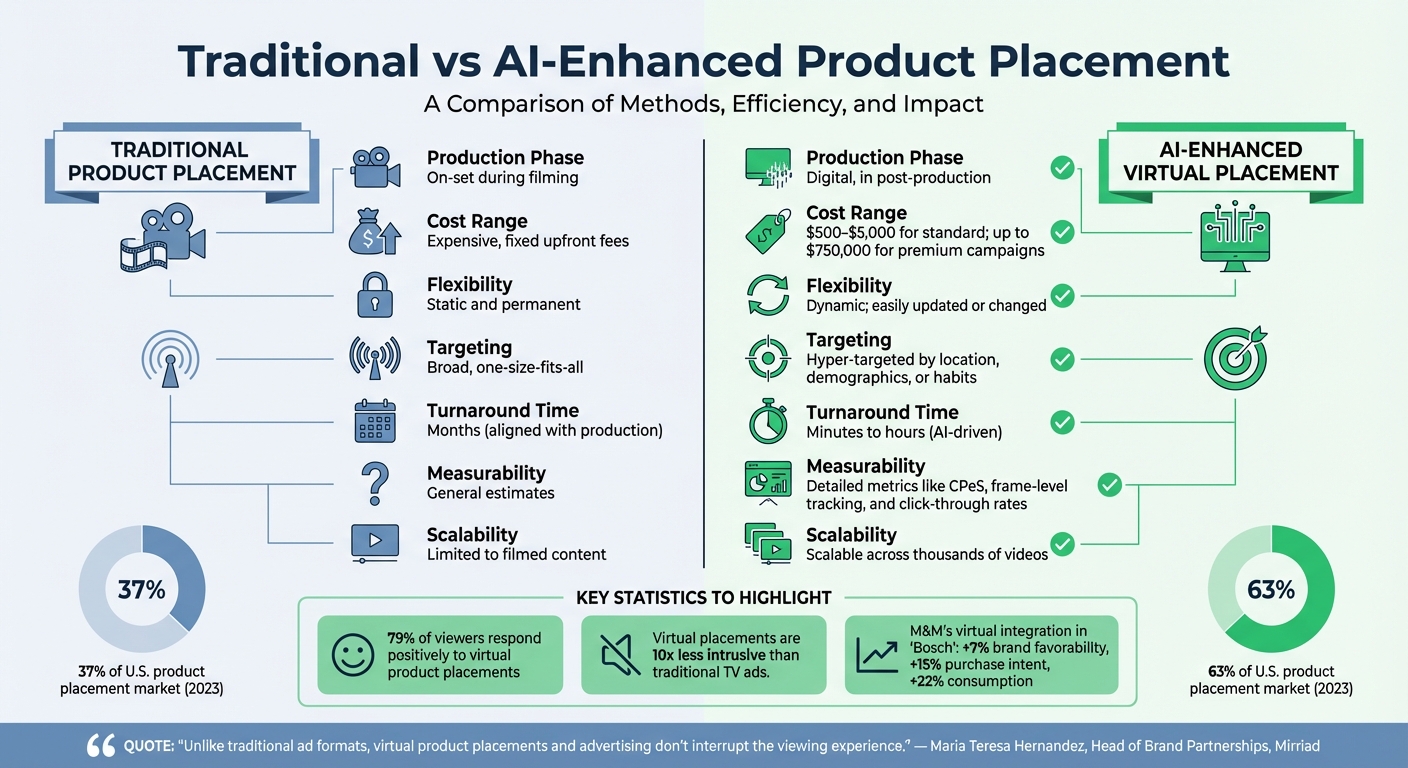
Traditional vs AI-Enhanced Product Placement: Cost, Speed, and ROI Comparison
Traditional product placement was a logistical challenge. It involved shipping products, syncing with filming schedules, and locking in decisions months in advance – leaving no room for changes after production wrapped. Enter AI-powered virtual product placement, which flips the script entirely. Products are now added digitally during post-production, allowing brands to integrate items into existing content, tailor placements for specific regions, or even swap out products as campaigns shift. What used to take months can now happen in mere minutes. This streamlined process not only saves time but also reshapes how budgets are spent.
Virtual product placement doesn’t just cut costs – it opens up creative possibilities. Compared to traditional methods, where costs could be steep and inflexible, virtual placements start at around $500 for standard digital content. Even influencer collaborations can cost under $1,000. Pricing models are also adapting, with performance-based options like cost per thousand impressions (CPM) or cost per exposure-second (CPeS) replacing flat fees.
Consumers seem to prefer this approach. Research shows 79% of viewers respond positively to virtual product placements, finding them far less intrusive than traditional TV ads – by a factor of 10. For instance, a virtual integration of M&M’s in the show Bosch increased brand favorability by 7%, boosted purchase intent by 15%, and drove a 22% rise in consumption compared to traditional TV exposure. Clearly, AI-driven placements are not just a technical upgrade – they’re meeting audience preferences head-on.
Comparison Table: Traditional vs. AI-Enhanced Product Placement
| Feature | Traditional Product Placement | AI-Enhanced Virtual Placement |
|---|---|---|
| Production Phase | On-set during filming | Digital, in post-production |
| Cost Range | Expensive, fixed upfront fees | $500–$5,000 for standard; up to $750,000 for premium campaigns |
| Flexibility | Static and permanent | Dynamic; easily updated or changed |
| Targeting | Broad, one-size-fits-all | Hyper-targeted by location, demographics, or habits |
| Turnaround Time | Months (aligned with production) | Minutes to hours (AI-driven) |
| Measurability | General estimates | Detailed metrics like CPeS, frame-level tracking, and click-through rates |
| Scalability | Limited to filmed content | Scalable across thousands of videos |
| Market Share (2023) | 37% (U.S. product placement market) | 63% (U.S. product placement market) |
"Unlike traditional ad formats, virtual product placements and advertising don’t interrupt the viewing experience."
– Maria Teresa Hernandez, Head of Brand Partnerships, Mirriad
With its speed, flexibility, and measurable impact, virtual product placement is redefining the advertising landscape, offering a smarter and more efficient alternative to traditional methods.
Measuring ROI and Optimizing Product Placement in 2026
Key Metrics for Tracking Success
When it comes to evaluating product placement, the journey spans multiple stages. From measuring top-of-funnel metrics like reach and impressions to gauging mid-funnel indicators such as brand recall and sentiment, and finally tracking bottom-of-funnel actions like website visits and sales, every step matters.
One standout metric is Net Placement Value (NPV), which helps calculate ROI by estimating the cost of achieving similar exposure through traditional advertising. This figure is then adjusted based on the quality of the placement. For example, standout placements can deliver an NPV of $412,400, compared to $299,803 for more standard placements.
"Through AI we’re able to understand which pieces of content are likely to be the biggest hits and which ones are likely to reach the audience that’s going to potentially buy your product." – Aaron Frank, SVP, Strategy, Research and Insights, BENlabs
Other important tools include the Cultural Relevance Index and brand lift studies, which measure shifts in recall, perception, and purchase intent by comparing audiences exposed to the placement versus those who weren’t. Social listening tools also play a vital role, tracking "share of voice" and sentiment immediately after content is released, capturing the initial buzz around your integration. With global spending on product placement expected to hit $41.5 billion by 2026, having precise measurement tools isn’t just helpful – it’s a necessity.
These insights pave the way for the next step: using AI to refine and optimize your placements efficiently.
Using PyxelJam for Cost-Effective Optimization
PyxelJam takes product placement to the next level with its AI-powered platform. By leveraging computer vision, it scans video frames to identify the best surfaces for placement while analyzing lighting and camera angles to ensure the product looks like it belongs. Additionally, Natural Language Processing (NLP) fine-tunes dialogue and sentiment to make sure the placement feels seamless and contextually appropriate.
One of PyxelJam’s standout features is its post-production flexibility. Brands can insert or swap products into existing content, making it possible to refresh campaigns or test variations without reshooting a single frame. This allows for A/B testing of product positions, scene timing, or even product variations, helping you find what works best to drive conversions.
This level of personalization is a game-changer. Companies that excel in tailoring their efforts see 40% more revenue from those activities compared to their competitors. PyxelJam’s tools also track every stage of the funnel, from initial reach to final sales, including website visits and in-store purchases.
With nearly 30% of businesses expected to adopt AI-driven analytics for ROI measurement by 2025, PyxelJam offers a way to stay ahead of the curve. And with virtual product placement costs ranging from just $500 to $5,000 per placement – significantly cheaper than traditional methods – you can scale your efforts without breaking the bank.
Conclusion
Overlooking product placement in 2026 could mean leaving a substantial amount of revenue on the table. With global spending on product placement projected to reach $41.5 billion this year and 91% of U.S. marketers considering it vital for connecting with audiences who sidestep traditional advertising, the focus has shifted from questioning its relevance to perfecting its execution.
AI has revolutionized how product placement works. What once required months of preparation, physical props, and hefty budgets can now be seamlessly accomplished in post-production for as little as $500 to $5,000 per placement. Platforms like PyxelJam use AI-driven tools, including computer vision and natural language processing, to pinpoint ideal integration opportunities, embedding brands naturally into the storyline. The impact? In-content product placement can enhance brand awareness by over 85% and significantly improve recall rates. PyxelJam’s approach turns these challenges into scalable, revenue-generating solutions.
The brands that thrive in 2026 are those embracing hyper-personalized experiences, offering tailored product placements based on viewer preferences, habits, and even location. This level of personalization isn’t just a buzzword – it’s a revenue driver, with companies achieving it earning 40% more revenue than their competitors. AI tools now make it possible to incorporate shoppable placements, conduct A/B testing, and optimize in real-time, shortening the path from viewer to customer.
These measurable outcomes underscore why forward-thinking brands view product placement as more than just an option. Ignoring it doesn’t just mean missing out on potential gains – it risks falling behind competitors already leveraging these cutting-edge tools. As industry leaders emphasize, the conversation has moved from debating the value of product placement to refining its strategies. PyxelJam offers that refinement, transforming existing video content into monetizable assets without the need for reshoots, actors, or traditional production costs.
The future of marketing isn’t about disrupting audiences – it’s about blending seamlessly into the content they enjoy. AI-powered product placement makes this not only possible but also trackable and scalable.
FAQs
How does AI improve the effectiveness of product placement in marketing?
AI is transforming product placement by leveraging tools like computer vision and contextual targeting to blend products naturally into video content. These technologies pinpoint the perfect moments to showcase a product, making the placement feel organic and appealing to viewers.
By examining audience preferences and the context of the content, AI enables brands to enhance visibility and build stronger connections with their audience. This approach not only boosts engagement but also improves ROI, making product placement a more effective marketing strategy.
What are the cost advantages of virtual product placement compared to traditional methods?
Virtual product placement brings a fresh, budget-friendly approach to advertising compared to traditional methods. Instead of physically placing products on set – which involves costs like transportation, set modifications, and coordination – products are digitally added during post-production. This eliminates many logistical expenses, cutting down on overall production costs.
What really sets virtual placements apart is their flexibility. Brands can easily tweak or update their messaging without needing to reshoot or redo entire scenes, saving both time and money. This flexibility also makes it possible to create campaigns tailored to specific audiences or regions, helping brands get the most out of their return on investment (ROI). In short, virtual product placement offers a modern, efficient alternative that traditional advertising methods often struggle to keep up with.
Why is product placement a more effective marketing strategy than traditional advertising in 2026?
Product placement has become a standout marketing strategy in 2026 because it fits naturally into the content people already love. Instead of interrupting their experience like traditional ads often do, it blends into TV shows, movies, or videos, making it feel more organic and less intrusive. This approach doesn’t just avoid being ignored – it grabs attention in a way that sticks.
Here’s the proof: 75% of consumers search for a product after spotting it in entertainment, and 57% actually make a purchase. That’s a game-changer, especially for brands trying to connect with audiences who actively avoid ads. By weaving products into content in a way that feels genuine, marketers can build stronger emotional ties, boost brand recall, and see a better return on investment compared to conventional advertising.