Struggling to decide between influencer marketing and product placement? Here’s the short answer:
- Influencer marketing: Ideal for quick sales and targeting niche audiences. It leverages trusted creators to promote your product directly to their followers. Costs range from $10 (nano-influencers) to $500,000+ (mega-influencers), with an average ROI of $5.78 per $1 spent.
- Product placement: Perfect for long-term brand visibility. Your product is seamlessly integrated into movies, TV shows, or games, staying visible for years. It’s pricier, with high-profile placements often exceeding $100,000, but it delivers lasting exposure and an average ROI of $8.23 per $1 spent.
Quick Overview:
- Use influencers for immediate engagement and specific audiences.
- Opt for product placement to build brand recognition over time.
Still unsure? Combining both strategies can amplify results – think influencers promoting your product’s appearance in a show or film.
Marketing Tips: Product Placement and Influencer Marketing
sbb-itb-0df1f49
What is Influencer Marketing?
Influencer marketing is all about partnering with content creators to promote your brand to their followers. Instead of relying on traditional ads, this approach taps into the trust and connection influencers have built with their audiences over time.
The key is finding a creator whose audience aligns with your target market. They then weave your product into their content – think TikTok reviews, Instagram Stories, or YouTube tutorials. This feels more like a trusted recommendation than a sales pitch. In fact, 72% of consumers trust influencer recommendations over direct brand messaging, making it a more effective alternative to traditional advertising.
The growth of this industry is undeniable. By the end of 2025, influencer marketing reached a value of $32.6 billion, with 85% of marketers recognizing it as an effective channel for achieving their goals. Why? For every dollar brands spend, they see an average return of $5.78.
In 2026, many brands are focusing on long-term ambassador programs to build deeper trust with audiences. Different platforms offer unique opportunities: TikTok is a hub for viral trends (used by 68.8% of brands), Instagram thrives on lifestyle content, and YouTube is perfect for detailed product reviews.
Interestingly, smaller creators, like nano-influencers (1,000–10,000 followers), are gaining traction. They boast engagement rates of 3.69%, which is more than double the rates of larger influencers.
"They are often the heartbeat of authentic connections… They bring a level of trust, engagement, and relatability with their audience, and credibility that’s hard to replicate with macro and mainstream voices".
This strategy sets the stage for tangible results, as outlined in the benefits below.
Benefits of Influencer Marketing
The core strength of influencer marketing lies in trust. When a creator endorses your product, their audience views it as a personal recommendation rather than a sales tactic. This trust delivers results: 60% of consumers are open to buying a product recommended by a relatable influencer, compared to just 3% for celebrity endorsements.
Another advantage is cost flexibility. Nano-influencers charge between $10 and $800 per post, while micro-influencers (10,000–100,000 followers) range from $100 to $5,000. Even larger creators often achieve better ROI than traditional advertising methods.
Influencer marketing also excels at targeting specific audiences. Instead of broadcasting to a general audience, you’re connecting with niche communities already interested in your product. For example, a skincare brand collaborating with a beauty influencer reaches viewers who are actively seeking skincare advice.
The content itself has lasting value. Unlike paid ads that vanish when your budget runs out, influencer posts can continue to generate organic views for months or even years, especially on platforms like YouTube and Pinterest. Additionally, brands can repurpose influencer-generated content for their own ads, often achieving 30% to 50% lower cost-per-acquisition.
A standout example is Simmons’ #Snoozzzapalooza campaign on TikTok. During the pandemic, the mattress brand encouraged users to "stage dive" into their beds, creating a fun, relatable challenge. The six-day campaign attracted 1.1 million participants, generated over 2 million videos, and racked up 6.3 billion views, resulting in a 107% increase in website traffic. This shows how influencer campaigns can achieve massive reach and engagement, even organically.
These benefits highlight why influencer marketing is such a powerful tool, though it comes with its own set of challenges.
Challenges of Influencer Marketing
Despite its advantages, influencer marketing isn’t without hurdles.
Finding the right creator takes time and effort. It’s not just about follower count – you need to ensure their audience aligns with your target market. Additionally, spotting fake followers requires analyzing engagement rates, audience demographics, and unusual follower growth patterns.
Maintaining consistent messaging can be tricky when working with multiple influencers. Each creator has their own voice and style, which is key to authenticity. However, you still need to ensure they follow brand guidelines without stifling creativity.
Reputation risks are another concern. If an influencer gets involved in a controversy, your brand could face backlash by association. To mitigate this, many brands now include "morals clauses" in contracts and have crisis response plans in place. A single misstep by a creator can have a ripple effect on your brand’s image.
Compliance with regulations adds complexity. As of 2026, FTC rules require clear disclosures like #ad or #sponsored to appear prominently in captions or within the first 30 seconds of videos. Failure to comply can lead to penalties for both the influencer and the brand.
Lastly, tracking ROI requires careful planning. Using tools like unique discount codes, UTM links, and dedicated landing pages helps measure which influencers are driving actual sales versus just generating likes. Without these systems, it’s hard to gauge the true effectiveness of your campaigns.
These challenges underscore the importance of a thoughtful approach to influencer marketing, ensuring it remains a reliable and impactful strategy.
What is Product Placement?
Product placement, also called "embedded marketing" or "brand integration", involves weaving branded products into the fabric of movies, TV shows, or online videos. Instead of interrupting viewers with a standalone ad, it blends the product into the storyline, keeping audiences engaged. This approach bypasses the issue of traditional ads being skipped or muted – something 66% of TV viewers admit to doing.
Product placement can range from a subtle logo in the background to a character actively using the product. The most memorable examples integrate the brand into the plot itself. Take Eleven’s obsession with Eggo waffles in Stranger Things, for instance. This storyline coincided with a 9.4% revenue increase for Kellogg’s in the first half of 2018.
One of the biggest draws of product placement is its lasting presence. Unlike commercials that run for a limited time, product placements stay embedded in the content, whether through reruns, streaming, or international distribution. This means the exposure can last for years – sometimes even decades – without requiring additional spending.
And it works. Studies show that viewers are 88% more likely to remember a product placement than a traditional ad, and for every dollar spent, brands see an average return of $8.23. This strategy offers long-term visibility and a measurable impact, as shown in its many benefits.
Benefits of Product Placement
One standout advantage of product placement is its permanence. Once your product appears in a movie or show, it becomes part of that content forever. For example, BMW spent $3 million to feature the Z3 in GoldenEye (1995), which resulted in $240 million in advance sales.
It can also have a massive cultural ripple effect. In 1983, Ray-Ban’s Wayfarer sunglasses were on the verge of being discontinued, selling only 18,000 pairs. But after Tom Cruise wore them in Risky Business, sales skyrocketed to 360,000 pairs that year. By 1986, after another appearance in Top Gun, sales hit 1.5 million pairs.
Another benefit is the sheer size of the audience. Around 75% of broadcast-network shows include some form of product placement, reaching millions of viewers at once. Plus, 60% of moviegoers report feeling more favorable toward brands they see in films.
Product placement also taps into emotional connections. When viewers see a beloved character using a product, they often associate those positive feelings with the brand.
"Product placement is effective because it embeds your brand within the content consumers are already engaged with, subtly weaving the idea and image of your brand into the storyline." – Stacy Jones, CEO, Hollywood Branded
The global exposure is another major plus. Content created for U.S. audiences often airs in multiple countries, providing international visibility without extra costs. Over time, as the content is replayed worldwide, the cost-per-impression drops significantly.
Finally, product placement drives consumer action. About 75% of viewers search for a product online after seeing it in a show or film, and 57% of those searches result in a purchase.
Challenges of Product Placement
While product placement offers many advantages, it isn’t without its challenges.
The most obvious issue is the price tag. High-profile placements can be prohibitively expensive. For example, Heineken reportedly spent $45 million for its placement in the James Bond film Skyfall (2012), while Ford shelled out $14 million for just three minutes of screen time in Casino Royale.
Another challenge is creative control. Unlike traditional ads where the brand controls every detail, product placement requires collaboration with filmmakers. Directors and producers ultimately decide how – and sometimes whether – the product appears on screen. This could mean your product ends up as a barely noticeable background element.
Long production timelines can also be an obstacle. For broadcast TV, it can take 3 to 9 months, while feature films might require 12 to 15 months before the placement is seen by audiences. This delay makes it less suitable for time-sensitive campaigns.
There’s also the risk of the placement feeling forced or unnatural. If a product is awkwardly integrated into a scene, viewers may pick up on it and form negative impressions. A seamless fit within the storyline is crucial, but not always achievable.
Measuring ROI is another hurdle. Unlike digital ads, which offer precise metrics like clicks and conversions, product placement relies on estimated impressions. Tying these impressions to actual sales often requires additional tools or tracking systems.
Lastly, product placement is a high-risk gamble. If the movie flops or the show gets canceled early, your investment might not yield much return. This makes it a riskier strategy compared to marketing channels with more predictable outcomes.
Though it differs from influencer marketing in its approach, product placement shares the goal of engaging audiences in a way that feels natural. Both methods can be effective, depending on the brand’s objectives and resources.
Influencer Marketing vs. Product Placement: Side-by-Side Comparison
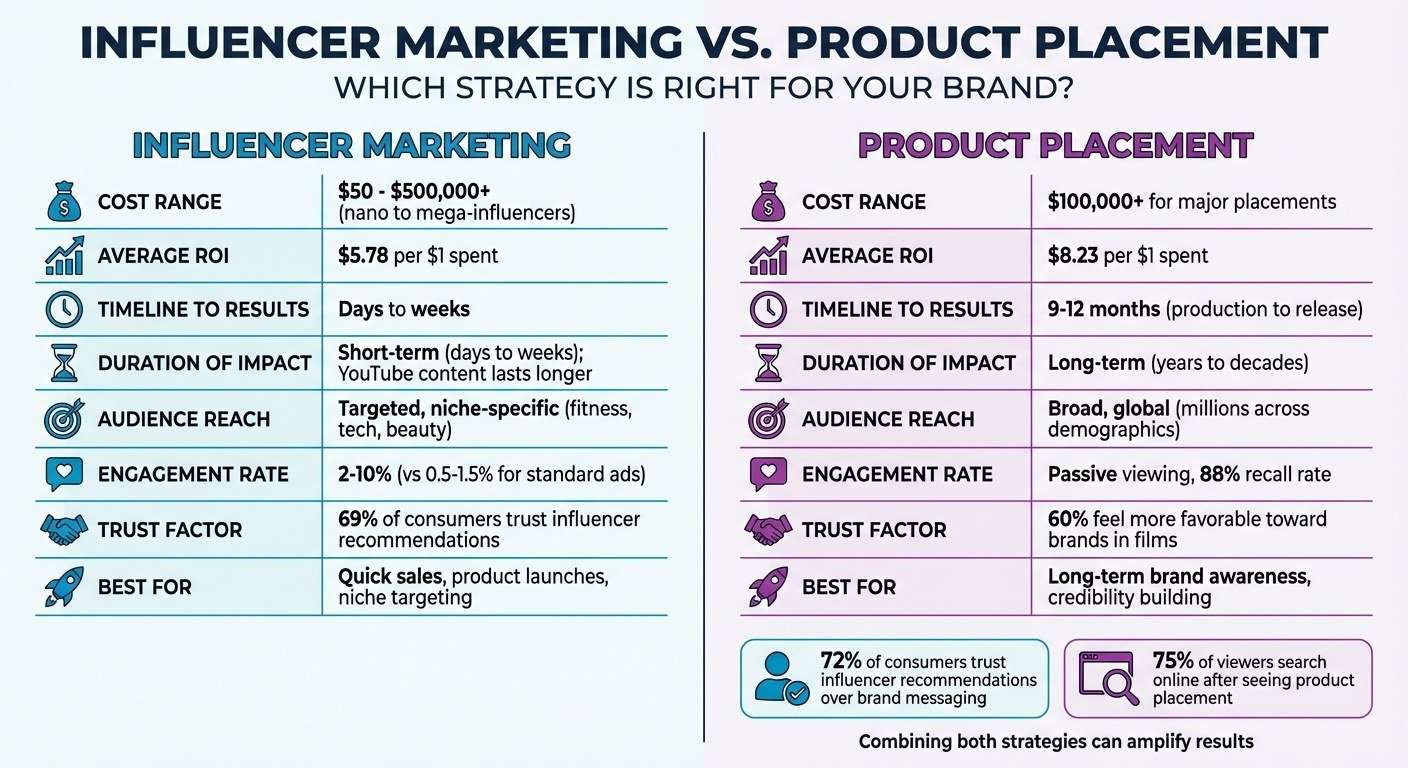
Influencer Marketing vs Product Placement: Cost, ROI, and Key Differences Comparison
To better understand how these two strategies stack up, let’s break them down side by side. Each has its strengths and limitations, depending on your goals.
Influencer marketing drives quick sales with its direct calls-to-action, while product placement embeds your brand into entertainment for longer-lasting visibility. As Stacy Jones, CEO of Hollywood Branded, explains:
"Once you are baked in the programming – you are there for life… TV and film’s I worked on over 20 years ago are still airing today".
These strategies also differ in how they engage audiences. Influencer campaigns often see engagement rates between 2% and 10%, significantly higher than the 0.5% to 1.5% typical for standard social media ads. This engagement is interactive – followers comment, share, and connect directly with the content. On the other hand, product placement works in the background, boosting brand familiarity without needing active viewer participation.
Trust is another key factor. Around 69% of consumers trust influencer recommendations over direct messaging from brands. Meanwhile, product placement builds credibility in a different way – by associating your brand with high-quality entertainment. As Hyperr Volt wisely notes:
"The question is not which is better. The question is what you are trying to accomplish, and which channel is better suited for that specific goal".
Here’s a quick comparison to highlight their differences:
Comparison Table: Key Differences
| Factor | Influencer Marketing | Product Placement |
|---|---|---|
| Reach | Targeted, niche-specific (e.g., fitness, tech) | Broad, global (millions of viewers across demographics) |
| Cost | Starts at $50 (nano-influencers) to $500,000+ (mega-influencers) | High upfront; often over $100,000 for major placements |
| Effectiveness | Great for immediate sales (average ROI of $5.78 per $1 spent) | Ideal for long-term brand recall over years |
| Authenticity | Relies on personal trust between creator and audience | Subtle integration feels natural but less personal |
| Duration | Short-term (days to weeks); YouTube content can last longer | Long-term (decades); remains in content for future airings |
| Target Audience | Highly specific to the creator’s followers | General audience of the show or film |
Each strategy offers unique benefits depending on whether your focus is on short-term conversions or building long-term brand awareness.
How to Choose the Right Strategy for Your Brand
When deciding between influencer marketing and product placement, think about your goals and resources. Influencer marketing delivers quick, targeted results, while product placement offers lasting brand visibility. Stacy Jones, CEO of Hollywood Branded, explains it well: "Product placement in general can serve a brand better ultimately, although influencer marketing may be quicker to drive some immediate sales". Your budget and objectives will play a key role in determining the best approach.
Budget Considerations
Your financial resources will heavily influence your choice. Influencer marketing is often more flexible and accessible, especially for smaller campaigns. For instance, nano-influencers (with 1,000–10,000 followers) might collaborate for as little as $0 to $500 per campaign, while micro-influencers can range from $0 to $3,000. This affordability makes it a great option for brands looking to test the waters or launch products quickly.
On the other hand, product placement usually requires a higher upfront investment. However, this approach can provide long-term visibility and credibility for your brand. If your budget is tight, starting with smaller influencer campaigns might be the way to go.
Target Audience and Goals
The right strategy also depends on your audience and what you want to achieve. Influencer marketing is perfect for connecting with specific niches, such as skincare enthusiasts or tech lovers, through trusted voices in those communities. These campaigns can be set up in just a few days or weeks, making them ideal for flash sales or product launches.
Product placement, however, is better suited for building broad awareness across a wide audience. For example, OPPO’s integration into a globally broadcast show helped the brand gain visibility in markets where its products weren’t yet available. Keep in mind that this approach requires patience, as it can take 9–12 months for films or TV shows to go from production to release.
Combining both strategies can be a powerful move. Use influencers to spotlight your product placement in entertainment, creating a mix of immediate engagement and long-term brand recognition.
Conclusion
Influencer marketing and product placement each offer distinct advantages for boosting your brand. Influencer marketing excels at driving quick sales and building trust through relatable voices, with brands seeing an average return of 5.78 times their investment. On the other hand, product placement provides long-term exposure by seamlessly integrating your brand into content.
Your choice between the two should depend on your budget, timeline, and specific goals. For instance, starting with micro-influencers can be highly effective, as they deliver engagement rates 60% higher than those of larger creators. If your aim is to establish enduring brand recognition and you’re ready to commit to a larger investment, product placement can deliver that lasting visibility, working for months or even years.
Think about your audience and timeline when deciding. Influencer marketing is great for reaching niche communities quickly, while product placement is better for building broad awareness over a longer period, typically 9–12 months. As Hyperr Volt Blog aptly puts it:
"The question is not which is better. The question is what you are trying to accomplish, and which channel is better suited for that specific goal".
In many cases, combining both strategies can be the smartest move. Use product placement for sustained visibility and pair it with influencer marketing to generate immediate buzz and amplify those placements across social media.
FAQs
How do I decide between influencer marketing and product placement?
Choosing between influencer marketing and product placement comes down to your brand’s specific goals, target audience, and the kind of impact you’re aiming for. Influencer marketing relies on creators to deliver relatable, engaging content, making it perfect for fostering trust and creating immediate connections with your audience. On the other hand, product placement integrates your brand into entertainment, offering extended visibility and shaping audience perception over time. To decide, think about what matters most to your brand – quick engagement or long-term awareness. Also, weigh factors like your budget, the audience you’re targeting, and how long you want the campaign to run.
How can I track ROI for product placement?
To determine the return on investment (ROI) for product placement, focus on a few key metrics. Start with audience reach and impressions, which show how many people were exposed to your brand. Additionally, track how often your product or logo appears on screen during the placement.
Beyond visibility, dig into performance indicators like sales lift, brand awareness, and consumer engagement. For example, did sales increase after the product placement aired? Are more people talking about your brand online?
Use tools like tracking links to monitor direct traffic or conversions tied to the placement. Keep an eye on social media activity, such as hashtags or mentions, to gauge audience reaction. Finally, compare sales data from before and after the placement to get a clear picture of its impact.
These insights not only help quantify ROI but also guide adjustments for future product placement strategies.
Can I combine influencer marketing and product placement effectively?
Combining influencer marketing with product placement can be a powerful way to expand your brand’s reach and improve engagement. This strategy taps into the trust and credibility influencers have with their audiences while showcasing your product through organic, relatable placements. By blending these approaches, brands can craft endorsements that feel natural, build stronger connections with audiences, and drive both quick sales and lasting brand recognition. Establishing long-term partnerships and tracking performance metrics ensures these efforts remain genuine and deliver measurable outcomes.
Related Blog Posts
- Text-to-Video vs. Image-to-Video: When to Use Each Approach for Best Results
- The Hidden Cost of Ignoring Product Placement in Your 2026 Marketing Mix
- 9 Industries That Benefit Most from Product Placement (Is Yours One of Them?)
- How AI-Powered Video Production Makes Product Placement Faster and Cheaper