
AI-powered video production is reshaping how brands handle product placement by offering faster, more affordable, and flexible solutions. Instead of relying on physical props or on-set crews, tools like PyxelJam allow products to be digitally added to finished footage. This process uses AI technologies like computer vision and 3D modeling to seamlessly integrate products into scenes, saving time and cutting costs by up to 90%.
Key benefits include:
- Cost Savings: AI reduces expenses by eliminating physical props, crews, and reshoots. A 30-second ad can cost as little as $2,000 compared to $250,000 using older methods.
- Speed: Turnaround times drop from weeks to minutes with automated scene analysis and rendering.
- Flexibility: Products can be swapped or updated post-production, allowing for regional or seasonal customization without filming new footage.
- Scalability: Entire content libraries, including older videos, can be updated with new placements.
For example, in 2025, the British Council reduced production costs by 70% with AI, while companies like Kalshi and Coign created high-quality ads in under 48 hours for a fraction of the cost.
AI-driven platforms like PyxelJam are transforming product placement, offering brands a faster, cheaper, and more efficient way to create engaging video content.
how i turn product images into (animated) video ads using AI.
sbb-itb-0df1f49
What is AI-Powered Product Placement?
AI-powered product placement, often referred to as Virtual Product Placement (VPP), is a technique that uses artificial intelligence to digitally embed branded products, signage, or advertisements into video content during post-production. Unlike traditional methods that require physical props on set, this approach allows brands to add products after filming, offering unmatched flexibility for marketers and content creators.
The process relies on three key technologies. Computer vision analyzes video frames to identify surfaces, lighting, and angles where products can blend seamlessly. 3D modeling creates digital replicas that align with the scene’s perspective and lighting conditions. Contextual analysis ensures that products appear naturally within the narrative – for instance, placing a branded coffee mug in a morning breakfast scene rather than forcing it into an unrelated action sequence.
Megan Ashdown, Senior Digital Account Director at The Kite Factory, explains:
"Virtual Product Placement is a groundbreaking AI-driven solution that allows brands to collaborate with content owners to seamlessly insert their products into images, videos, movies, or social media posts after production."
This technique eliminates the need for shipping physical props or having brand representatives on set, which streamlines the filming process and avoids creative disruptions.
Beyond simplifying logistics, AI-powered product placement unlocks new creative opportunities. Brands can digitally insert products into existing content libraries – like classic movies or older TV shows – creating fresh revenue streams without the need for reshoots. It also allows for tailored placements across different markets or seasonal updates.
Companies like PyxelJam take this a step further, enabling product placements in challenging environments – whether underwater, in historical eras, or futuristic worlds – while automating complex tasks like CGI and set design. This technology is reshaping how brands engage with audiences through video content.
Key Benefits of AI in Product Placement
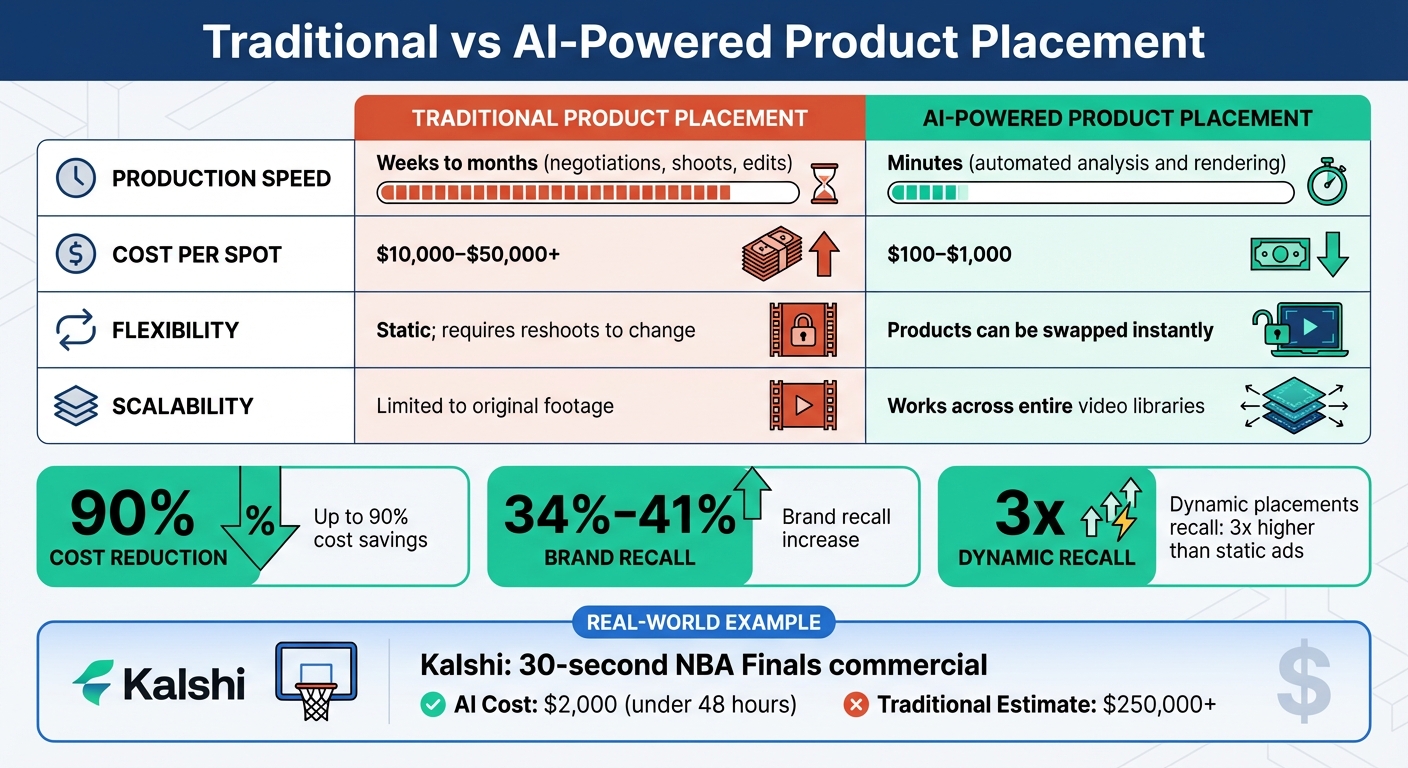
Traditional vs AI-Powered Product Placement: Cost, Speed & Flexibility Comparison
AI-powered product placement is transforming the advertising industry by slashing production costs – up to 90% in some cases – and cutting turnaround times from weeks to mere minutes. But the advantages go far beyond cost and time savings. With AI, brands can seamlessly replace products in existing footage without reshoots, test multiple variations simultaneously, and even tailor placements to specific regions or demographics. For example, in 2025, the British Council successfully used AI to localize over 1,000 advertising assets, reducing production costs by 70% and speeding up time-to-market by 50%. These efficiencies highlight the transformative potential of AI in areas like cost reduction, production speed, and scalability.
The financial impact of AI-driven product placement is undeniable. Take Kalshi, for example, which created a 30-second commercial for the NBA Finals in June 2025. Using AI, the project cost just $2,000 and was completed in under 48 hours – compared to traditional production estimates exceeding $250,000. Similarly, in February 2026, financial services company Coign utilized Google’s Veo 3 model to produce a TV commercial in half a day at less than 1% of the typical cost.
| Feature | Traditional Product Placement | AI-Powered Product Placement |
|---|---|---|
| Production Speed | Weeks to months (negotiations, shoots, edits) | Minutes (automated analysis and rendering) |
| Cost per Spot | $10,000–$50,000+ | $100–$1,000 |
| Flexibility | Static; requires reshoots to change | Products can be swapped instantly |
| Scalability | Limited to original footage | Works across entire video libraries |
The effectiveness of AI-driven placements also speaks volumes. Studies show that these placements increase brand recall by 34% to 41% compared to traditional ads. Dynamic placements, in particular, achieve three times higher recall than static ads. As Henry, a Creative Technologist at Bonega.ai, puts it:
"The real power of AI video ads is not replacing what existed. It is enabling campaigns that were previously too expensive to attempt".
Cost Savings
AI eliminates the need for costly elements like physical props, on-set crews, shipping logistics, and reshoots. Instead, updates can be made digitally in just minutes. This is particularly useful when branding changes or campaign goals shift mid-production. Automation further reduces labor costs by handling tasks like scriptwriting, asset selection, and editing. For instance, global fintech company Klarna saved $10 million annually by integrating AI into its operations, including a $4 million reduction in external agency fees for creative production. Similarly, advertising leader WPP reported efficiency gains of up to 70% on campaigns that leveraged AI tools.
Faster Turnaround
AI doesn’t just save money – it also speeds things up. By automating scene analysis and real-time rendering, AI can handle tasks that once took weeks in mere minutes. Using computer vision, AI models scan video frames to identify optimal placement zones, factoring in surfaces, lighting, shadows, and camera angles. Advanced algorithms then use neural rendering to seamlessly integrate 3D products into scenes, matching environmental physics and lighting perfectly. Batch processing allows AI to apply these placements across entire video libraries simultaneously, which dramatically accelerates production timelines.
Flexibility and Scalability
AI’s post-production capabilities are redefining how brands approach campaigns. Instead of locking in product placements during pre-production, brands can now make these decisions after filming. This means the same footage can be repurposed across multiple campaigns by digitally swapping products – opening up entirely new revenue streams. With hyper-targeting, brands can customize placements to suit specific demographics, locations, or viewing habits. For example, a single scene can feature different beverage brands or restaurant logos depending on the region, all without additional filming. Marketers can also generate multiple variations for A/B testing, helping them identify which placements resonate most with specific audiences. As Emily Oberkrieser, Director of Integrated Marketing at Mirriad, explains:
"AI provides the freedom to integrate, adjust, and even replace products post-production, bringing much-needed agility to these collaborations".
How PyxelJam Streamlines Product Placement
PyxelJam has reimagined the product placement process by removing the need for traditional production elements like cameras, actors, and physical sets. Instead, the platform uses AI-generated visuals to showcase products in a wide range of settings – from everyday environments to extraordinary, imaginative scenes. This innovative approach not only enables placements in locations that would otherwise be impossible but also significantly speeds up production timelines, delivering completed videos in just 3–5 days, compared to the usual 2–4 weeks.
By cutting out the costs tied to production crews, equipment, and location logistics, PyxelJam offers a cost-effective solution. As the company puts it:
"Our AI-driven method slashes overhead and time, allowing us to pass the savings onto you!"
Here’s a closer look at the key elements that make PyxelJam’s process so efficient.
AI-Powered Scene Analysis
PyxelJam’s AI uses computer vision to identify the best spots for product placement within video footage. Whether it’s a table, a wall, or even a hand interaction, the AI pinpoints areas where products can naturally fit into the scene. This level of precision ensures that the placements feel seamless and resonate with the intended audience. Plus, the system processes this information in real-time, making it easy to tweak placements or make edits without the need for costly reshoots.
Realistic Rendering and Lighting Matching
To ensure a seamless integration, PyxelJam creates highly realistic digital replicas of products. The AI analyzes the scene’s ambient lighting, allowing products to reflect light naturally and cast appropriate shadows. Even during camera movements, the scale and positioning remain consistent. Advanced physics engines also simulate lifelike material properties, such as the reflections on glass or metal, avoiding any unnatural or "off" appearance. These capabilities not only enhance the visual quality but also contribute to faster production and lower costs.
Data-Driven Insights for Better Engagement
PyxelJam goes a step further by using analytics to tailor videos for specific audiences, maximizing both engagement and ROI. The AI evaluates every detail – scenes, dialogue, and visuals – to align placements with brand goals and the emotional tone of the content. For example, it can run A/B tests to show different products to different viewers based on their location or demographics, such as featuring a sports drink for one audience and an energy bar for another in the same gym scene. This targeted approach has been shown to boost brand recall by 34%. These insights empower advertisers to make smarter decisions about their campaigns, ensuring they achieve measurable results while keeping costs and timelines in check.
Step-by-Step Guide to Using PyxelJam for Product Placement
Using PyxelJam’s AI-powered platform for product placement is a simple and efficient process. The system automates the workflow, cutting down on time and effort. Here’s how you can get started:
Step 1: Upload Video Footage
Start by uploading your video content through the PyxelJam dashboard. Once the footage is submitted, the AI begins analyzing it immediately. This step replaces hours of manual work with a quick, automated process that takes just minutes.
Step 2: AI Scene Analysis
After the upload, PyxelJam’s AI scans every frame of your video. It evaluates key factors like lighting, angles, and occlusion while using natural language processing to identify the best spots for product placement. Whether it’s a kitchen counter, a city street, or a cozy living room, the platform ensures that products appear naturally within the scene. For example, a coffee mug might be placed in a morning scene rather than during a tense evening discussion.
Step 3: Choose and Customize Products
Once the AI identifies placement opportunities, you can upload your own 3D models, logos, or high-resolution visuals. Alternatively, you can select items from PyxelJam’s library of virtual products. For a realistic look, the platform uses 3D assets and simulates material properties to match the lighting, shadows, reflections, and perspective of your footage seamlessly.
Step 4: Render and Preview
PyxelJam provides real-time previews of your product placements, allowing you to see how each item looks within the scene before finalizing. You can experiment with various positioning options to find the most natural and visually appealing arrangement. The platform also enables dynamic adjustments, such as swapping products for different audience segments based on demographics or geographic locations.
Step 5: Finalize and Export
Once you’re satisfied with the placements, finalize the video and export it in your desired format. This entire process, from uploading footage to exporting the final video, typically takes just 3–5 days – much faster than the 2–4 weeks traditional methods often require. PyxelJam’s streamlined approach saves both time and resources, making it a game-changer for product placement projects.
Real-World Applications and Success Stories
PyxelJam’s AI-driven video production has opened the doors of professional video creation to small and medium businesses like flower shops, auto repair services, and clothing boutiques – businesses that previously couldn’t afford the steep costs of traditional commercial production. By eliminating the need for actors, crews, and physical sets, PyxelJam delivers high-quality video content at a fraction of the usual cost. This affordability doesn’t just save money – it unlocks creative opportunities that were once out of reach.
The platform enables brands to create visuals that would be nearly impossible – or outrageously expensive – to achieve with traditional methods. Imagine showcasing a product on Mars, inside a medieval castle, or alongside talking animals. These imaginative settings allow businesses to tell engaging stories that break free from the constraints of physical production. Combined with the cost savings and speed of production, these creative possibilities are reshaping how brands approach marketing.
And it’s not just about creativity – these videos deliver results. Studies show that 80% of people are persuaded to buy a product or service after watching a brand’s video, and AI-enhanced product placements can boost brand recall by 34%. PyxelJam’s ability to produce polished commercials in as little as 48 hours gives businesses a unique edge, enabling them to respond quickly to trends and seasonal opportunities. This is a stark contrast to the 12-week timelines typical of traditional production methods.
The platform also excels in efficiency. PyxelJam reduces the time required to produce a video ad from about 4.5 hours to under 3 hours. It also allows for last-minute edits without the added costs of reshoots. These time and cost savings make it easier for businesses to iterate and adapt their campaigns, ensuring they stay relevant in an ever-changing market.
Conclusion
AI-powered video production is changing the game for product placement by cutting out the need for expensive on-set shoots and significantly reducing costs. Traditional methods often come with lengthy timelines that delay campaigns, but PyxelJam’s AI-driven approach speeds up production, allowing brands to quickly respond to market trends and seasonal opportunities.
With AI-driven scene analysis and real-time rendering, PyxelJam unlocks creative possibilities that were once out of reach. Imagine showcasing your product on Mars, inside a medieval castle, or in any other imaginative setting – visuals that would be nearly impossible (or wildly expensive) to achieve with conventional filming methods. This kind of creative freedom, paired with the power of engaging video marketing, gives businesses a noticeable edge in a competitive market.
"Our AI slashes overhead and turnaround time – powering savings directly to you!"
In short, PyxelJam is redefining video marketing. It’s no longer a costly, time-consuming process – it’s fast, flexible, and inspiring. Whether you’re a small business looking to compete with industry giants or an established company aiming to boost your marketing ROI, PyxelJam’s AI-powered video production offers the speed, affordability, and creativity you need to rethink your product placement strategy. The tools are ready – are you?
FAQs
What files do I need to start using PyxelJam?
To begin using PyxelJam, all you need to do is sign up for an account on their platform. PyxelJam offers a suite of AI-powered video production tools, including automated editing and virtual sets, designed to simplify and speed up your video creation process.
How do you make the product look real in my footage?
AI-powered virtual product placement allows products to integrate naturally into your footage. By leveraging techniques such as dynamic lighting and shadow matching, surface texture analysis, and scene understanding, these tools ensure the product feels like part of the scene. They identify the best placement spots, adjust lighting to align with the environment, and make sure the product interacts naturally with its surroundings – making it nearly impossible to tell it apart from real objects.
Can I swap placements later for different audiences?
AI-powered platforms make it possible to adjust product placements later through real-time customization and dynamic editing. This flexibility allows you to effortlessly adapt content to suit various audiences, ensuring it aligns with their preferences and needs.