
Product placement is a marketing strategy where brands integrate their products into movies, TV shows, or other content. It works because it feels natural, not like a traditional ad. And the numbers back it up: 81% brand recall when products are used and mentioned on-screen, compared to just 32% for regular ads. Plus, 75% of viewers search for brands they see, and over half go on to buy them.
Here’s a quick look at nine industries thriving with this approach:
- Automotive: Cars often symbolize status or power in stories, driving sales. For example, BMW‘s Z3 in GoldenEye led to $240M in sales.
- Fashion: Iconic outfits, like those in The Devil Wears Prada, create demand for brands.
- Consumer Electronics: Devices like laptops and smartphones add realism while boosting visibility.
- Food & Beverage: Memorable scenes, like Eggo Waffles in Stranger Things, drive sales spikes.
- Retail & E-commerce: Brands like Target naturally fit into stories, making them relatable.
- Entertainment & Media: Shows and movies integrate brands to enhance realism and cut costs.
- Gaming & Esports: Interactive placements, like branded items in games, engage players.
- Beauty & Cosmetics: Makeup and skincare define characters and inspire viewers.
- Hospitality & Travel: Travel brands, like Vrbo, fit seamlessly into storylines about connection.
AI-powered tools like Virtual Product Placement (VPP) make it easier to insert products into finished content, saving time and money. These tools allow brands to customize placements for specific audiences and adapt to changing trends, all while delivering measurable results like higher sales and engagement. If your product fits naturally into a story, product placement might be the perfect strategy.
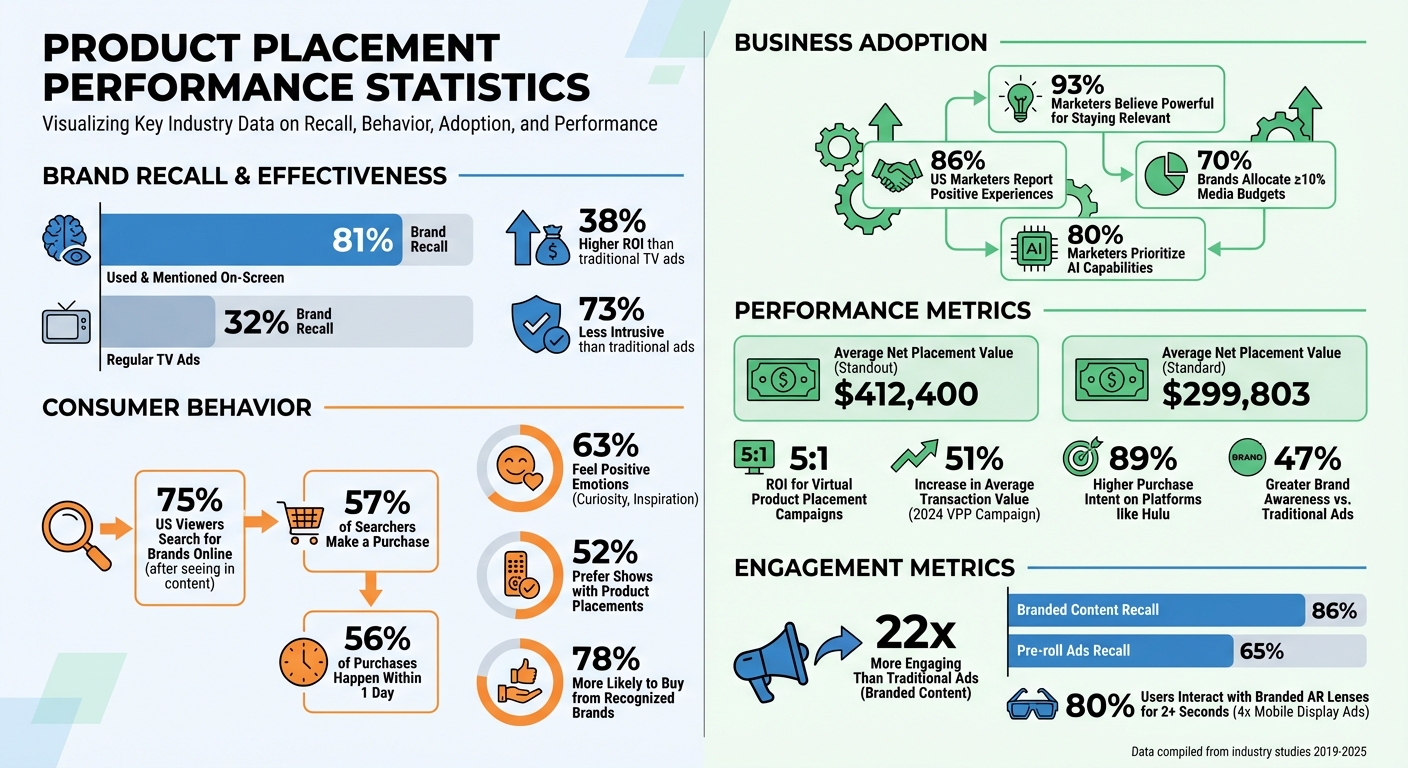
Product Placement Statistics: Brand Recall, ROI, and Consumer Behavior Data
1. Automotive Industry
Integration into Storytelling
Cars often act as more than just transportation in films and TV – they symbolize status, power, and even personality. Think about Breaking Bad: when Walter White upgraded to a Chrysler 300, the car became a clear representation of his growing wealth and evolving character. This kind of storytelling works because viewers associate the traits of the character with the brand. A hero or prominent figure driving a specific car model? That instantly elevates the brand’s image.
The best placements make the car an integral part of the narrative. Take The Italian Job, for instance: the movie’s heist scenes revolved around over 30 Mini Coopers, and BMW saw a 22% jump in Mini Cooper sales the following year. Similarly, BMW’s $3 million investment to feature the Z3 in GoldenEye (1995) led to 9,000 preorders and $240 million in sales within just a month of the movie’s release. These examples show how weaving vehicles into the storyline can leave a lasting impression and drive measurable results.
Impact on Brand Visibility
Automotive product placements deliver impressive recall rates. While a typical 30-second TV ad achieves about 32% brand recall, that figure skyrockets to 81% when the vehicle is both shown on-screen and mentioned in dialogue. Major productions featuring standout placements generate an average Net Placement Value of $412,400, outperforming traditional TV ads by 38%.
Another advantage? Longevity. Unlike commercials that fade after airing, placements in films and shows remain accessible through streaming platforms, giving brands extended exposure. This is a key reason why 70% of companies are now channeling at least 10% of their traditional ad budgets into product placement.
Suitability for AI-Enhanced Video Solutions
AI is transforming how automotive brands approach video marketing. Virtual Product Placement technology allows specific car models to be seamlessly added to completed footage – no need for reshoots or lengthy coordination, which typically takes 4–15 months. Companies like PyxelJam offer AI-powered tools that make this process easier and more accessible, enabling brands to insert their vehicles into engaging storylines without requiring film crews or physical cars. These tools even allow for dynamic customization, adjusting placements based on a viewer’s location or profile.
With 80% of marketers now prioritizing AI’s predictive capabilities when selecting partners, this approach provides a way to estimate ROI before committing resources. The benefits? Faster production, reduced costs, and placements that feel naturally integrated rather than forced. By leveraging AI, automotive brands can create personalized, data-driven campaigns that resonate with audiences.
sbb-itb-0df1f49
2. Fashion and Apparel Industry
Integration into Storytelling
Clothing often becomes more than just wardrobe; it transforms into a storytelling tool. Take The Devil Wears Prada as an example – Chanel boots didn’t just complete an outfit; they symbolized the intense world of fashion journalism and the protagonist’s personal growth. When apparel is woven into the narrative, it becomes essential to the story.
The results speak volumes. In 2021, Weinsanto placed a lace gown from its AW 21 collection on actress Philippine Leroy-Beaulieu in Netflix‘s Emily in Paris. The outcome? The gown sold out immediately after the episode aired. Even more impressive, as of June 2025, that one dress still generates 15% of the brand’s total revenue and continues to attract new customers. Similarly, Tom Cruise’s iconic look in Top Gun gave Ray-Ban a nearly 40% boost in sales. This kind of placement positions fashion brands at the heart of cultural moments.
Impact on Brand Visibility
Product placements often outperform traditional ads, which people tend to skip. When fashion brands are seamlessly integrated into popular shows, they become part of the broader conversation, elevating their prestige and keeping them relevant long after the show ends.
The stats back this up: 75% of US consumers have searched for a brand online after seeing it in a movie or show, and 57% of those ended up making a purchase. On-screen placements achieve recall rates as high as 81%, compared to just 32% for standard ads. Certain placements, like those in TV dramas or music videos, can even trigger search spikes of up to 300%. This kind of visibility cements a brand’s presence in the minds of consumers.
Consumer Engagement Potential
Fashion placements don’t just catch eyes – they spark emotional connections. A staggering 78% of consumers are more likely to buy from brands they recognize through content. Branded content also outshines pre-roll ads, achieving an 86% recall rate compared to 65% for pre-roll ads.
The cost of placements varies widely, making it accessible for brands of all sizes. Indie film placements can cost up to $50,000, while major blockbuster integrations can climb into eight-figure territory. For smaller budgets, TikTok creators with 1,000–100,000 followers offer a more affordable option, charging just $25 to $125 per post. This flexibility allows brands to experiment with different strategies and scale successful ones.
Suitability for AI-Enhanced Video Solutions
AI is taking product placement to the next level. Virtual Product Placement technology allows clothing and accessories to be digitally added to finished footage – no need for reshoots or complex production coordination. This means brands can tailor placements for different markets or even swap items to suit individual viewer profiles.
AI-powered tools like PyxelJam streamline content creation by eliminating the need for traditional film crews and actors. This approach makes it faster and more cost-effective to produce videos featuring fashion products. AI also enables personalization: for instance, a viewer in a colder region might see a thermal jacket, while someone in a warmer area sees a moisture-wicking tank top from the same brand. Some platforms even include shoppable overlays, allowing viewers to click and buy directly from the video player. With 70% of brands expected to allocate at least 10% of their media budget to product placement by 2024, AI-driven solutions offer the adaptability and speed brands need to stay ahead.
3. Consumer Electronics Industry
Integration into Storytelling
Tech products often blend seamlessly into storylines. Take The Big Bang Theory, for example, where characters openly debated their preference for Xbox over other consoles. This created a sense of genuine connection to the brand without feeling forced. Similarly, Dell strategically positioned its devices in HBO‘s Succession to craft an authentic corporate environment. They later expanded to shows like The Sex Lives of College Girls and And Just Like That, tapping into a broader audience.
"Product placement only works if brands are incorporated authentically into the story, empowering the storyline and not disrupting it." – BENlabs
Electronics also act as visual cues. A specific laptop or smartphone can instantly signal a character’s financial status, tech expertise, or professional role without a single line of dialogue. Productions lean toward real products to make fictional worlds feel more grounded and relatable. This natural integration boosts visibility and digital interaction for brands in the consumer electronics sector.
Impact on Brand Visibility
When electronics are prominently featured and tied into the script, they deliver an average Net Placement Value of $412,400, surpassing the $299,803 average for standard placements. If a product is both shown on-screen and mentioned in dialogue, brand recall skyrockets to 81%. These placements also drive significant digital engagement, with 40% of viewers more likely to look up a product after seeing it in a show. The result? Noticeable spikes in online searches and interactions.
Consumer Engagement Potential
Electronics placements don’t just boost visibility – they create trust. Seeing a favorite character use a specific gadget can carry more weight than traditional ads, especially since many consumers rely on reviews before buying tech. For instance, Canon‘s integration into popular TV shows led to a 55% increase in brand favorability among viewers.
Branded content outperforms traditional ads, delivering 22 times more engagement, 100% higher viewability, and 35% better recall [3,20]. Additionally, 63% of viewers say product integrations make brands feel more relatable. With 44% of consumers taking over a day to make a purchase after seeing a placement, digital retargeting becomes a critical tool for converting interest into sales [20,6].
Suitability for AI-Enhanced Video Solutions
With authenticity and visibility as the foundation, AI is taking product placement to the next level. Virtual Product Placement (VPP) technology allows devices to be digitally inserted into content, saving production time and ensuring the tech remains current [1,21]. AI can even tailor placements to match a viewer’s profile or location, offering a personalized experience.
In 2019, BENlabs’ AI successfully identified the top five broadcast shows for product placement, outperforming traditional methods. This predictive capability ensures brands position their products in content with the largest reach. PyxelJam’s AI solutions create professional-grade content quickly and at a lower cost, eliminating the need for traditional film crews. With 80% of marketers now prioritizing AI when selecting partners for product placement and global spending forecasted to hit $41.5 million by 2026 [6,22], AI-driven solutions are helping electronics brands stay ahead in a competitive market.
4. Food and Beverage Industry
Integration into Storytelling
Food and beverage brands shine when they seamlessly weave into a story. Take Stranger Things, for instance. Eleven’s love for Eggo Waffles wasn’t just a quirky trait – it created an emotional bond with viewers. After Season 2 aired in October 2017, Kellogg’s saw a 14% jump in sales and a 9.4% boost in Q1 2018 revenue. Kellogg’s CEO Steven Cahillane even acknowledged how the show influenced shoppers to rethink their choices.
"It’s ideal for brand integration to be integrated into the actual content itself." – Mike Proulx, Research Consultant, Forrester
Food choices in stories often serve as subtle cues, adding depth to characters or settings without needing extra explanation. This kind of integration not only fosters emotional connections but also translates into tangible visibility and sales gains.
Impact on Brand Visibility
Strategic placement can significantly amplify a brand’s presence and deliver real results. General Mills used this approach by featuring Cheerios in Netflix, Disney+, and Amazon Prime shows aimed at teens. The result? A 44% unaided brand recall and the sale of an extra 80,000 cases. Similarly, Hot Cheetos made an appearance in Gentefied, leading to a 4% uptick in purchase intent.
Consumer Engagement Potential
Product placement doesn’t just get noticed – it drives action. Sixty-five percent of viewers report a positive impression after encountering a brand this way. Even more impressively, 75% of U.S. viewers have looked up a brand they spotted in a movie or show, and 57% went on to make a purchase. A 2024 campaign using virtual product placement saw a 51% increase in average transaction value and delivered a 5:1 return on investment.
Suitability for AI-Enhanced Video Solutions
Virtual Product Placement (VPP) technology is changing the game for food and beverage brands. Instead of waiting 4–15 months for traditional product integration, VPP allows brands to digitally insert items like packaging or signage into video content after production. AI takes this a step further, tailoring placements to match a viewer’s preferences or location. With 80% of marketers identifying AI as a key part of their strategy, tools like PyxelJam’s AI-powered video solutions offer brands a fast, cost-effective way to create high-quality content, mirroring success stories from other industries.
5. Retail and E-commerce Industry
Integration into Storytelling
Retail and e-commerce brands shine when seamlessly woven into storytelling. A great example is Target’s 2019 partnership with NBC‘s Superstore, a sitcom set in a big-box retail environment. The show featured Target-style products and layouts, creating a natural connection between the brand and the storyline. This approach felt organic, unlike traditional ads that 86% of viewers tend to skip. By embedding the brand within the narrative, Target became part of the entertainment itself, making the experience both engaging and memorable.
Impact on Brand Visibility
Story-driven product placements do more than entertain – they boost brand visibility in measurable ways. Take CarMax’s virtual product placement in the 2022 Lifetime holiday movie A Show-Stopping Christmas. This clever integration led to a 20-point increase in brand rating. When products are not only visible but also mentioned in dialogue, brand recall soars to 81%, a stark contrast to the 32% recall rate of traditional TV ads. These numbers underscore how retail brands can expand their reach without relying solely on conventional advertising methods.
Consumer Engagement Potential
Product placement doesn’t just spark awareness – it drives consumer action. In fact, 75% of U.S. viewers search for brands they notice on-screen, and 57% go on to make a purchase. A standout example is the ramen brand immi, which used Shopify Collabs in 2021 to send samples to content creators with affiliate links. This campaign resulted in 432 brand ambassadors, over 4,400 referral orders, and more than $200,000 in affiliate sales. These results highlight how well-executed placements can translate directly into sales and stronger consumer relationships.
Suitability for AI-Enhanced Video Solutions
AI-powered tools are opening up new doors for retail and e-commerce brands to capitalize on video content. Virtual Product Placement (VPP) technology, for instance, allows brands to digitally insert products into existing videos after production. Amazon tested this approach in 2022 by virtually placing a bowl of M&M’s into the TV show Bosch, which led to a 7% increase in brand favorability and a 15% rise in purchase intent. AI also enables interactive, shoppable video features, letting viewers click on a product to buy it directly from the video player. For online retailers, platforms like PyxelJam offer efficient, high-quality integrations with measurable results that traditional methods can’t match.
6. Entertainment and Media Industry
Integration into Storytelling
The entertainment and media industry has taken product placement to a whole new level. It’s not just about slipping a brand into the background; it’s about making it part of the story. When actual brands are woven into narratives, they create experiences that generic props simply can’t match. These story-driven placements can even push the plot forward, turning brands into essential elements of the narrative. Plus, they help cut down on staging costs, allowing more room for creative storytelling.
Impact on Brand Visibility
The impact of product placement on brand visibility is hard to ignore. For instance, Hot Cheetos saw a 4% jump in purchase intent after being featured in a memorable scene from Netflix’s Gentefied. And it’s not just about visibility – 75% of U.S. consumers search for brands online after seeing them in entertainment, with 57% of those searches leading to purchases. To put it into perspective, standout placements can generate an average Net Placement Value of $412,400, compared to $299,803 for more standard placements.
Consumer Engagement Potential
Unlike traditional ads, product placement has the power to forge emotional connections. About 63% of consumers report feeling positive emotions – like inspiration or curiosity – when they see brands seamlessly integrated into entertainment content. Even better, 52% of viewers say they prefer programs with product placements over those interrupted by commercials. A great example is the Go RVing road trip series featured on The Ellen DeGeneres Show, which racked up over 15 million views and 440 million social media impressions. And because these integrations live on whenever the content is rewatched, they continue to engage audiences long after their initial airing. This lasting impact is paving the way for AI-driven innovations to refine these strategies even further.
Suitability for AI-Enhanced Video Solutions
AI is revolutionizing how brands approach product placement in entertainment. Around 80% of marketers now see AI capabilities as a key factor when choosing partners for these integrations. Virtual Product Placement (VPP) allows brands to digitally insert products into completed footage, opening up new possibilities. In 2024, AI-powered predictions by BENlabs accurately identified the top five broadcast shows, outperforming traditional industry methods. Tools like those from PyxelJam are also making waves, analyzing hours of content to pinpoint optimal integration moments and forecast which placements will deliver the highest return on investment. These advancements are reshaping the way brands connect with audiences through entertainment.
7. Gaming and Esports Industry
Integration into Storytelling
Gaming has become a playground for immersive brand storytelling. Players don’t just see brands – they interact with them. Whether it’s wearing branded avatar clothing or sipping on a virtual energy drink, these elements blend seamlessly into the game’s narrative, making them part of the experience [1,28]. This approach, known as narrative placement, allows brands to actively contribute to the storyline or character development.
Technology has made it easier for brands to integrate into these virtual worlds. Digital tools now let companies insert signage, packaging, or even 3D objects into game environments that closely resemble real-world settings [1,3]. Some fictional brands, like "Potion" from Final Fantasy, have even crossed over into reality, giving fans a tangible connection to the game’s universe.
Impact on Brand Visibility
The interactive nature of gaming delivers measurable results for brands. Products featured in games have a recall rate of 81%, far surpassing the 32% recall typical of traditional TV ads. Unlike TV commercials, gaming content sidesteps ad-skipping and blocking, ensuring that brands capture undivided attention. For instance, a 2024 campaign for a consumer packaged goods company used virtual product placement in gaming and saw a 51% increase in average transaction value, achieving a 5:1 ROI.
Gaming also boosts engagement in unexpected ways. Nearly half (43%) of consumers report feeling more connected to a music artist after seeing them appear in a video game. For smaller businesses, collaborations with gaming influencers provide an affordable way to break into this space.
Consumer Engagement Potential
Gamers are highly receptive to branded content when it feels authentic and enhances their experience. For example, branded AR lenses see impressive engagement, with 80% of users interacting for at least two seconds – four times the typical benchmark for mobile display ads. Livestreaming has added another layer of interaction, allowing brands to use digital overlays and embed products directly into a creator’s live setup. However, the key to success lies in subtlety; forced placements can lead to "ad fatigue", which savvy gamers quickly reject.
Suitability for AI-Enhanced Video Solutions
AI is taking in-game branding to the next level. Virtual Product Placement (VPP) technology allows brands to insert signage, packaging, or 3D objects into games and esports broadcasts during post-production [1,3]. This process eliminates the need for reshoots or long production timelines, giving brands the flexibility to tweak placements as needed [3,4]. AI can even personalize ads by swapping out virtual billboards or clothing based on a viewer’s preferences or context.
The numbers show how big this market is becoming. The global AI in gaming market is expected to grow from $3.28 billion in 2024 to over $51 billion by 2033. More than half of game developers are already using generative AI tools. Platforms like PyxelJam are helping brands analyze gaming content to identify the best moments for integration, ensuring maximum impact. These advancements show how AI-driven strategies are reshaping product placement, not just in gaming but across multiple industries, making it a cornerstone of modern marketing.
8. Beauty and Cosmetics Industry
Integration into Storytelling
Beauty products can do more than just appear in a scene – they can define a character or even drive the story. Think about how a signature makeup look or a specific skincare routine can make a character feel more authentic and relatable. For example, in Sex and the City, Carrie Bradshaw’s bold red lipstick wasn’t just makeup – it became part of her identity. MAC Cosmetics, the brand behind that iconic look, became a go-to for viewers who wanted to channel her confidence and style. Using real products like this doesn’t just enrich storytelling; it also cuts costs and creates a more immersive experience for audiences.
Impact on Brand Visibility
The numbers are hard to ignore: brands featured on-screen see a recall rate of 81%, compared to just 32% for a traditional 30-second ad. Unlike standard ads, product placements feel more natural and are 73% less intrusive, making them a smart way to avoid ad-skipping. This approach doesn’t just boost visibility – it drives action. Seventy-five percent of viewers search for a brand after seeing it in a show or movie, and 57% of those searches lead to purchases. Beauty tutorials and talk-show segments also outperform traditional ads, being 22 times more engaging. For products that need a little explaining, like anti-aging serums, talk shows offer a perfect platform to connect with a specific audience.
Consumer Engagement Potential
Beauty product placements don’t just inform – they inspire. Sixty-three percent of consumers feel curious or motivated after seeing a brand integrated into content, and more than half prefer shows with product placements over traditional ads. Social media amplifies this effect. Influencers seamlessly weave products into makeup tutorials or "get ready with me" videos, turning casual viewers into potential buyers. Costs for influencer partnerships vary widely, from $25 for smaller creators to $1 million or more for major feature film placements. Even augmented reality (AR) is making waves – branded AR lenses see 80% of users interacting for at least two seconds, quadrupling the engagement of typical mobile ads.
Suitability for AI-Enhanced Video Solutions
AI tools are transforming how beauty brands integrate into content. By analyzing hours of footage, AI can pinpoint the perfect scenes or characters to match a brand’s aesthetic. This is especially valuable for Virtual Product Placement (VPP), where products, logos, or signage are digitally added during post-production. This method is not only flexible but also allows for personalization – AI can adjust the product shown based on the viewer’s profile or preferences. Platforms like PyxelJam use AI to ensure that placements feel natural and fit seamlessly into the story. The results speak for themselves: product integrations on platforms like Hulu lead to 89% higher purchase intent and 47% greater brand awareness compared to traditional ads.
9. Hospitality and Travel Industry
Integration into Storytelling
Travel brands have a unique opportunity to weave their services into the fabric of a story. Picture this: a character books a vacation rental or checks into a hotel to reconnect with family. In this case, the travel service doesn’t feel like an interruption – it actually drives the plot forward. Vrbo nailed this concept by showing characters booking vacation homes to spend meaningful time together, making the brand a natural part of the narrative. Even small touches, like branded luggage or hotel toiletries, can add a sense of realism without breaking the bank. This kind of subtle integration can boost brand visibility in a way that feels effortless.
Impact on Brand Visibility
When done right, product placement can make a brand unforgettable. Integrated placements often leave a stronger impression than traditional ads. In fact, 93% of marketers believe product placement is a powerful way to stay relevant to consumers. Platforms like Hulu have shown how virtual integrations can deliver impressive results, including an 89% uptick in purchase intent and a 47% increase in brand awareness. Unlike conventional ads that travelers often skip, product placements reach audiences who are already tuned in and engaged.
Consumer Engagement Potential
The numbers speak for themselves: 75% of viewers search for a brand after seeing it in a show or movie, and 57% of those searches lead to purchases. What’s more, over half (56%) of these purchases happen within just one day. Beyond driving sales, product placements also leave a positive impression – 63% of consumers report feeling good about brands they see on-screen, and 52% even prefer shows or movies that feature product placements over traditional ads. For hospitality brands, this means placements can translate into immediate bookings, especially when paired with tools like social listening to track search trends and online buzz.
Suitability for AI-Enhanced Video Solutions
AI is reshaping the way travel brands approach product placement. A whopping 80% of marketers now rely on AI to make smarter placement decisions. By analyzing video footage during post-production, AI can pinpoint the perfect moments to insert logos, destination signs, or branded elements – eliminating the need for on-set coordination. This method, known as virtual product placement, delivers a return on investment five times greater than traditional approaches. Tools like PyxelJam use AI to seamlessly embed digital branding into scenes, allowing companies to test different placements, customize them for specific audiences, and scale them across multiple streaming platforms. For time-sensitive campaigns, AI shortens production timelines from over a year to just a few months, making it a game-changer for the industry.
Three Tips to Supercharge Product Placement in the Streaming Age
Conclusion
Product placement has become a powerful tool for driving customer engagement across nine different industries. Consumer behavior consistently shows its effectiveness, with statistics highlighting that product placement achieves a 38% higher ROI compared to traditional TV ads. It’s not just an alternative to commercials – it’s a smarter investment.
The rise of AI-driven video solutions has taken this strategy to the next level. Tools like PyxelJam streamline the process by digitally embedding branding into completed content, cutting out production delays entirely. This isn’t just about speed – it’s about results. Virtual placements have been shown to boost average transaction values by 51% and deliver a 5:1 ROI. These AI solutions allow brands to scale placements across platforms while tailoring content to specific audiences.
For brands across industries, the key is blending authenticity with smart technology. If your product can seamlessly fit into a story – like a car in a thrilling chase, a smartphone in a lead character’s hand, or even a coffee cup on a desk – product placement could be the perfect strategy. The magic happens when the integration feels natural: brands that enhance the storyline and add realism see the best results. On the flip side, forced placements tend to miss the mark. It’s no surprise that 86% of U.S. marketers who have used product placement report positive experiences, and 70% of brands are expected to dedicate at least 10% of their media budgets to this tactic.
AI tools make it easier to experiment, measure, and refine placements without overspending. PyxelJam’s AI-powered production eliminates the need for traditional crews and equipment, offering faster turnarounds and endless creative opportunities. Whether you’re a small brand testing the waters or a major player scaling across streaming platforms, these tools let you test placements, track engagement in real time, and adjust strategies as needed. The conversation has shifted from debating whether to use product placement to figuring out how to do it best. Brands embracing AI-driven solutions are already setting the pace.
Think about where your product naturally fits into today’s most-watched content and use AI tools to execute placements effectively and affordably. The opportunities are endless.
FAQs
How do AI tools improve product placement strategies?
AI tools are transforming how product placement strategies work, making them smarter, more tailored, and easier to track. By diving into data, AI allows brands to weave products into content in a way that feels natural and relevant to the audience. The result? Better brand visibility and consumer engagement without interrupting the viewer’s experience.
On top of that, AI automates much of the placement process, enabling businesses to scale their efforts across various markets and media platforms. It also delivers real-time insights by monitoring consumer behavior and engagement, helping brands pinpoint what resonates most and tweak their strategies for stronger results. In short, AI makes product placements sharper, more focused, and more effective.
What makes product placement more effective than traditional advertising?
Product placement comes with some standout benefits compared to traditional advertising. For one, it lets brands reach audiences in a more natural and less intrusive way, especially in an era where many people skip or tune out conventional ads. By weaving products directly into the storyline of video content, brands can create a connection that feels more genuine and relatable.
This strategy often sparks curiosity and encourages viewers to explore or buy the featured products. It’s a win-win: brands gain more exposure while leaving a lasting impression by tying their product to a compelling narrative.
What industries benefit the most from product placement?
Industries like technology, consumer goods, and transportation see some of the biggest advantages from product placement. These sectors thrive because their products often integrate seamlessly into the stories told in movies, TV shows, and online content.
Take tech companies, for instance – brands like Apple and Google frequently appear in entertainment, which not only boosts their visibility but also strengthens consumer trust. Similarly, consumer goods giants like Coca-Cola use product placement to build emotional connections with viewers. Here’s a telling statistic: 75% of U.S. consumers search for products they spot in shows or movies, and more than half of them actually make a purchase. That’s a clear indicator of how effective this strategy can be for driving both engagement and sales.
If your business operates in any of these industries – or has a natural tie-in with entertainment content – considering product placement could be a smart move for amplifying your marketing efforts.