Product placement is a powerful way for brands to connect with audiences by embedding their products into entertainment content like movies, TV shows, video games, and social media. Unlike traditional ads, these placements are unskippable and often feel like a natural part of the story. In 2024, the product placement market was valued at $33 billion and is projected to grow to $41 billion by 2026.
Here’s a quick breakdown of the 10 types of product placement covered in this article:
- On-Set/Narrative-Integrated: Products are central to the storyline (e.g., FedEx in Cast Away).
- Background/Set Dressing: Products appear subtly in the background (e.g., a brand logo on a billboard).
- Character-Use: Characters actively use or interact with the product (e.g., Ray-Ban sunglasses in Top Gun).
- Visual Logo: A brand’s logo is visible on-screen without direct interaction.
- Verbal Mention: The brand name is spoken by a character or host.
- Plot Device: The product is essential to the story (e.g., Wilson volleyball in Cast Away).
- Co-Branded/Sponsored Segment: Brands collaborate with producers to create dedicated content segments.
- Cross-Media: The brand is integrated across multiple platforms, including social media and retail campaigns.
- Purpose-Built Prop: Custom-made products are created specifically for the story (e.g., Nike MAG shoes in Back to the Future Part II).
- AI-Powered Placement: Virtual product placements added in post-production using AI tools.
Each type offers unique benefits, costs, and risks, making it important for brands to choose the right approach based on their goals and audience. Deeper integrations often result in higher recall rates but come with greater investment and creative control challenges.
Want a quick overview? Here’s a summary table comparing these methods:
| Placement Type | Visibility | Story Integration | Risk Level | Cost Range |
|---|---|---|---|---|
| On-Set/Narrative-Integrated | High | Deep | High | $1M–$45M |
| Background/Set Dressing | Low | Minimal | Low | $50K–$250K |
| Character-Use | High | Active | Moderate | $250K–$2M |
| Visual Logo | Low | Passive | Low | $50K–$250K |
| Verbal Mention | Moderate | Auditory | Moderate | $50K–$500K |
| Plot Device | Very High | Central | High | $1M–$45M |
| Co-Branded Segment | High | Total | Low | $500K–$35M |
| Cross-Media | High | Synergistic | Low | Varies |
| Purpose-Built Prop | High | Deep | Moderate | $1M+ |
| AI-Powered Placement | Variable | Low–Medium | Low | Flexible |
The key takeaway? Product placement works best when it feels natural and aligns with the content’s tone and audience. Whether you’re aiming for subtle visibility or full-on integration, there’s a placement strategy for every brand.
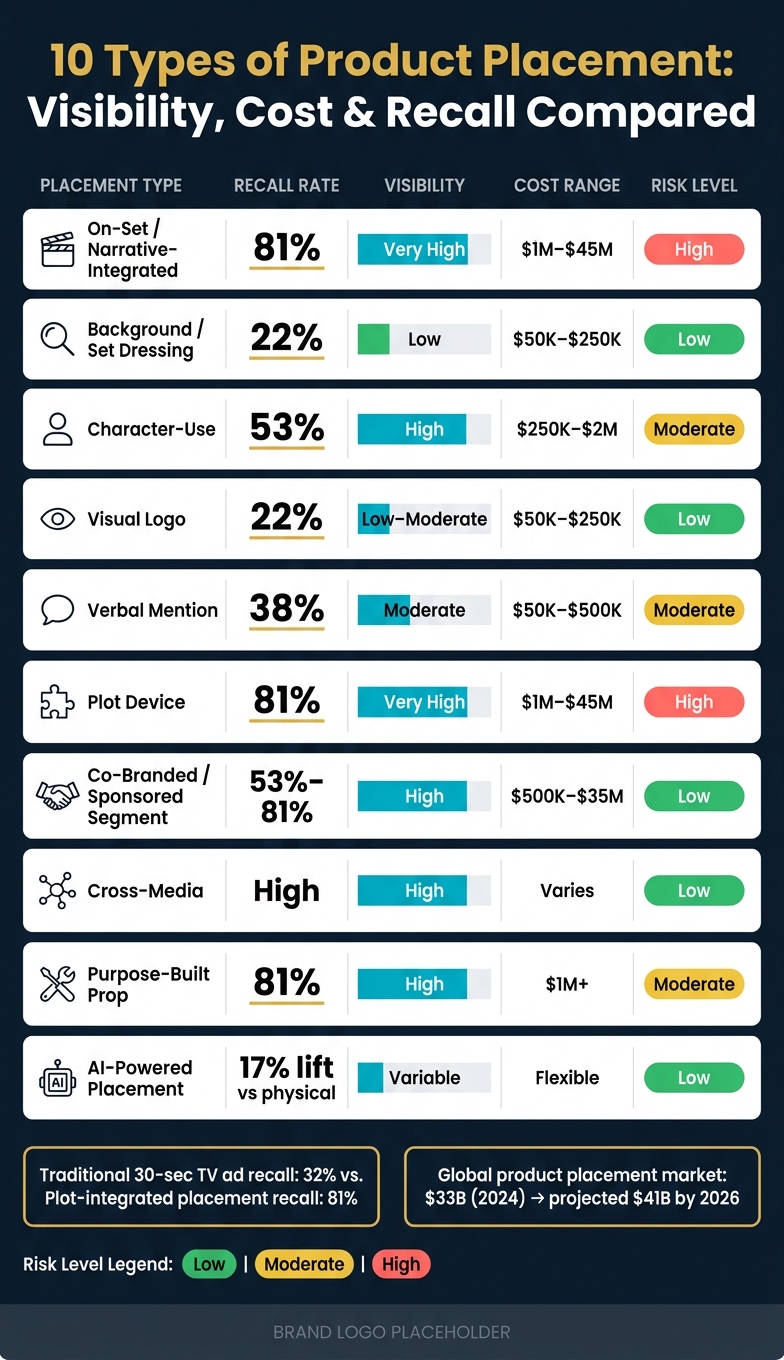
10 Types of Product Placement: Visibility, Cost & Recall Compared
Top 10 Product Placements That Made the Movie Better
1. On-Set or Narrative-Integrated Placement
When it comes to product placement, weaving a brand into the storyline can leave a lasting impression. On-Set placement, where a product becomes so intertwined with the plot that its removal would alter the story, is a prime example. Take Cast Away: FedEx wasn’t just a backdrop – it was central to the narrative, resulting in a 96% brand recall and millions of dollars’ worth of exposure.
Plot-integrated placements have an impressive 81% recall rate, compared to only 32% for a typical 30-second TV commercial. This is because when a character visibly uses and mentions a product, it engages both visual and auditory memory, making the brand unforgettable.
A great example of this approach is Vince Gilligan’s work in the Apple TV+ drama Pluribus, where Sprouts Farmers Market was seamlessly written into the storyline. In a five-minute scene, Rhea Seehorn’s character passionately says, "I just want my Sprouts back", as Sprouts delivery trucks refill store shelves. To make this happen, Sprouts CMO Alisa Gmelich arranged for an Albuquerque store to close for two days of filming. The brand amplified this exposure by launching a "Carol’s Collection" on its website and running a $500 gift card sweepstakes.
"Sprouts plays a role in this very important character’s life, and she is one of our customers. I’ll be honest, it’s hard for me to deny my customers." – Alisa Gmelich, CMO, Sprouts Farmers Market
However, with such deep integration comes risk. While this approach can significantly boost visibility, it also limits a brand’s control over how it’s portrayed. For instance, Peloton faced backlash when a character in And Just Like That… died following a workout on their bike, causing their stock to drop 11% overnight. To avoid such pitfalls, brands should negotiate clear terms upfront, including guidelines that prevent their products from being tied to negative storylines or antagonists. Additionally, securing early access to scripts and production clips can help brands maximize the placement’s value long after its initial airing.
2. Background or Set Dressing Placement
Not every brand needs to take center stage. Background or set dressing placement is when your product quietly appears in a scene – maybe on a kitchen shelf, a billboard, or even as part of a vehicle – without any character directly interacting with or mentioning it. This is the most subtle and affordable form of product placement, with costs typically ranging from $50,000 to $250,000 per placement.
However, there’s a tradeoff: visibility. Background placements have an aided recall rate of about 22%, which is significantly lower than the 53% recall rate when a character actively uses the product or the 81% recall rate for full plot integration. Still, repeated exposure can help build brand recognition over time. To make the most of this method, distinctive packaging is crucial – if your logo or design blends into the scene, viewers might miss it entirely.
Stacy Jones, CEO of Hollywood Branded, highlights the realism that real products bring to a scene:
"Refrigerators are full of real products, and you want that to be realistic. Unless it’s full of Tupperware. But Tupperware is a brand, too."
Using real brands also adds authenticity to the narrative. Jillian Raskin, Vice President at United Talent Agency, explains:
"Fake or nondescript brands can take a viewer out of the experience."
From a production standpoint, background placements are popular because they often lower costs. Brands frequently supply props like espresso machines or luxury cars, which can save productions money. But there’s a potential downside. For instance, in 2021, Duke University faced a PR issue when HBO’s The White Lotus featured a character wearing a Duke "Blue Devils" t-shirt while under the influence and contemplating suicide – something the university hadn’t approved.
This example underscores the importance of brand control. Always negotiate clear contractual terms upfront to specify how your product will appear, for how long, and in what context. These safeguards can protect your brand from unintended associations. While subtle, this form of placement can set the stage for more integrated approaches down the line.
3. Character-Use Placement
Character-use placement goes a step further than background placements by showing a character actively engaging with a product – holding it, using it, or consuming it on screen. This direct interaction makes the placement far more memorable, with studies showing it generates a 53% brand recall rate.
Why does this work so well? Audiences naturally form emotional connections with characters. When a beloved character uses a specific product, that positive association often transfers to the brand. Think about Elliott munching on Reese’s Pieces in E.T. – it felt completely natural and led to a 65% profit increase for Hershey in just two weeks. Similarly, Tom Cruise sporting Ray-Ban Aviators in Top Gun not only fit his character but also revived the brand, driving sales up by 40% within seven months. These examples show how seamlessly integrating products into a story can create a lasting impact, ultimately making the higher cost of these placements worthwhile.
Speaking of costs, character-use placements typically range between $250,000 and $2,000,000, depending on the production and the character’s importance. While this is a hefty price tag compared to background placements, the increased visibility and stronger audience recall often justify the investment – especially when the product aligns naturally with the storyline.
But here’s the catch: authenticity is key. If a product feels out of place or contradicts a character’s personality, audiences will notice – and not in a good way. Apple, for instance, has strict rules ensuring only protagonists or likable characters use its devices on screen. As Advergize puts it:
"The most effective placements are invisible because they serve the narrative. The worst placements are visible precisely because they interrupt it."
A perfect example of authentic integration is the Nike Air Jordan 1s worn by Miles Morales in Spider-Man: Into the Spider-Verse. The sneakers weren’t just a product – they were a part of who Miles was. As the film’s director put it, "Miles without Jordans isn’t Miles". This kind of alignment between character and product is what makes character-use placements so impactful.
4. Visual Logo Placement
Visual logo placement works by showcasing your brand on screen without requiring direct interaction. Picture a logo on a delivery truck zooming by in a chase scene, a product subtly visible on a shelf, or a billboard featured in the background. This approach is one of the most common forms of product placement and relies on passive visibility.
Since it doesn’t require script changes or alterations to character behavior, this method carries minimal risk. However, it also tends to yield the lowest recall rate – around 22% – compared to more interactive placements like character use. Still, repeated exposure in the background can gradually influence brand preferences over time, making it a subtle but effective complement to more prominent placements.
A great example of this is the sportswear brand Lonsdale, which appeared for over 16 minutes in the 2020 film The Gentlemen. This visibility generated an estimated $16.5 million in advertising value, according to Concave Brand Tracking. On the other hand, Wilson Sporting Goods gained 10.5 minutes of screen time in the 2000 film Cast Away, resulting in an estimated $1.85 million in advertising value – all without paying a placement fee. Dominic Artzrouni, founder of Concave Brand Tracking, highlights the potential of such placements:
"Product placement is the gift that keeps on giving. The ROI can be ridiculous; a brand might get into a film for free and get $3m in value from it."
The cost of visual placements typically ranges from $50,000 to $250,000. However, many deals involve barter arrangements – such as loaning vehicles or electronics – which can save productions anywhere from $250,000 to $5 million in prop expenses.
One key to success is ensuring your logo is instantly recognizable, even without a close-up. For instance, the Coca-Cola bottle’s iconic shape is unmistakable, while a generic label might go unnoticed. Additionally, controlling the context is crucial for maintaining a positive brand image. For example, companies like Dell carefully review scripts to ensure their logos don’t appear in scenes with negative or inappropriate associations. After all, visibility only adds value when it aligns with and reinforces the brand’s identity.
5. Verbal Mention Placement
Verbal mention placement happens when a character, host, or creator says a brand name aloud, without showing it visually. This method achieves an aided recall rate of about 38%, which is higher than background placements, as it reinforces the brand’s identity through sound. However, this only works when the mention feels like a natural part of the conversation.
The key here is authenticity. If the mention feels forced or interrupts the flow, viewers tend to lose interest. Interestingly, research indicates that verbal placements in comedy shows are 46.3% less likely to feel intrusive compared to those in drama series.
To ensure the mention feels genuine, scripts need careful review. A verbal mention in the wrong context – like from a villain or during a negative moment – can backfire. Jillian Raskin, Vice President at United Talent Agency, explains: "Fake or nondescript brands can take a viewer out of the experience". The flip side is also true: a real brand mentioned inappropriately can leave a bad impression. When executed well, especially alongside on-screen usage, recall rates can soar to 81%, compared to just 32% for a typical 30-second TV ad.
Next, we’ll dive into how product placements evolve from simple mentions to becoming integral parts of the storyline.
6. Plot Device Placement
Plot device placement takes brand integration to its peak. In this case, a product isn’t just featured – it becomes central to the storyline. The plot literally depends on the product. If you remove the brand, the entire narrative collapses. This makes it stand apart from other types of placements, which are more surface-level. Here, the product isn’t just present; it’s pivotal.
This depth translates into some impressive numbers. Plot-integrated placements boast an 81% brand recall rate. Compare that to 22% for background placements and 32% for traditional TV ads. Why? Because the audience can’t engage with the story without noticing the brand. That level of integration leaves a lasting impression.
Take the FedEx package in Cast Away, for instance. Without that package, the film’s plot falls apart. Remarkably, FedEx didn’t even pay for the placement, yet it reaped massive exposure and brand value. Fast forward to December 2025, when Sprouts Farmers Market played a key role in the Apple TV+ drama Pluribus. The storyline hinged on a character’s emotional plea: "I just want my Sprouts back." This moment underscored how deeply the product was woven into the narrative. Sprouts CMO Alisa Gmelich explained its importance:
"It was very clear to me that the role that Sprouts was going to play in the storyline was going to be more than just a location. Sprouts plays a role in this very important character’s life."
Sprouts didn’t stop there. They launched "Carol’s Collection" on their e-commerce site and ran a sweepstakes offering a $500 gift card. A single scene turned into a full-blown marketing campaign.
However, this level of integration comes with risks. When a product is tied so closely to a story, brands give up a lot of creative control. Directors have the final say, which can lead to unintended consequences. If the product is linked to a negative moment – like a villain, an accident, or even a death – it can backfire. Peloton experienced this firsthand in December 2021. In And Just Like That…, a character suffered a fatal heart attack after using one of their bikes. The fallout was immediate, with Peloton’s stock dropping 11% overnight.
For brands considering this type of placement, early script reviews and detailed contract agreements are non-negotiable. The costs for such high-stakes integration typically range from $1 million to $45 million.
sbb-itb-0df1f49
7. Co-Branded or Sponsored Segment Placement
Co-branded placements take brand integration to the next level by embedding a brand directly into a dedicated content segment through collaboration with media producers. Unlike fleeting logo appearances or quick mentions, this approach gives the brand its own scene, segment, or even a recurring role. The result? Stronger audience recall.
Sponsored integrations boast impressive recall rates of 53%–81%, compared to just 25%–32% for traditional TV ads. Plus, because the brand is seamlessly woven into the content, viewers can’t skip it like they would a commercial break.
Take reality TV as an example. In Winter 2024, Playmobil teamed up with Seven.One Media to introduce a "Playmobil Pirate" as a competing character on The Masked Singer Germany. Over six prime-time episodes, this character sang and performed, reaching a cumulative 10.6 million TV viewers, achieving a 61% placement recall rate, and even becoming a fan favorite. Seven.One Media highlighted the success, saying:
"The campaign proved that the most creative advertising does not feel like advertising at all – it feels like a natural, engaging part of the content that audiences actively want to watch and share."
This strategy isn’t new. Back in the 2000s, American Idol set the standard with Coca-Cola cups prominently displayed on the judges’ table and Ford sponsoring special contestant segments. These integrations were valued at around $35 million per season.
More recently, Expensify found success as the title sponsor of the fictional "APXGP" racing team in the 2025 film F1. The brand’s name appeared in the team title, on cars and suits, and was even mentioned by real commentators. This creative integration led to a 400% spike in sign-ups during promotional events. Expensify CFO Ryan Schaffer explained:
"F1 is special in that these sponsors are kind of a big part of the sport… so slapping our logo all over the drivers isn’t some forced thing; that’s actually true to the actual sport."
However, this strategy isn’t without its challenges. Deep integrations like these require careful brand alignment and context control. Brands risk losing creative control since the producer’s vision ultimately shapes the segment. If the tone shifts or a character acts contrary to expectations, the brand could inherit an unintended image. To navigate these risks, early involvement is key – reviewing scripts during pre-production, setting clear brand safety guidelines (like specifying which characters can use the product), and negotiating rights to repurpose clips for the brand’s own marketing channels later.
8. Cross-Media Placement
Cross-media placement is all about creating a unified campaign where a brand shows up across multiple platforms – streaming services, social media, retail stores, podcasts, and more. Instead of limiting the brand’s presence to a single moment, like a brief cameo in a movie, this strategy weaves the brand into a larger, interconnected ecosystem.
Take Mattel’s Barbie movie campaign in July 2023 as an example. Mattel partnered with over 100 brands, including General Motors, to amplify the movie’s presence. This wasn’t just about licensing products for retail; it also included social media campaigns and physical merchandise. The result? The film brought in a staggering $1.4 billion at the box office.
Coca-Cola took a similar approach with its Coke Zero product during Season 2 of The Bear on Hulu in June 2023. The product was subtly integrated into a scene, and Coca-Cola backed this up with synchronized ad campaigns on Hulu. The combined effort paid off, with the show seeing a 70% jump in viewership compared to the previous season. As Brand Vision put it:
"The placement gets stronger when it is paired with a clear merchandising plan, an integrated marketing campaign, and a conversion path that respects the audience."
The secret to making cross-media placement work? Reinforcement. A single on-screen moment might grab attention, but it’s the follow-through – on social media, dedicated landing pages, and other owned channels – that keeps the momentum going and turns interest into action. Without this multi-channel support, even the best placements can lose their impact quickly.
However, cross-media campaigns come with challenges. One major risk is losing consistency. What feels authentic in a scripted TV show might come off as awkward in a social media ad. To avoid this, brands need to plan ahead – secure rights to reuse content across platforms and set clear rules for how the product should appear in different formats. This kind of careful coordination not only strengthens the brand’s image but also ensures that the placement feels seamless, no matter where the audience encounters it.
9. Purpose-Built Prop Placement
Purpose-built prop placement takes product integration to a whole new level by designing custom items that seamlessly fit into the story’s world. Instead of showcasing an existing product, this approach involves collaborating with the production team to create something entirely new – a prop that not only serves the plot but also embodies the brand’s identity. These props are crafted specifically to enhance the narrative, making them an integral part of the story.
Why does this matter? Because when a brand is woven directly into the plot, it becomes unforgettable. Plot-integrated placements boast a brand recall rate of 81%, and purpose-built props are designed to hit that mark. If the audience can’t follow the story without noticing the brand, the brand naturally leaves a lasting impression.
Take Nike’s "Nike MAG" from Back to the Future Part II, for example. This futuristic shoe became a cultural phenomenon, sparking decades of demand. In 2016, Nike auctioned 89 real pairs, raising an incredible $6.75 million for the Michael J. Fox Foundation. The MAG’s popularity even inspired the Nike Adapt product line. Similarly, Wilson Sporting Goods turned a modified volleyball from Cast Away into a fan favorite. The "Cast Away" edition volleyball has been in production for over 20 years. These props didn’t just enhance the films – they created long-term consumer engagement and product lines.
However, this strategy isn’t without risks. A purpose-built prop ties the brand’s reputation to the film’s success and storyline. If the character using the prop is portrayed negatively or the movie flops, the brand might face backlash. To mitigate these risks, brands should review specific sections of the script, give prop masters multiple design options, and negotiate usage rights so the prop can be featured in the brand’s own marketing campaigns.
"The best branded entertainment protects the story first, then lets the product earn attention." – Brand Vision
This type of placement works particularly well in sci-fi, period dramas, or high-concept films where building a believable world is crucial. While the cost for these blockbuster-level integrations starts at $1 million, the potential for long-term cultural resonance makes it a compelling investment.
10. AI-Powered Product Placement (e.g., PyxelJam)
AI-powered product placement offers a post-production edge that traditional methods simply can’t replicate. Tools like PyxelJam make it possible to insert products – think 3D objects, packaging, signage, or labels – directly into finished video footage. This eliminates the need for physical props or costly reshoots, redefining how brands integrate their products into content.
Here’s how it works: AI scans video content frame-by-frame, pinpointing natural opportunities for placement. For instance, it might spot an empty coffee cup, an unbranded cereal box, or a blank billboard in the background. Then, it seamlessly inserts the brand’s asset, ensuring it blends perfectly with the scene. The outcome? It looks like the product was part of the original filming. This technique, called Virtual Product Placement (VPP), is already proving its worth – a 2024 campaign for a consumer packaged goods (CPG) brand saw a 51% increase in average transaction value and delivered a 5:1 ROI compared to control markets.
One of the biggest advantages of virtual placement is its flexibility. Unlike traditional placements, which are locked in after filming, virtual placements can be updated, swapped out, or even removed after a video is released. This allows brands to tailor campaigns for different markets or audiences. Even better, virtual placements have been shown to improve brand recall by 17% compared to physical placements.
That said, this method isn’t without its challenges. If not executed well, virtual props can look out of place or "fake", which risks breaking the audience’s immersion. High-resolution brand assets are critical here – low-quality visuals can distort during cinematic rendering. Additionally, brands must comply with FTC and FCC disclosure rules, which require clear sponsorship labels for AI-inserted placements.
AI-powered product placement shines on platforms like streaming services, music videos, and social media, where post-production workflows are common, and audience targeting data is abundant. For brands looking to scale quickly, target diverse markets, and avoid the hassle of reshoots, this tool is a game-changer in the realm of product placement.
Comparison Table
Product placements differ in how visible they are, how deeply they’re woven into the story, and the level of risk they carry for brands. The table below breaks down these factors, showing how deeper integration often leads to better recall but also comes with higher costs and potential risks. This summary builds on earlier points, mapping out the trade-offs involved.
| Placement Type | Visibility Level | Story Integration | Best-Fit Media | Brand Risk |
|---|---|---|---|---|
| On-Set / Narrative-Integrated | Very High | Deep / Essential | Scripted Film, TV | High – backlash if it feels forced |
| Background / Set Dressing | Low | Minimal | Movies, TV | Low – passive exposure only |
| Character-Use | High | Active | Movies, TV, Social Media | Moderate – tied to character reputation |
| Visual Logo | Low to Moderate | Passive | Sports, Movies, Games | Low – easy to overlook |
| Verbal Mention | Moderate | Auditory | TV, Podcasts, Talk Shows | Moderate – can feel scripted |
| Plot Device | Very High | Central | Blockbuster Movies | High – narrative failure hurts brand |
| Co-Branded / Sponsored Segment | High | Total | Unscripted TV, Late Night | Low – brand controls the message |
| Cross-Media | High | Synergistic | Brand Ecosystems, Franchises | Low – consistent internal messaging |
| Purpose-Built Prop | High | Deep | Film, TV, Branded Content | Moderate – requires authentic fit |
| AI-Powered (e.g., PyxelJam) | Variable | Low–Medium | Streaming, Reruns, Games | Low – flexible and updatable |
Deeper integration often comes with a hefty price tag. For instance, background placements typically cost between $50,000–$250,000, while integrating a brand as a key plot device in a blockbuster can run up to $45 million. On the other hand, co-branded segments and AI-powered placements provide brands with more control and less exposure to risk, making them great options for those new to product placement.
"Product placement works because audiences cannot skip, block, or ignore a brand woven into entertainment content." – Advergize
AI-powered placements stand out as the most flexible option. Their visibility can range from low (e.g., a digital billboard in the background) to high (e.g., a branded product actively featured in a scene). This adaptability allows brands to experiment and adjust without committing to long-term arrangements, making it an appealing choice for those looking to test the waters.
Conclusion
This article has broken down how different product placement strategies can effectively boost brand visibility and connect with audiences. With the global product placement industry valued at $33 billion, it’s clear this marketing approach holds immense potential. The ten strategies discussed each serve distinct purposes, and the ideal choice depends on your specific marketing objectives.
The depth of integration plays a critical role in audience recall and campaign success. Deeper integration – like weaving a product into the storyline – tends to leave a stronger impression. However, this approach often comes with added challenges, including higher costs, longer planning timelines (ranging from 4 to 15 months), and the risk of seeming unnatural. For brands new to this space, starting with co-branded segments or AI-driven placements can provide a safer, more controlled entry point.
The key to success lies in creating a seamless, story-driven integration. The product must feel like a natural part of the narrative. When it doesn’t, audiences can sense the disconnect, and the backlash may outweigh the exposure. As Brand Vision aptly stated:
"The best branded entertainment protects the story first, then lets the product earn attention."
To get started, define your goals – whether it’s raising awareness, driving purchase intent, or achieving cultural relevance – and select a placement strategy that matches your budget and audience. For instance, a brand targeting teens on streaming platforms will take a different approach than one reaching sports fans during live broadcasts.
Research supports the effectiveness of this method: recognition through entertainment content increases purchase likelihood by 78%. When done right, product placement not only builds brand familiarity but does so in a way that feels more organic than traditional advertising. By aligning your brand’s vision with authentic storytelling, you can unlock the full potential of this powerful marketing tool.
FAQs
Which product placement type is best for my goals and budget?
For a range of goals and budgets, Visual/Background placement is a solid choice. It’s relatively affordable, falling between $50,000 and $250,000, and simple to execute. However, it does come with a trade-off: recall rates are on the lower side, around 22%.
If you’re aiming for better recall and have more to invest, Usage placement might be the way to go. With a recall rate of approximately 53%, this option costs between $250,000 and $2 million, offering a higher level of impact.
For those with larger budgets seeking the biggest impression, Plot integration delivers the strongest recall at about 81%. That said, it’s the priciest option, ranging from $1 million to $45 million, and carries more risk due to its complexity.
How can I protect my brand from negative story associations?
Before diving into any partnerships, it’s crucial to establish clear brand safety protocols and approval processes. This ensures your brand’s reputation stays intact.
Experienced product placement agencies can play a key role here. They can carefully review scripts and storylines to flag any potentially problematic content – such as themes involving illegal activities or anything that clashes with your brand’s core values. Beyond just identifying issues, these agencies can negotiate changes, like removing risky scenes or swapping out your product, to keep everything aligned with your brand’s image.
How do I measure ROI from a product placement campaign?
To gauge ROI, focus on both quantitative metrics and behavioral insights. Start with indicators like Net Placement Value, which compares the cost of ad placements to the exposure they generate. Another key metric is brand recall – integrated content often achieves recall rates above 80%, making it a powerful tool for brand awareness.
For tracking conversions, consider using unique discount codes, UTM links, or dedicated landing pages. These tools help you pinpoint how well your content drives action. Beyond that, social listening tools can be invaluable for monitoring sentiment, brand mentions, and sudden spikes in search activity.
To evaluate how well a placement aligns with your brand’s story, scoring systems like YouGov’s PQS offer valuable insights. These methods combine data and context to provide a clearer picture of your campaign’s effectiveness.