Why is product placement dominating advertising in 2026? It’s simple: viewers hate interruptions. Ads that disrupt content are being replaced by brands seamlessly integrated into movies, TV shows, and streaming platforms. Here’s why product placement is winning:
- Better engagement: 88% of viewers remember product placements, compared to 32% for regular ads.
- Stronger emotional connections: 63% of consumers feel positive about brands naturally featured in content.
- Higher ROI: For every $1 spent, brands see up to $8.23 in returns.
- Unskippable exposure: Placements are embedded in content, ensuring visibility across streaming, reruns, and syndication.
- AI-driven personalization: Virtual placements tailor ads to individual viewers, boosting relevance and impact.
1. Natural Story Integration Reduces Ad Fatigue
Alignment with 2026 Consumer Preferences and Trends
Conventional ads are losing their grip on American viewers. By 2026, a staggering 91% of users ignore social ads altogether. This growing ad fatigue has led to a 33% drop in click-through rates, while costs per click have climbed by about 20%. As a result, users are flocking to platforms with fewer ads. The numbers speak volumes: 83% of Americans were streaming content in 2025, compared to just 36% relying on cable or satellite TV. This shift highlights why weaving brands into the content itself is now a winning strategy.
Product placement integrates brands directly into the narrative. For instance, when a character in Stranger Things grabs Eggo waffles, or a racing team in the F1 movie showcases the Expensify logo, the brand becomes an organic part of the story. Stacy Jones, CEO of Hollywood Branded, puts it perfectly:
"We don’t want to sit there necessarily and watch a 30-second ad, but we want our free content. So the ads aren’t disappearing, they’re just going undercover".
This approach not only aligns with current preferences but also ensures higher attention and recall, making it a standout advertising method.
Audience Engagement and Recall Effectiveness
Product placements aren’t just subtle – they’re effective. Research shows they significantly improve brand recall and emotional resonance. In fact, viewers are 88% more likely to remember a product placement than a traditional ad, and brand awareness can jump by up to 20%. When done right – like Tom Cruise’s iconic Ray-Ban Aviators in Top Gun – placements can even boost sales by 47%.
Beyond recall, product placements evoke positive emotions. About 63% of consumers report feelings like happiness or inspiration after seeing a product placement, a stark contrast to the irritation caused by disruptive ads. A striking example came in July 2025, when the teaser for the Brad Pitt F1 movie dropped. Featuring Expensify as the title sponsor of the fictional APXGP racing team, the teaser caused Expensify’s stock trading volume to skyrocket from an average of 560,000 shares to over 17.7 million shares in a single day. This kind of impact far outpaces skippable pre-roll ads, proving that authentic, story-driven integrations resonate deeply with audiences.
Integration into Storytelling and Content Longevity
Unlike traditional ads that vanish after their brief runtime, product placements offer lasting visibility. Once embedded in content, the brand remains part of the story across streaming platforms, syndication, and beyond. This permanence leads to a declining cost-per-impression over time. For example, BlackBerry’s campaign achieved CPMs as low as $0.18, generating 6.5 billion impressions.
On the other hand, traditional ads demand constant spending to stay visible, with rising CPMs due to competitive bidding. Product placement, however, thrives as a cost-effective and impactful strategy, offering brands a long-term presence and a more meaningful connection with viewers in 2026.
sbb-itb-0df1f49
2. Longer Screen Time and Visibility
Integration into Storytelling and Content Longevity
Traditional 30-second commercials come and go quickly, but product placements stick around for the long haul. Once a brand is integrated into a movie or show, it remains visible through every release – whether it’s streaming, international screenings, or reruns. Over time, this extended visibility significantly reduces the cost-per-impression, sometimes to nearly zero.
Take the 2003 film The Italian Job as an example. The BMW Mini Cooper, prominently featured in the movie, saw a 22% increase in sales the following year. Even decades later, the film continues to promote the brand as it’s watched on various platforms, with no additional costs. Stacy Jones, CEO of Hollywood Branded, highlights the enduring value of this approach:
"The initial airing of a show or movie captures the first wave of viewers, but the real value comes from prolonged exposure: reruns, on-demand views, international screenings, and more".
This kind of repeated exposure ensures that brand visibility only grows stronger over time.
Audience Engagement and Recall Effectiveness
When it comes to staying memorable, product placement outshines traditional ads. Research shows that 81% of viewers recall brands integrated into on-screen content, compared to just 32% for standard TV ads. A classic example is Reese’s Pieces in E.T. the Extra-Terrestrial. After the candy appeared in the 1982 film, sales skyrocketed by 65% within just two weeks. Another standout moment came in 2021 when Netflix’s Emily in Paris featured a lace gown by Weinsanto. The dress sold out immediately and, by June 2025, accounted for 15% of the label’s total turnover.
These examples show how repeated exposure not only boosts sales but also creates lasting engagement, keeping the brand top of mind for consumers.
Alignment with 2026 Consumer Preferences and Trends
With ad avoidance becoming the norm in 2026, brands are rethinking their strategies. Consumers increasingly skip traditional ads, and video continues to dominate as the preferred media format. Product placement offers a solution by weaving brands directly into the content, making them impossible to skip or block. Whether it’s a single scene or multiple appearances across a series or film, this approach ensures the product remains visible and relevant to audiences.
In a world where consumers are in control, integrating brands into storytelling is proving to be an unbeatable strategy.
top 100 product placement brands in 2025 movies
3. Better Brand Recall and Memory Association
Product placement doesn’t just blend brands into content – it cements them in viewers’ minds and strengthens emotional ties with consumers.
Audience Engagement and Recall Effectiveness
Did you know viewers are 88% more likely to remember a product placement compared to a traditional ad? The reason is simple: when a beloved character uses a product, it creates an emotional link. This connection often mirrors celebrity endorsements, transferring appeal directly to the brand. The impact is clear – 63% of consumers report feeling positive emotions like happiness or curiosity after seeing a product placement, and 59% say it improves their perception of the brand. Contrast that with traditional ads, which often feel like interruptions rather than part of the experience. It’s no wonder product placement resonates more deeply.
Integration into Storytelling and Content Longevity
When brands like Apple or Starbucks are seamlessly woven into a storyline, it feels natural – like a "mirror to real life." This realism not only enhances the narrative but also drives consumer action. In fact, 75% of viewers have searched for a product after spotting it in a show or movie, and 57% of them went on to make a purchase. Unlike fleeting ads, these brand moments stick because they’re tied to stories audiences revisit through streaming, reruns, or even international releases. The result? Long-lasting impressions that outlive the content itself.
Alignment with 2026 Consumer Preferences and Trends
As of now, 83% of Americans stream content, while only 36% stick to traditional cable or satellite TV. Product placement thrives in this streaming-dominated world, meeting viewers where they’re most engaged – within stories they’ve chosen to watch. This active engagement builds deeper memory associations and fosters long-term loyalty. Instead of feeling like forced exposure, product placement creates positive, contextual experiences, making it the go-to strategy for building lasting consumer relationships in 2026’s evolving media environment.
4. Natural and Organic Brand Positioning
Integration into Storytelling and Content Longevity
When brands naturally blend into a story, they become part of the experience rather than an interruption. This approach feels genuine to viewers, much like seeing characters use iPhones or sip Starbucks – it mirrors everyday life. Stacy Jones, CEO of Hollywood Branded, captures this idea perfectly:
"In real life, all of those items in that set are actual products. … It’s set up to look like real life".
This seamless integration also ensures that brands remain visible for the long haul. Unlike traditional ads that vanish when their airtime ends, product placements stay embedded in the content for as long as it streams or plays.
Audience Engagement and Recall Effectiveness
The numbers back up the power of organic product integration. Research shows that viewers are far more likely to recall brands that are part of the narrative compared to standard ads. Why? Because these placements feel like a natural extension of the story, not a sales pitch. Trust plays a big role here: 63% of consumers report positive feelings toward brands featured in content, and this trust boosts purchase likelihood by 63%.
Cost-Efficiency Compared to Traditional Advertising
Beyond its authentic appeal, product placement also makes financial sense. It delivers a 38% higher ROI compared to traditional TV ads. On average, a single placement costs $412,000, but the benefits often outweigh the expense. Brands frequently provide props, costumes, or sets, helping to offset production costs – sometimes covering 10% to 20% of a show’s budget. As Jon Holtzman, Founder of Eclipse Worldwide, explains:
"They [productions] can get a little bit, maybe 10-20% of their budget, through product integration. So that I think will happen more and more".
Unlike conventional ads that require ongoing investment to maintain visibility, a single placement continues to work as long as the content remains available to viewers.
Alignment with 2026 Consumer Preferences and Trends
As more viewers skip traditional ads, product placements are becoming a must-have strategy because they can’t be skipped or blocked. These placements are baked into the entertainment itself. To make them feel natural, brands are increasingly collaborating with creators during the scriptwriting phase. Jon Holtzman emphasizes the importance of this approach:
"As soon as something takes you out of the story, I think it backfires. So people have to be really careful".
When executed thoughtfully, organic positioning builds trust in ways that traditional advertising simply can’t. It aligns with modern viewer preferences while reinforcing the growing trend of immersive, story-driven brand integration.
5. Precise Audience Targeting Through Content Selection
Alignment with 2026 Consumer Preferences and Trends
Product placement has evolved into a sharp tool for targeting specific audiences by embedding brands into the content viewers already love. Unlike traditional advertising, which casts a wide net and hopes for the best, product placement ensures brands reach the right people by aligning with the shows or movies they actively choose. This is especially relevant today, as 83% of Americans stream content compared to just 36% who stick with cable.
With many viewers skipping traditional social media ads, personalized advertising is becoming the new norm. In fact, 81% of Gen Z and 57% of Millennials prefer ads tailored to their interests. By tapping into these preferences, brands can deliver messages that feel relevant and uninterrupted, increasing the chances of engagement and leaving a lasting impression.
Audience Engagement and Recall Effectiveness
AI technology is making product placement even more precise and memorable. Through virtual product placement, brands can tailor what viewers see based on factors like location, interests, or even the time of day. This means two people watching the same scene might see entirely different brands – each perfectly matched to their context. As Gyrus AI puts it:
"Two people could watch the same movie scene and see two completely different brands – both relevant to their context".
This level of personalization pays off big time. When products are both mentioned and used by characters, recall rates jump to an impressive 81%, compared to just 32% for traditional TV ads. AI tools analyze video content in real time, identifying objects, themes, and activities to ensure placements make sense within the story, avoiding anything that feels forced or out of place.
Integration into Storytelling and Content Longevity
Brands are taking integration to the next level by collaborating with creators early in the storytelling process. By getting involved during the script-writing phase, they can ensure products naturally fit the narrative. For example, a luxury brand feels right at home with a high-end character, while pairing a budget product with a wealthy protagonist could feel jarring and alienate audiences.
AI also breathes new life into old content by updating it with contextually relevant ads. Streaming platforms now track metrics like completion rates, emotional engagement, and social amplification to refine their targeting strategies. This approach not only keeps older content fresh but also ensures that product placements remain aligned with modern viewer preferences, creating a win-win for brands and audiences alike.
6. Ongoing Content Distribution and Longevity
Integration into Storytelling and Content Longevity
Unlike short-lived commercials, products featured in films or TV series become a permanent part of the story. Once a brand is embedded in a piece of content, it remains there through its entire lifecycle – whether it’s the original release, streaming reruns, or syndication.
This permanence is safeguarded by legal contracts with directors and actors, making it nearly impossible to alter or remove the product after production is finalized. As a result, your brand continues to gain exposure across multiple platforms, from theaters and streaming services to in-flight entertainment, hotel channels, and international syndication. Shows that run for several seasons often enter off-network syndication, reaching millions of viewers worldwide for years or even decades – all without requiring additional investment. This enduring visibility not only expands reach but also delivers exceptional cost efficiency.
Cost-Efficiency Compared to Traditional Advertising
Product placement stands out for its long-term cost advantages. While traditional ads disappear once the budget runs out, product placement requires a single upfront investment and keeps delivering impressions over time. As viewership grows, the cost-per-thousand impressions (CPM) decreases significantly, eventually becoming almost negligible.
For every $1 spent on product placement, brands can generate up to $8.23 in return – offering a 38% higher ROI compared to standard TV commercials. This ongoing visibility makes product placement a financially smart alternative to traditional advertising, especially when looking at long-term returns.
Alignment with 2026 Consumer Preferences and Trends
Modern audiences engage with content differently. Studies show they are 88% more likely to recall a product placement than a traditional ad. If the product is both mentioned and used on-screen, recall rates soar to 81%, compared to just 32% for typical TV ads. Additionally, 75% of viewers have searched for a brand online after seeing it featured in a show or movie, and 57% of those searches lead to purchases.
The rise of streaming has amplified this advantage. By 2024, global investment in product placement is expected to hit $33 billion. Streaming platforms ensure that brands remain visible and relevant, while evergreen content – like holiday movies – provides predictable annual viewership spikes. These seasonal boosts offer recurring exposure without the need for additional spending. This approach aligns perfectly with today’s viewing habits, keeping brands top-of-mind for longer periods.
7. Higher Brand Prestige and Cultural Association
This section explores how product placement goes beyond traditional advertising by seamlessly integrating brands into narratives, enhancing both their prestige and their connection to popular culture.
Audience Engagement and Recall Effectiveness
When a beloved character uses your product, their emotional connection with the audience transfers to your brand. Unlike traditional ads that disrupt the viewing experience, product placement embeds your brand into stories that viewers already care about. This approach doesn’t just increase visibility – it creates a deeper, lasting emotional bond.
The numbers back this up. Research shows that 59% of viewers feel more positively about brands that appear naturally in their favorite shows. This isn’t just about being seen; it’s about creating a meaningful connection that builds long-term brand equity.
Integration into Storytelling and Content Longevity
Product placement can elevate a brand into the realm of cultural significance. Take Netflix’s Never Have I Ever, where a character humorously remarked:
"I Zillowed his house. Do you want to know what his Zestimate was?"
Moments like this can turn a brand into part of everyday conversation. These placements go beyond driving short-term sales; they establish a lasting presence in the cultural zeitgeist. By blending seamlessly into the narrative, brands achieve not just exposure but enduring relevance.
Alignment with 2026 Consumer Preferences and Trends
Modern audiences are tired of intrusive ads. Instead, they gravitate toward brands that feel like a natural part of the stories they enjoy. This shift is reflected in the $33 billion spent on product placement in 2024, with continued growth expected through 2028. Today’s consumers value authenticity and are drawn to brands that align with their values and the characters they admire.
As Michael Keenan from Shopify explains:
"Consumers see placements as part of the story, not a sales pitch. That’s why they trust the brands that appear on screen."
Authenticity is what makes these placements work. For instance, when Apple products appear in Wednesday or BMW vehicles feature in Mission: Impossible, they reinforce qualities like innovation, luxury, and relevance. In these cases, the brand becomes an extension of the character’s identity, enhancing its prestige without feeling forced. This natural integration reflects broader trends for 2026, where authenticity, immersive storytelling, and AI-driven personalization define successful marketing strategies.
8. AI-Driven Personalization and Creative Production
Cost-Efficiency Compared to Traditional Advertising
AI has completely reshaped the way product placement is handled, making it far more flexible and scalable. Virtual Product Placement (VPP) allows brands to be seamlessly inserted, removed, or replaced during post-production, cutting out the need for expensive reshoots or physical props. This means a single piece of content can now feature hundreds of tailored brand variations, with AI adjusting placements based on factors like geography, viewer demographics, or streaming habits.
The costs for VPP range widely, from $500 to $5,000 for a single placement, while premium multi-placement packages can climb to $750,000. Oleg Tagobitsky, CEO of Re:plain, highlights the savings:
"The cost of digitally inserting a logo or a billboard – often just a fraction of the production budget – pales in comparison to the expense and disruption of traditional methods."
This efficiency not only saves money but also gives creative teams more freedom to experiment with new, personalized branding ideas.
Integration into Storytelling and Content Longevity
AI also breathes new life into older content by enabling dynamic updates. Studios can refresh older scenes with modern branding, turning previously completed content into a revenue-generating asset that stays relevant over time. This type of "evergreen inventory" ensures that older films and shows can evolve alongside changing consumer trends.
Using machine learning, AI adjusts elements like lighting, shadows, and film grain so that new placements blend seamlessly into the original footage. This approach can increase streaming ad revenues by up to 25%, thanks to better use of inventory. And while these updates once took hours to complete, AI has reduced the process to mere minutes. These advancements make it easier to deliver highly targeted and visually cohesive product placements.
Alignment with 2026 Consumer Preferences and Trends
As consumer expectations evolve, AI is making it possible to deliver deeply personalized and context-aware product placements. Today’s audiences expect seamless integration, and AI makes that a reality by tailoring placements to individual viewers. For instance, two people watching the same scene might see entirely different brands – one person might see a local beverage ad, while another sees a global brand – all without disturbing the story.
Edwin Karapetian from Hollywood Branded sums up the shift:
"2026 will be the year it [Hollywood] learns how to monetize it [AI] properly. Data and AI are no longer ’emerging tools’ – they are embedded into every stage of film and television production."
Additionally, the industry is moving toward "cost per exposure-second" (CPeS) billing, which tracks exactly how long and how clearly a brand appears on screen. This level of transparency ensures advertisers can measure the impact of their campaigns while giving viewers a smarter and more personalized experience.
9. Better Attribution and Performance Measurement
Alignment with 2026 Consumer Preferences and Trends
AI has completely changed how product placement effectiveness is measured. Using advanced tools, brands can now track audience reactions in real time, analyzing sentiment, engagement, and behavioral changes instead of relying on outdated estimates of impressions. Through computer vision technology, every frame of a show or movie is scanned, logging the exact timestamp, screen location, and size of branded assets. This ensures that every brand appearance is accounted for accurately.
Oleg Tagobitsky from Re:plain highlights this shift:
"The days of guesswork in product placement are over. With the advent of advanced AI-powered computer vision… every branded appearance on screen can now be verified, measured, and priced with scientific precision."
The introduction of cost-per-exposure-second (CPeS) pricing has brought a new level of transparency. Brands are now charged based on how long and how prominently their product appears on screen. AI even assigns a "Placement Quality Score", evaluating factors like prominence, focus, and character interaction to distinguish organic, story-driven placements from generic overlays. This level of precision ensures advertisers get reliable data, transforming product placement into a data-driven, modern advertising approach.
Audience Engagement and Recall Effectiveness
When brands are integrated into content, they see impressive results. Unaided recall rates reach 44%, compared to 30% for traditional TV ads. And when characters actively use the product on screen, recall rates jump to a staggering 81%.
The impact goes beyond just memory. 75% of viewers search for a brand online after seeing it in a movie or show, and of those, 57% make a purchase. For example, Oreo experienced a 60% surge in Google searches and a 25% increase in website traffic after its placement in Avengers: Endgame. Similarly, Ray-Ban saw a 50% boost in positive social media sentiment following its appearance in Top Gun: Maverick.
Interactive technology is also bridging the gap between entertainment and shopping. Shoppable overlays now allow brands to directly attribute on-screen exposure to sales, tracking clicks, searches, and purchases in real time – something traditional ads simply can’t do. These engagement metrics directly translate into measurable financial returns.
Cost-Efficiency Compared to Traditional Advertising
Product placement offers long-term benefits that traditional advertising can’t match. Placements continue to generate impressions through reruns, streaming, and international syndication, all without additional spending. For every $1 invested, brands see an average return of $8.23, which is 38% higher ROI than standard TV spots. Virtual Product Placement (VPP) has also proven its value, increasing average transaction values by 51%.
Take Bumble‘s integration into Riverdale as an example – it generated 115% more fan engagement while keeping the CPM under $3. AI-verified virtual placements are also boosting streaming ad revenues by up to 25%, thanks to better inventory management and premium pricing for verified exposures. On top of that, AI-powered GPU services can analyze hours of video content in minutes, making it possible to audit and monetize older content catalogs efficiently.
10. Lower Costs Over Campaign Lifespan
Cost Efficiency Compared to Traditional Advertising
Product placement offers a budget-friendly alternative to traditional advertising, especially when considering the long-term impact. Unlike TV commercials or digital ads that require ongoing funding to maintain visibility, a product featured in a movie or TV show stays in the content permanently. This means it continues to reach audiences without additional costs. Stacy Jones, CEO of Hollywood Branded, highlights this advantage:
"Product placement offers incredible value and efficiency… your investment diminishes as the content continues to reach new audiences – approaching the magical cost-per-impression (CPM) of ‘almost nothing.’"
The numbers back this up. For every $1 spent on product placement, brands see an average return of $8.23, with CPMs ranging between $0.18 and $0.32 – far below the $47 average for a 30-second TV ad. A great example is FLIR‘s six-year campaign, which achieved 220 million impressions annually at a CPM of just $0.32. This shows how well-placed product integrations can cut costs while significantly increasing visibility.
Integration into Storytelling and Content Longevity
The long-lasting nature of embedded content further amplifies its value. Once a product is part of a film or series, it keeps generating impressions through reruns, streaming platforms, international syndication, and even seasonal replays like holiday specials. With every new viewer, the original investment becomes more cost-effective. Shows that make it to four or more seasons often enter off-network syndication, airing globally and driving the cost-per-impression down to nearly zero.
Take Cast Away (2000) as an example. Wilson Sporting Goods‘ volleyball was featured for 10.5 minutes, providing an estimated $1.85 million in advertising value. Remarkably, Wilson paid nothing for this exposure and continues to profit from replica sales over 20 years later. Dominic Artzrouni, Founder of Concave Brand Tracking, sums it up perfectly:
"Product placement is the gift that keeps on giving. The ROI can be ridiculous; a brand might get into a film for free and get $3m in value from it."
In many cases, brands don’t even need to spend money to secure placements. Instead, they loan products like cars, electronics, or clothing to productions in exchange for screen time. This arrangement can save filmmakers between $250,000 and $5 million while giving brands priceless exposure. By weaving products naturally into storytelling, these placements ensure that every dollar invested continues to deliver value as new audiences discover the content.
11. Matches Non-Interruptive Video Advertising Trends
Alignment with 2026 Consumer Preferences and Trends
Ad-blockers, skip buttons, and ad-free subscriptions have completely changed how people consume content. With 91% of users ignoring social ads and 83% of Americans streaming content, compared to just 36% still using cable or satellite TV, brands can no longer depend on traditional commercial breaks. Instead, product placement has emerged as a solution, embedding brands directly into the content people actively choose to watch. This approach delivers brand messages without disrupting the viewing experience.
By blending into the content naturally, product placement respects viewer preferences while keeping brands visible. This approach not only aligns with today’s ad-resistant audience but also boosts engagement metrics by delivering a smoother, more enjoyable viewing experience.
Audience Engagement and Recall Effectiveness
Because product placement doesn’t interrupt the viewing experience, it achieves better results than traditional ads. Products that are actively mentioned or used on-screen enjoy an 81% recall rate, while simple product visibility still achieves 53% recall – both far surpassing the 32% recall rate of standard TV ads. These stats show how avoiding interruptions leads to stronger memory retention, fitting perfectly with current video advertising trends.
On top of that, product placement delivers a 38% higher return on investment compared to traditional TV commercials, with an average integration valued at $412,000. A great example of this is the July 2024 teaser for the Formula 1 movie, where Expensify was featured as the fictional APXGP team’s sponsor. This seamless integration showed how product placement can drive real market impact without disrupting the viewer’s experience.
Integration into Storytelling and Content Longevity
Thanks to advancements like VPP (Virtual Product Placement) technology, brands can now be added to content even after filming, ensuring that products naturally blend into each scene’s lighting, perspective, and setting. This innovation transforms older content into revenue opportunities by allowing new brand placements, creating what some in the industry call "evergreen monetization". As Gyrus AI explains:
"Virtual product placement isn’t just another flashy design idea… it’s how brands adapt to today’s viewing habits. Since more people want no ads… this approach keeps shows enjoyable while still making money at scale".
These non-disruptive strategies ensure that brands remain visible over time, aligning perfectly with the changing advertising landscape of 2026. By integrating seamlessly into content, product placement offers long-term value without compromising the viewer’s experience.
12. Cultural Integration and Generational Impact
Alignment with 2026 Consumer Preferences and Trends
Product placement has evolved into an advertising method that mirrors the flow of everyday life, creating worlds that feel relatable across different generations. By 2026, audiences expect real-world brands to appear naturally in settings like kitchens or gas stations. When they’re absent, it feels oddly out of place. Director Robert Zemeckis captured this sentiment perfectly:
"In terms of creating the image of the past, one of the ways you create the past is through brand names… a car would pull into a gas station, and there would be no name on the gas station. That’s ridiculous".
Gen Z, in particular, has a low tolerance for blatant brand promotion. They want product placements to seamlessly blend with a character’s personality and the storyline. This generation is quick to recognize when a brand truly understands internet culture versus when it’s just trying too hard. George Bacon, Founder of GBM Group, explains:
"Gen Z audiences can spot when a brand understands the language of the internet (and when it doesn’t). Memes resonate when grounded in authentic cultural context".
This heightened awareness means brands must carefully integrate into narratives in a way that feels genuine, ensuring their presence enhances rather than disrupts the story.
Integration into Storytelling and Content Longevity
With these cultural dynamics in mind, brands are no longer just sponsors – they’re partners in storytelling. Many now collaborate with content creators early in the production process, often contributing 10% to 20% of a project’s budget. This partnership allows brands to become part of the narrative from the script stage, rather than being tacked on later. A standout example is the 2025 movie F1, where Expensify became the title sponsor for the fictional APXGP racing team. This approach not only added credibility but also demonstrated how thoughtful integration can enhance a brand’s market presence.
By embedding themselves into stories in this way, brands gain a lasting presence in the audience’s memory, reinforcing the idea that product placement is more than just a fleeting marketing tactic – it’s a way to secure cultural relevance over time.
Audience Engagement and Recall Effectiveness
When product placements feel authentic, they forge stronger emotional connections than traditional ads. Research shows that 63% of US consumers respond positively to integrated placements, with an equal percentage reporting increased purchase intent. This trust is built on seeing brands as natural parts of the storyline, not as intrusive interruptions.
What’s more, integrated campaigns generate 4-5x greater impact over the long term compared to non-integrated approaches. By prioritizing cultural relevance, brands can create a deeper emotional connection, ensuring their visibility and influence last well beyond the initial viewing experience. In this way, product placement remains a powerful and enduring tool in the modern advertising landscape.
Product Placement vs. Traditional Advertising Comparison
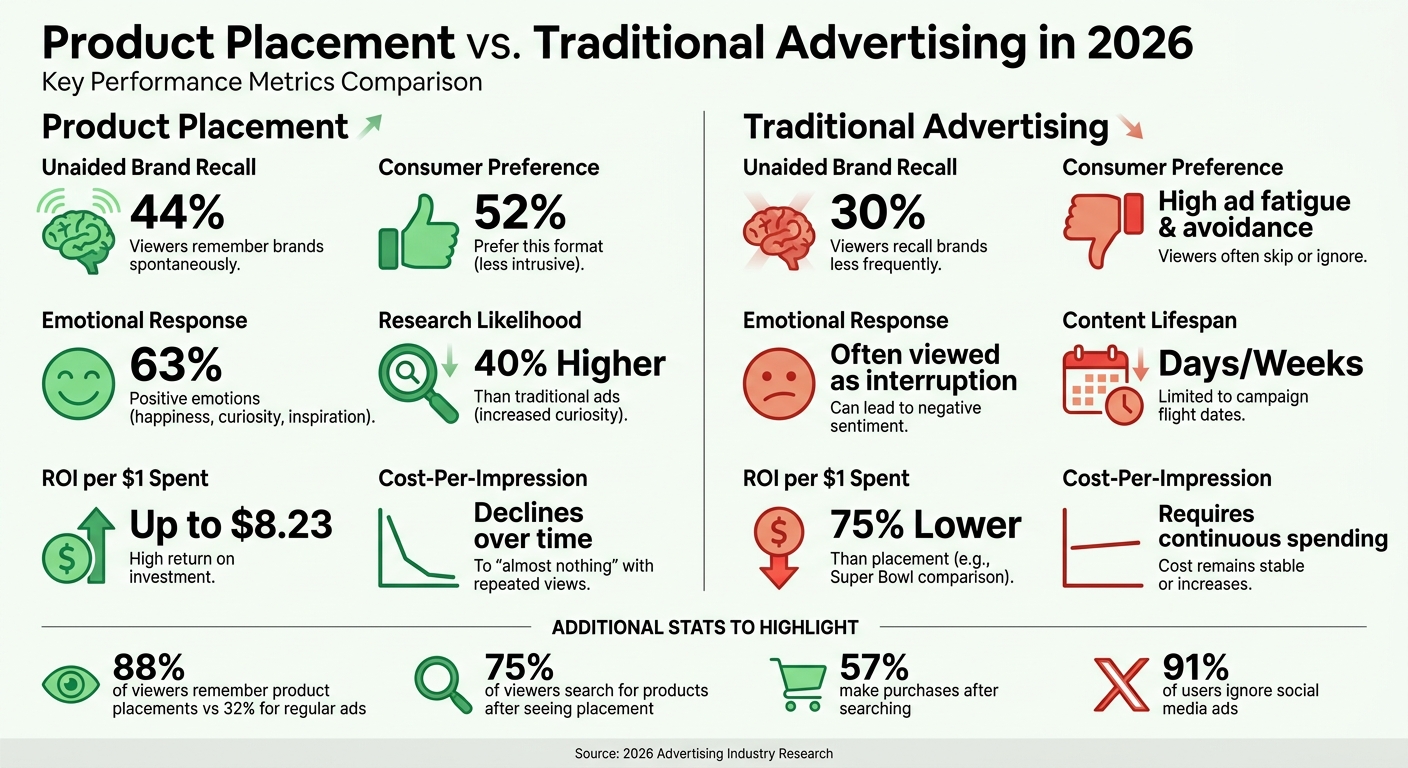
Product Placement vs Traditional Advertising: 2026 Performance Metrics Comparison
Looking at the data, it’s evident why product placement is gaining ground over traditional advertising. A direct comparison shows how product placement consistently outshines traditional ads across key metrics in 2026. Audience behavior has shifted, with viewers responding far more positively to brands integrated into content rather than those disrupting their experience.
The numbers speak for themselves: 52% of consumers prefer watching programs with product placement over those interrupted by traditional ad breaks. On the other hand, traditional ads face increasing fatigue, with many viewers actively avoiding commercials.
The emotional connection is another game-changer. 63% of consumers report positive emotions – like happiness, curiosity, and inspiration – after encountering product placement in a show or movie. In contrast, traditional ads are often seen as unwelcome interruptions. This emotional difference drives action: consumers are 40% more likely to research a product after seeing it in content like a film or TV program compared to a traditional commercial.
| Metric | Product Placement | Traditional Advertising |
|---|---|---|
| Unaided Brand Recall | 44% | 30% |
| Consumer Preference | 52% prefer this format | High ad fatigue and avoidance |
| Emotional Response | 63% positive (happiness, curiosity) | Often viewed as an interruption |
| Research Likelihood | 40% higher than traditional ads | Lower; consumers multitask or ignore |
| Content Lifespan | Years/decades (streaming & syndication) | Days/weeks (campaign flight dates) |
| ROI per $1 Spent | Up to $8.23 | Super Bowl ROI 75% lower than average |
| Cost-Per-Impression | Declines over time to "almost nothing" | Requires continuous spending |
The longevity of product placement is another standout advantage. Unlike traditional ads, which run for a limited time, product placements embedded in movies or TV shows can generate impressions for years or even decades, thanks to streaming and syndication. This extended lifespan, combined with lower ongoing costs, makes product placement an increasingly smart investment. For every dollar spent, product placement can deliver an ROI of up to $8.23, while traditional formats like Super Bowl ads lag far behind in return.
Technology is also making it easier to measure success. Advanced AI tools now track real-time emotional responses, providing advertisers with clearer ROI metrics than ever before. Edwin Karapetian from Hollywood Branded captures this evolution perfectly:
"ROI used to be the most elusive metric in entertainment marketing. In 2026, it’s one of the clearest".
This clarity is driving change. By 2026, 70% of brands have reallocated at least 10% of their traditional media budgets toward product placement in entertainment content. It’s a shift that reflects where consumer attention – and advertiser dollars – are heading.
Conclusion
Product placement has shifted from being a simple visibility tactic to becoming one of the most effective advertising approaches in 2026. By embedding brands into stories, it bypasses the intrusiveness of traditional ads. In fact, 73% of viewers perceive brand integrations as less disruptive than standard ads, while a staggering 91% of users completely ignore social media ads.
Stacy Jones, CEO of Hollywood Branded, highlights this shift:
"Brands are increasingly partnering with content creators from the earliest stages – helping finance scripts and integrating into the story itself".
This early collaboration ensures that product placements feel natural and seamlessly woven into the narrative.
Technology has also revolutionized how advertising success is measured. Advanced AI tools can now track emotional responses, predict content performance, and provide real-time behavioral insights. These tools, combined with measurable metrics, have turned product placement into a data-driven strategy. Its consistent presence across distributed content further makes it a more financially attractive option.
The impact is undeniable: brands achieve 81% recall when their products appear on-screen, compared to just 32% for standard TV ads. Additionally, product placement yields a 38% higher return on investment than traditional TV spots and leaves lasting impressions.
As advertising continues to evolve, the focus is on blending in naturally, respecting the audience’s intelligence, and delivering authentic value. In 2026, product placement exemplifies this approach perfectly.
FAQs
How do I choose the right show or movie for my audience?
When choosing shows or movies to partner with, focus on content that naturally connects with your brand’s target audience and goals. The key is to align with what your audience already loves to watch. This approach helps your brand stick in their minds and creates a positive connection.
Think about your audience’s viewing habits and preferences. Are they into action-packed dramas, lighthearted comedies, or thought-provoking documentaries? The better you understand their tastes, the easier it is to choose entertainment that feels relevant and engaging.
Also, consider how the partnership reflects on your brand. Does the tone and style of the show or movie complement your image? By prioritizing this alignment, you can create a partnership that not only appeals to your audience but also reinforces your brand’s identity.
What does virtual product placement cost in 2026?
In 2026, the cost of virtual product placement generally falls between $30 and $40 per thousand impressions (eCPM). However, these prices can shift depending on the platform you choose and the scale of your campaign. When planning your budget, it’s crucial to align your spending with your specific goals and target audience for the best results.
How can I measure product placement ROI accurately?
To get an accurate read on product placement ROI, start by tracking audience reach and impressions. These metrics tell you how many people saw your product and how much screen time it received. But don’t stop there – dig deeper with data and AI-powered analytics. These tools can help you assess engagement levels, the emotional response your product placement sparked, and even the long-term boost to your brand. By moving beyond basic visibility stats, you’ll gain a much clearer understanding of what your product placement is truly delivering.