AI video production is reshaping how brands create content. Here’s why:
- Cost: AI videos cost 30× to 250× less than traditional methods. A 30-second ad costs $1,000–$2,000 with AI vs. $10,000–$50,000 traditionally.
- Speed: AI delivers videos in minutes or hours, while traditional production takes weeks (4–12 weeks on average).
- Scalability: AI can generate 100+ video variations monthly, perfect for quick A/B testing and multilingual campaigns.
- Engagement: AI ads drive higher click-through rates (up to 11% more) but may lack emotional depth. Traditional production excels at building trust and emotional connections.
Key takeaway? Most brands in 2026 use a hybrid approach: AI for 80–90% of high-volume, platform-specific videos and conventional methods for 10–20% of flagship campaigns.
Quick Comparison
| Factor | AI Production | Conventional Production |
|---|---|---|
| Cost | $1,000–$2,000/ad | $10,000–$50,000/ad |
| Timeline | Minutes to hours | 4–12 weeks |
| Scalability | High (100+ variations) | Low (linear scaling) |
| Emotional Impact | Limited | Strong |
| Localization | ~2 minutes/language | 3–7 days/language |
This blend of speed, cost savings, and quality ensures brands maximize efficiency while retaining authenticity where it matters most.
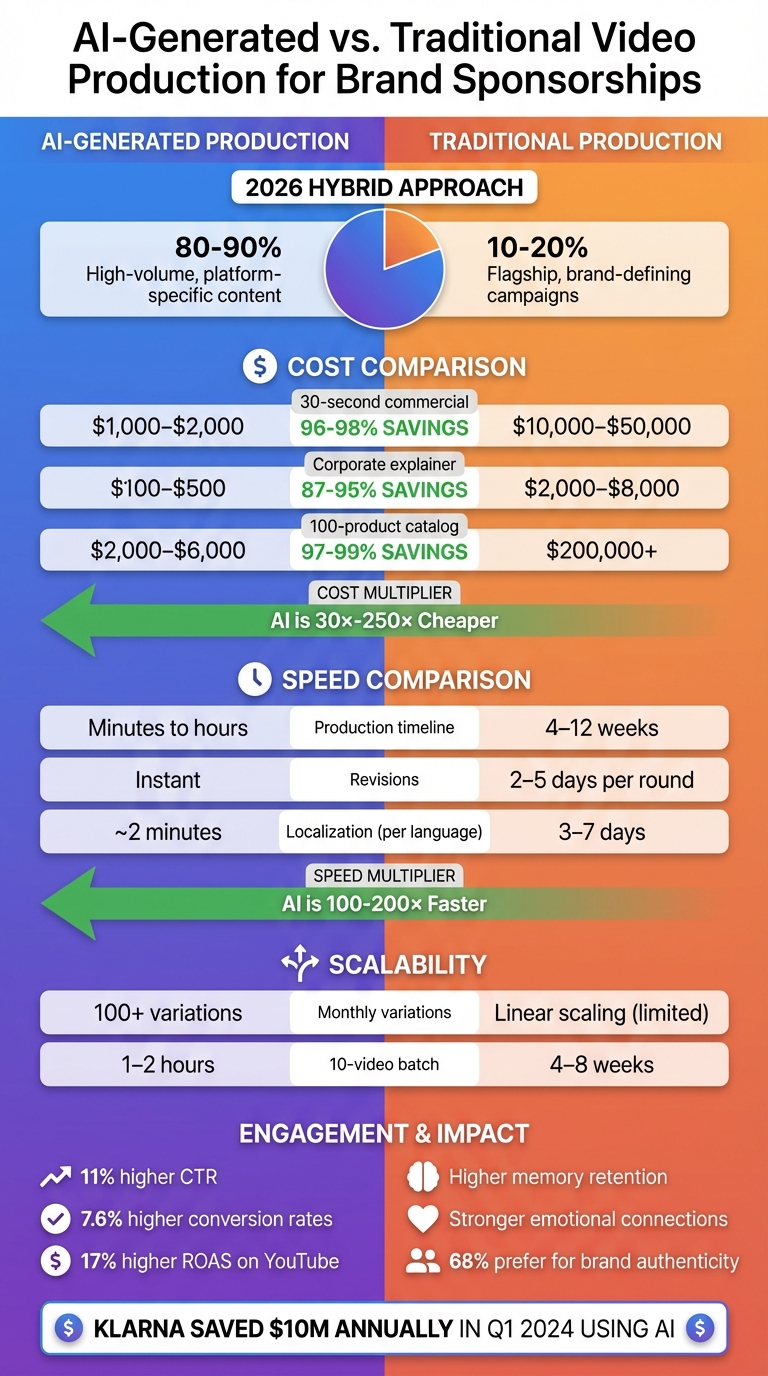
AI vs Traditional Video Production: Cost, Speed, and Scalability Comparison
Cost Comparison: AI vs. Conventional Video Production
AI Video Production Costs
AI video platforms use subscription-based pricing, offering a new approach to content creation costs. These services typically range from $8.99 to $358 per month, depending on the features and the volume of output. When scaled, the cost per video can drop to as little as $1–$5. For a polished marketing video, including revisions, the total expense usually falls between $100 and $1,000.
One of the biggest cost advantages is eliminating on-set expenses, such as hiring crews, renting equipment, securing locations, and paying talent fees. Tools like PyxelJam allow in-house teams to create professional-grade 4K videos using simple inputs like a product URL, a text script, or reference images – all without needing advanced editing expertise.
Conventional Video Production Costs
Traditional video production costs increase directly with the number of videos produced. A standard 30-second commercial typically costs between $10,000 and $50,000, while corporate explainer videos or 3-minute branding pieces range from $2,000 to $25,000. These expenses cover everything from pre-production planning to shoot-day logistics and post-production editing.
Freelance editors usually charge $40–$80 per hour, which can result in $80 to $640 for a single performance ad. For companies creating localized versions of content, costs escalate quickly. For example, producing videos for 10 different markets can exceed $100,000 when accounting for local talent, re-shoots, and regional production teams.
Cost Comparison Table
| Production Type | Traditional Cost | AI Cost | Savings |
|---|---|---|---|
| 30-second commercial | $10,000–$50,000 | $1,000–$2,000 | 96–98% |
| Corporate explainer | $2,000–$8,000 | $100–$500 | 87–95% |
| 100-product catalog | $200,000+ | $2,000–$6,000 | 97–99% |
| Localized (10 languages) | $100,000+ | $1,000–$3,000 | 97–99% |
The savings are striking. For example, Klarna, a fintech company, reported $10 million in annual savings in Q1 2024 after adopting AI marketing tools. This included cutting $4 million in external agency fees and reducing image production costs by $6 million.
"AI will lower the entry barrier for some of the smaller brands who can’t afford a traditional video ad campaign." – Alok Saboo, Marketing Professor, Georgia State
With the cost benefits of AI firmly established, the next step is to examine its impact on production speed and scalability.
sbb-itb-0df1f49
Production Speed and Scalability
AI-Generated Content Turnaround Times
AI video production has dramatically shortened the time it takes to create high-quality videos. What used to take 5–30 days with traditional methods can now be completed in just 2–10 minutes using AI tools. This speed boost is possible because AI eliminates the need for complex logistical processes.
One major advantage is how quickly AI allows for revisions. While traditional methods need 2–5 days for each round of changes, AI tools make edits instantly. This capability enables brands to experiment with different visual styles in real time. For instance, PyxelJam lets teams create professional-grade videos almost instantly by simply uploading a product URL or script.
Companies are already seeing results. In Q1 2024, Klarna reduced their marketing production cycle from six weeks to just seven days by adopting generative AI. Similarly, filmmaker PJ Accetturo used AI tools to produce a 30-second NBA Finals ad in just two days.
Now, let’s compare these rapid AI timelines to the slower, step-by-step process of traditional video production.
Conventional Video Production Timelines
Traditional video production is a lengthy, multi-phase process that doesn’t allow for shortcuts without compromising quality. Pre-production tasks like scripting, storyboarding, casting, and scheduling can take 2–4 weeks. After that, the actual filming day requires careful coordination of crews and equipment. Post-production – covering editing, color grading, and sound design – adds another 2–4 weeks. Altogether, creating a polished video typically takes 6–12 weeks from start to finish.
Scaling up production adds even more time. For example, producing 10 videos traditionally can take 4–8 weeks, while AI can handle the same workload in just 1–2 hours. Localization is another time-consuming step. Adapting content for different languages usually takes 3–7 days per language, whereas AI dubbing completes the task in about 2 minutes per language. Traditional methods scale linearly, meaning doubling the output requires doubling the time, resources, and budget. AI, on the other hand, scales logarithmically, with additional videos requiring minimal extra time or cost.
Scalability Comparison Table
The following table highlights the stark differences between traditional and AI-driven production timelines:
| Metric | Traditional Production | AI-Generated Content |
|---|---|---|
| Script to final cut | 5–30 days | 2–10 minutes |
| Concept to delivery | 4–8 weeks | Hours or days |
| Revisions per round | 2–5 days | Instant |
| 10-video batch production | 4–8 weeks | 1–2 hours |
| Localization (per language) | 3–7 days | ~2 minutes |
For example, Modern Canada reported a 90% faster delivery rate after switching to AI platforms, saving approximately $6,000 per video in the process.
For brand sponsorships, where responding to real-time events or trends is crucial, AI’s speed advantage – 100 to 200 times faster than traditional methods – opens up new possibilities. Brands can now test 10–20 creative variations in a single week to identify the most effective messaging, something that would be both costly and time-prohibitive using conventional production methods. This combination of speed and scalability is reshaping how brands approach time-sensitive campaigns.
Creative Options and Personalization
AI’s Creative and Personalization Advantages
AI is transforming video production by generating visuals based on conceptual input rather than relying on traditional cameras and physical sets. This means creators can bring almost any idea to life, regardless of how complex or unconventional it might seem.
Another game-changer is AI’s ability to personalize content. With just one script or image, brands can create hundreds of variations tailored for specific audiences, regions, or platforms – all at the same time. And the results speak for themselves: 93% of companies that use personalized videos report higher conversion rates, with AI-driven personalized ads outperforming both generic videos and even personalized image-based ads. This opens up a world of creative possibilities and flexibility.
AI tools also introduce a modular approach, often referred to as the "Brick System." This method allows brands to swap out specific sections of a video – like hooks, trust-building elements, or calls-to-action – while keeping the rest of the content intact. The result? Brands can test more than 100 creative variations in a single month, all on the same budget that would typically produce just 10 traditional video ads.
Additionally, AI simplifies localization. It can translate, dub, and adjust content into over 11 languages in minutes, all while maintaining a consistent brand voice. AI can even generate user-generated content (UGC)-style videos at scale using talking avatars, eliminating the need to coordinate with multiple influencers or actors.
Conventional Production Limitations
Traditional video production, on the other hand, comes with a host of challenges. For starters, creating multiple variations is often impractical due to budget constraints. Each new version requires a separate project, complete with its own timeline and costs, which forces brands to focus only on the most essential ideas.
Physical limitations also play a role. Concepts that AI can generate with ease – like impossible camera angles, fantastical settings, or seamless transformations – require expensive CGI or may not even be achievable with traditional methods. Personalizing video content at scale is another major hurdle since each version demands its own costly shoot.
Localization is similarly cumbersome. Translating and dubbing content traditionally involves hiring language experts and studios, which can take weeks per language. And adapting videos for different platforms, like TikTok‘s vertical 9:16 format or YouTube’s horizontal 16:9, requires manual editing, adding more time and expense. Traditional production scales linearly, meaning doubling your output essentially doubles your costs and resources, with little room for efficiency.
Creative Potential Comparison Table
Here’s a side-by-side look at the creative capabilities of traditional production versus AI-generated content:
| Feature | Traditional Production | AI-Generated Content |
|---|---|---|
| Creative Source | Physical reality (cameras, sets) | Imagination and computation |
| Personalization | Limited; each version needs a new project | High; one script generates dozens of variations |
| A/B Testing Capacity | 5–10 variants/month (budget-limited) | 100+ variants/month |
| Iteration Speed | 2–5 days per revision round | Instant regeneration |
| Localization | 3–7 days per language | About 2 minutes per language |
| Platform Reformatting | Manual re-editing required | One-click reformatting |
| Visual Constraints | Limited by physics and budgets | No physical limits |
Looking ahead, the industry is moving toward a hybrid model by 2026. This approach combines traditional production for 10–20% of high-value "brand anchor" content with AI handling 80–90% of high-volume social and performance-driven content. This blend allows businesses to achieve both creative excellence and operational efficiency.
Audience Engagement and Brand Impact
AI-Driven Engagement Metrics
AI-generated video content has shown impressive short-term performance. For instance, a study involving 21,000 consumers found that AI-personalized video ads achieved click-through rates (CTR) that were 9.4% higher than personalized image ads and 6.5% higher than generic videos. Meta reported similar success, with campaigns using generative AI features delivering an 11% higher CTR and a 7.6% boost in conversion rates compared to those without AI. On YouTube, AI-powered video campaigns delivered a 17% higher return on ad spend, according to a 2024 Nielsen study.
Real-world examples further highlight these results. The edtech company Headway, for example, incorporated AI tools like HeyGen and Midjourney into their video production process in early 2024. This shift led to a 40% increase in video ad ROI and 3.3 billion impressions, with AI-generated user-generated content (UGC)-style videos driving 30–50% of their total subscriptions. Similarly, in June 2025, Kalshi, a prediction market, aired a 30-second AI-generated commercial during Game 3 of the NBA Finals. Created in just two days for roughly $2,000 using Google Veo 3, the ad amassed over 20 million impressions and 3 million views on X.
However, researchers caution that much of AI’s engagement success may be due to its novelty. While AI excels in generating immediate results, traditional video production remains essential for building long-term brand loyalty and trust.
Conventional Video’s Authenticity and Relatability
Traditional video production, while less data-driven, excels at creating emotional connections and fostering trust. A December 2024 NIQ brain-scan study revealed that AI-generated ads trigger weaker memory activation in consumers compared to traditional ads. Ramon Melgarejo, President of Strategic Analytics at NIQ, emphasized this point:
"Brands and agencies need to be cautious, as our study reveals that consumers are quite sensitive to the authenticity of ad creatives".
This sensitivity is reflected in consumer attitudes. By early 2025, 67% of adults expressed discomfort with AI-generated advertising, and 41% of consumers found such ads bothersome, compared to only 29% of marketers. Many viewers described AI-generated ads as "annoying", "boring", or even "soulless".
The risks of relying solely on AI are clear. In late 2024, Coca-Cola faced backlash for an AI-generated remake of its 1995 "Holidays Are Coming" commercial, with critics calling it "soulless" and "devoid of creativity". McDonald’s Netherlands encountered an even harsher reaction when their AI-generated holiday ad was pulled after just three days due to public criticism, including comments about "creepy" distorted faces and "melting" textures.
Traditional production stands out for its ability to capture what experts call "human residue" – the subtle imperfections that signal genuine human involvement, such as fingerprints in clay or slight manual jitters. As Aplus.tv aptly noted:
"If the audience notices the medium, they stop believing the message".
This contrast highlights the importance of carefully selecting the right production approach for brand sponsorships.
Engagement Comparison Table
| Engagement Factor | AI-Generated Video | Traditional Video Production |
|---|---|---|
| Primary Metric Strength | High CTR, conversion, ROAS | High memory retention, trust, brand equity |
| Emotional Impact | Often perceived as "soulless" or "plastic" | High; captures human nuance and authenticity |
| Audience Perception | Can be seen as "creepy" or "annoying" | Perceived as authentic, premium, and crafted |
| Storytelling | Effective for short, data-driven hooks | Superior for complex, emotional narratives |
| Retention Rates | High for short-form/novelty content | Higher for long-form/narrative content |
| Consumer Comfort | 41% bothered by AI ads | Preferred by 68% for brand authenticity |
Real or AI? Using AI in Video Production and Filmmaking
Choosing the Right Approach for Your Brand
Determining the best production process for your brand depends on factors like cost, speed, and creative needs. Here’s a breakdown to help you decide.
When to Choose AI-Generated Video Content
AI is ideal for creating large volumes of content quickly, especially for platforms like TikTok, Instagram Reels, or YouTube Shorts. Turnaround times with AI are just 2–10 minutes, compared to the 5–30 days required for traditional production.
For brands focused on budgets, AI offers massive savings – cutting costs by 30× to 250× per video. For example, a mid-sized company producing 50 videos a month could save over $137,000 annually by switching to AI.
AI also shines in performance marketing, where rapid A/B testing is crucial. With AI, you can generate 20 ad variations to test different hooks and calls-to-action before committing to a high-budget production. Multilingual campaigns benefit significantly too – AI can create localized versions of a video in 11+ languages, with voiceovers ready in only 2 minutes per language, compared to the 3–7 days traditional dubbing requires.
PyxelJam’s AI video production eliminates the need for film crews, actors, and equipment, offering professional-quality videos with endless creative options. This makes AI a great choice for product demos, social ads, educational content, and any scenario requiring a fast response to market trends.
However, for long-term brand storytelling or when authenticity matters most, traditional production may still be the better option.
When to Choose Conventional Video Production
Traditional production is best for creating flagship content that defines your brand – such as homepage hero videos, annual campaigns, or major product launches. These projects often require authenticity and emotional depth that only human-led production can provide.
If your campaign relies on real customer testimonials, executive thought leadership, or celebrity collaborations, the human touch captured through traditional filming is irreplaceable. Similarly, physical product demonstrations, where texture, size, or real-world interaction are critical, call for conventional methods.
Brands operating in highly regulated industries like healthcare, finance, or legal services may also need the controlled environment of traditional production to ensure compliance.
Final Recommendations
To strike the right balance, consider a hybrid approach: use traditional production for 10–20% of your high-value, brand-defining content, while relying on AI to handle 80–90% of your high-volume, platform-specific videos. This strategy allows you to create up to 8× more content on the same budget compared to using traditional methods alone.
"The most effective strategy in 2026 is hybrid: use traditional production for 10-20% of your content (high-value, brand-defining pieces) and AI for the remaining 80-90% (high-volume, platform-specific content)." – AllesPlay Team
Start by experimenting with lower-stakes AI projects to develop familiarity with prompts and gather reference materials. PyxelJam’s AI solutions already deliver 90–95% of the quality of traditional production at just 1–5% of the cost for performance marketing needs. Testing AI on smaller projects first can help you build confidence before scaling up.
Ultimately, the key is aligning your production method with your campaign goals – whether you’re aiming to reach a broader audience through high-volume content or crafting deep emotional connections with carefully produced storytelling.
FAQs
How do I decide which videos should be AI-made vs. traditionally produced?
Choosing between AI-generated videos and traditional video production boils down to your goals, budget, and the type of content you’re creating. If you need quick, budget-friendly, and high-volume content – like TikToks or Instagram Reels – AI-generated videos are a great fit. On the other hand, for projects requiring intricate storytelling, emotional resonance, or live-action elements (think brand commercials), traditional production is the way to go. In short, AI offers speed and efficiency, while traditional methods deliver quality and depth.
How can I keep AI videos from feeling “soulless” or inauthentic?
To make AI-generated videos feel more engaging and less "soulless", it’s important to focus on realism and building an emotional connection. Use natural lighting, incorporate textures, and pay attention to physical details to give the visuals a more lifelike quality. Lean into storytelling that evokes emotion and aligns closely with your brand’s values. Establishing clear creative controls and approval processes ensures the final product maintains both quality and trust. This approach helps balance efficiency with a meaningful, human-like touch.
What should I watch out for when using AI for sponsored content and ads?
When incorporating AI into sponsored content, it’s crucial to consider how it might affect consumer trust and how people view your brand. AI-generated ads can sometimes come across as impersonal or artificial, which might erode trust in your brand. There’s also the risk of over-personalizing content, which could trigger privacy concerns or make your audience feel uncomfortable.
Another important factor is that many consumers tend to favor authentic, user-generated content over the polished output of AI. Leaning too heavily on AI might make your brand seem less genuine, potentially harming your reputation in the process. Balancing AI’s capabilities with a human touch is key to maintaining trust and authenticity.