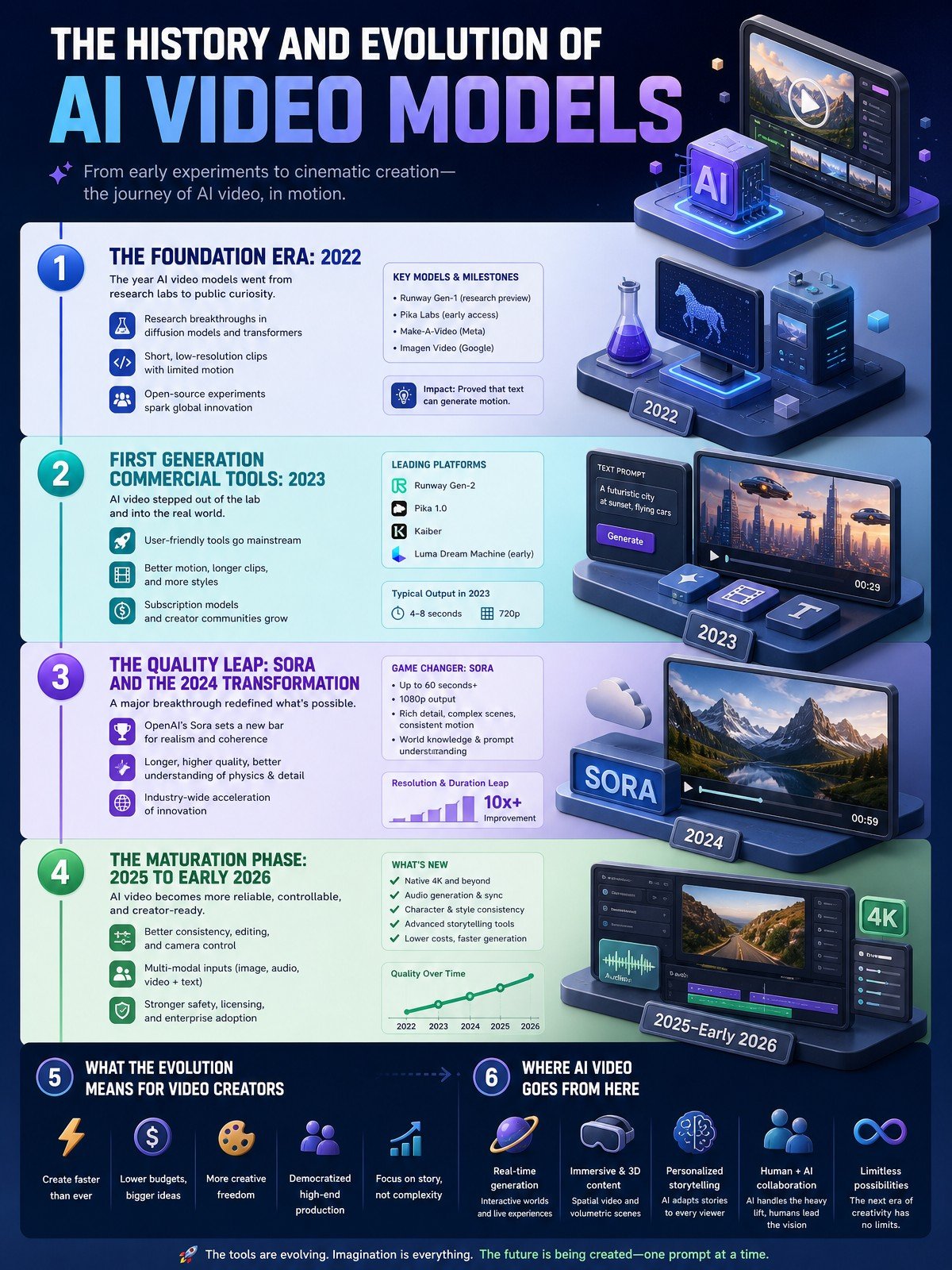
In just four years, AI video generation transformed from a research curiosity into a production-ready technology reshaping how creators work. What started as short, blurry clips full of artifacts has evolved into systems capable of producing minutes of coherent, high-resolution footage that can pass as real footage.
This is not hyperbole. Anyone following the field closely knows that 2022 to 2026 marked the most aggressive advancement cycle in generative media history. Understanding how we got here helps creators make better decisions about which tools to adopt and how to position themselves in an increasingly competitive space.
This timeline covers the landmark models, the key moments, and the technical breakthroughs that defined each phase of the evolution of generative AI video models.
Want to earn a living with AI video?
Get early access to PyxelJam Studios – a storytelling-first AI video platform built for creators who think like filmmakers and storytellers – not prompt engineers.
The Foundation Era: 2022
The modern AI video revolution traces back to 2022, when latent diffusion models like Stable Diffusion transformed image generation. Researchers quickly realized these architectures could be extended to video, and the first wave of generative video models emerged.
Meta released Make-A-Video in September 2022, demonstrating that AI could generate short video clips from text prompts. The results were impressive for their time but limited: low resolution, flickering artifacts, and clips rarely exceeding a few seconds. The system learned from paired video-text data but struggled with motion coherence and physical realism.
Later that year, Stability AI entered the space with experimental video generation capabilities built on its image generation foundation. These early systems shared common limitations: poor temporal consistency (objects flickering between frames), inability to handle complex motion, and frequent physics violations like objects passing through each other.
Despite these constraints, the proof of concept worked. Researchers and developers recognized that video generation was achievable and that improvements in architecture, training data, and compute would drive rapid advancement. The foundations were laid for what came next.
First Generation Commercial Tools: 2023
2023 marked the year AI video generation moved from research labs to commercial products. Several breakthrough models defined this period.
Runway released Gen-2 in June 2023, establishing the first commercially viable text-to-video system. While still producing artifacts and limited motion control, Gen-2 could generate multi-second clips with noticeably improved resolution and consistency compared to 2022 systems. The platform’s user-friendly interface brought AI video capabilities to mainstream creators for the first time.
Stability AI released Stable Video Diffusion in late 2023, introducing a different approach centered on image-to-video generation. This open-source method became popular for animation and motion effects, giving creators more control over output direction.
Pika Labs launched its platform in late 2023, competing directly with Runway. The company differentiated through features like motion brush (directing motion in specific image areas) and improved character consistency. By December 2023, Runway updated to Gen-2.1 with better coherence, pushing the quality bar higher.
During this phase, most AI-generated video remained unsuitable for professional production. Results worked for social media content and experimental art, but broadcast quality remained out of reach. However, the commercial infrastructure matured: multiple competing platforms, improving interfaces, and growing user communities signaled that the technology would not disappear.
The Quality Leap: Sora and the 2024 Transformation
February 2024 fundamentally changed the AI video space. OpenAI released Sora, a system that could generate videos up to 60 seconds long with unprecedented photorealism, smooth camera movements, and coherent physics simulation. Sora was not publicly available initially, but the research demonstrations proved that AI video had crossed a critical threshold.
The impact was immediate and global. Within weeks, Google released Veo, Meta announced Movie Gen, and Runway pushed Gen-3 Alpha into development. The Chinese tech sector accelerated development of competing systems: ByteDance developed Jiamo, Kuaishou released Kling, and Minimax introduced substantial improvements to its video generation platform.
Runway released Gen-3 Alpha in mid-2024 with professional-grade outputs for subscribers. The system could generate 10-second clips with improved camera control, better text adherence, and more natural motion. Runway continued releasing updates through the year, adding advanced features like Actrix for character consistency.
The 2024 transformation established several new baselines: multi-minute generation became standard, resolution reached 720p to 1080p routinely, camera motion controls became normalized, and character consistency improved substantially. AI video had officially entered the production consideration set for marketing teams, independent filmmakers, and content studios.
The Maturation Phase: 2025 to Early 2026
By 2025, the AI video space had fragmented into distinct tiers. OpenAI expanded Sora access with extended generation modes and editing tools. Google established Veo 2 with strong emphasis on cinematic quality controls. Meta continued iterating on Movie Gen while also developing AI filmmaking pipeline tools for creators. Chinese platforms (ByteDance, Kuaishou, Minimax) offered competitive quality at lower price points, capturing significant market share in Asia.
The open-source movement matured dramatically. Models like Wan 2.1 and CogVideoX achieved quality levels matching proprietary systems while running on consumer hardware. This democratization enabled independent researchers, smaller studios, and hobbyists to experiment without subscription costs, creating a competitive pressure that benefited all creators.
Technical focus shifted from raw generation capability to contextual intelligence. Systems began handling character consistency across longer videos, narrative coherence across scenes, and integration with other production tools. Some platforms moved toward agentic AI video automation, where AI handles not just generation but also sequencing, editing, and workflow management.
Current generation models (as of April 2026) demonstrate generation up to several minutes at HD resolution, with some platforms supporting 4K output for specific use cases. Text-to-video fidelity has improved, with better adherence to complex prompts and fewer physics violations. The trajectory continues upward, though fundamental challenges around long-form narrative coherence and true photorealism remain active research areas.
What the Evolution Means for Video Creators
Looking at the complete timeline reveals a pattern familiar to anyone who watched image generation explode from 2021 onward. The progression moved from research to novelty to utility to necessity in roughly three years. AI video is currently in the utility phase, with clear signs of approaching necessity status for certain production contexts.
The practical implications are significant. For social media content, AI video generation has become a viable primary production method. For advertising and short-form commercial work, it serves as an efficient prototyping and production tool. For independent film and experimental work, it opens creative possibilities that were previously impossible without substantial budgets.
The remaining limitations matter less than they did two years ago. Most creators working within AI video’s current constraints find ways to work around them rather than waiting for the technology to improve. The tools are good enough today to produce real work.
The creators positioned best for what comes next understand the technology’s trajectory, adopt new models as they release, and develop workflows that combine AI generation with human creative direction. Platforms that integrate generation, editing, and distribution into cohesive end-to-end video creation pipeline capabilities are becoming the preferred choice for professionals who value efficiency.
Where AI Video Goes from Here
The evolution of generative AI video models from 2022 to 2026 represents one of the fastest technology adoption cycles in creative industries. What began with basic proof-of-concept systems has matured into production-ready tools that generate minutes of coherent, high-resolution footage.
The trajectory suggests continued improvement. Challenges that remain (long-form narrative coherence, perfect photorealism, physics accuracy) are engineering problems rather than fundamental barriers. Each monthly release cycle produces measurable improvements in quality, capability, and reliability.
For video creators, the strategic question is no longer whether to incorporate AI video tools, but rather how to integrate them effectively into existing workflows. Those who understand the technology’s current capabilities and limitations, maintain familiarity with new releases, and develop hybrid production approaches combining AI generation with human creative direction will maintain competitive advantages.
The AI video space in 2026 offers more capability, more choice, and more opportunity than at any prior point. The tools exist, the quality is sufficient, and the path forward is clearer than it has ever been.
The evolution of generative AI video models from 2022 to 2026 represents one of the fastest technology adoption cycles in creative industries. What began with basic proof-of-concept systems has matured into production-ready tools that generate minutes of coherent, high-resolution footage.
The trajectory suggests continued improvement. Challenges that remain (long-form narrative coherence, perfect photorealism, physics accuracy) are engineering problems rather than fundamental barriers. Each monthly release cycle produces measurable improvements in quality, capability, and reliability.
For video creators, the strategic question is no longer whether to incorporate AI video tools, but rather how to integrate them effectively into existing workflows. Those who understand the technology’s current capabilities and limitations, maintain familiarity with new releases, and develop hybrid production approaches combining AI generation with human creative direction will maintain competitive advantages.
The AI video space in 2026 offers more capability, more choice, and more opportunity than at any prior point. The tools exist, the quality is sufficient, and the path forward is clearer than it has ever been.
Frequently Asked Questions
What was the most significant advancement in AI video model evolution?
The release of OpenAI Sora in February 2024 marked the most significant milestone. It demonstrated that AI could generate coherent, photorealistic videos up to 60 seconds long, shifting industry expectations and accelerating competitive development across all major players.
How have AI video models improved in quality from 2022 to 2026?
Quality improvements have been dramatic across every measurable dimension. Resolution increased from 256×256 to 1080p and higher. Generation duration extended from single seconds to several minutes. Artifacts and flickering reduced substantially. Physics simulation became more accurate. Character consistency improved significantly.
What distinguishes open-source from proprietary AI video models?
Proprietary models like Sora, Veo 2, and Gen-3 Alpha typically lead in raw capability but require paid subscriptions. Open-source models like Wan 2.1 and CogVideoX now match proprietary quality for many use cases and run on consumer hardware, making them accessible without recurring costs.
Can AI video models handle long-form narrative content?
Current models can generate multiple minutes of video, but maintaining narrative coherence across extended sequences remains challenging. Character consistency, plot continuity, and scene-to-scene logic require human oversight or specialized systems designed for longer-form production.
Which AI video models are considered best for professional production?
Runway Gen-3 Alpha, OpenAI Sora, Google Veo 2, and Pika Labs represent the current top tier for professional work. The best choice depends on specific requirements around quality, control, cost, and workflow integration. Testing multiple platforms before committing to one production workflow is advisable.
Want to earn a living with AI video?
Get early access to PyxelJam Studios – a storytelling-first AI video platform built for creators who think like filmmakers and storytellers – not prompt engineers.