Want to stand out in the streaming ad space? Here’s what Netflix, Hulu, and Amazon prioritize in brand partnerships:
- AI and Data Integration: All three platforms leverage AI for targeting and campaign optimization. Netflix focuses on secure data use and creative alignment, Hulu emphasizes automated compliance and personalized ad formats, while Amazon excels in purchase-driven attribution and interactive ads.
- Talent Consent: Netflix leads with strict policies requiring written consent for AI use involving talent likeness. Hulu follows industry standards but shares less detail publicly. Amazon ensures transparency in AI use for talent-related enhancements.
- Ad Formats and Insights: Netflix uses AI to blend ads naturally into content. Hulu offers interactive formats like QR-enabled ads and "Binge Ads" for long viewing sessions. Amazon connects ad impressions to shopping behavior with tools like its Marketing Cloud.
- Platform Strengths: Netflix is ideal for brands prioritizing storytelling. Hulu benefits from Disney’s ecosystem for emotional targeting. Amazon dominates in linking ads to transactions with its vast shopper data.
Quick Comparison:
| Platform | Focus | Key Features | Drawbacks |
|---|---|---|---|
| Netflix | Creative alignment, data security | AI-enhanced storytelling, strict talent consent | Slower due to approval processes |
| Hulu | Audience engagement, compliance | Interactive ads, Disney ecosystem integration | Limited transparency on consent |
| Amazon | Commerce and data precision | Purchase attribution, interactive ad formats | Less focus on storytelling |
Each platform offers unique advantages based on your campaign goals – whether it’s connecting through storytelling, leveraging emotional targeting, or driving purchases.
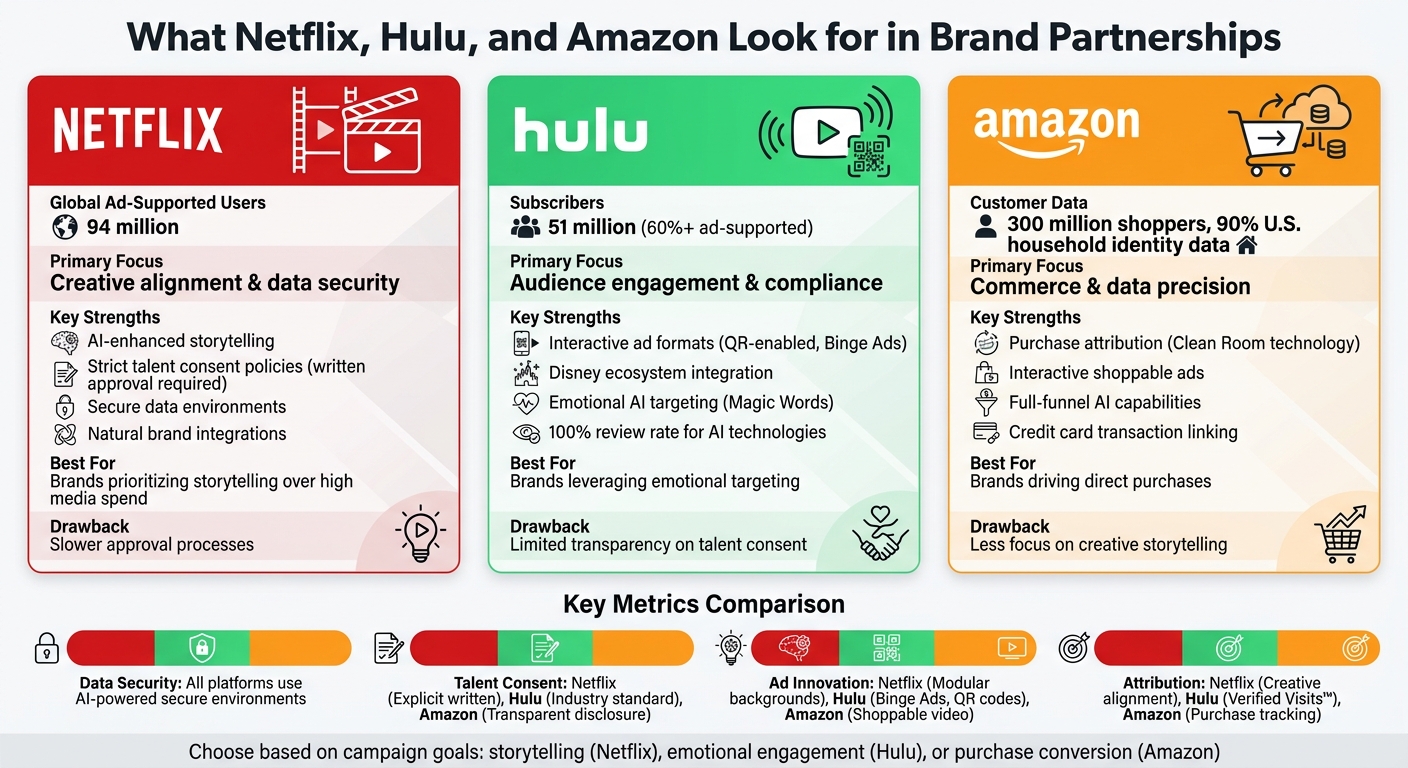
Netflix vs Hulu vs Amazon Brand Partnership Comparison
Disney: The Future of Streaming Partnerships, Live Experiences, and AI-Powered Measurement
sbb-itb-0df1f49
1. Netflix
Netflix evaluates its partners based on four key areas – data security, talent rights, creative integration, and advertising alignment – to safeguard its content and engage its 94 million global ad-supported users.
AI Data Security
Netflix holds its production partners to rigorous data security standards. Partners must have documented AI use policies and operate within secure enterprise environments to ensure generative AI tools cannot store, reuse, or train on sensitive production data. To further protect advertisers, Netflix is working on a proprietary clean room strategy for secure data activation and measurement. Additionally, partners are explicitly prohibited from inputting Netflix-owned materials or personal information about cast and crew into AI tools without prior written consent.
"The generative tools used do not store, reuse, or train on production data inputs or outputs."
- Netflix Guiding Principles
This robust security framework ensures strict oversight on talent representation.
Talent Consent Policies
AI outputs involving talent likenesses, synthetic voices, or digital replicas require documented consent and written approval from Netflix. This includes significant modifications, such as visual ADR (automated dialogue replacement) to adjust lip-sync for new dialogue, which could alter the emotional tone of a performance. Netflix also mandates that third-party vendors adhere to these consent policies, ensuring compliance throughout the production process. AI models designed for talent-related enhancements must be used exclusively for the approved production.
These guidelines provide a solid foundation for partners to explore AI-driven creative possibilities with confidence.
Innovation in AI Integration
Netflix uses AI to enhance storytelling and create seamless brand integrations in popular series like Wednesday and Stranger Things. For example, products are incorporated naturally into the narrative world, enriching the viewer experience. Through its collaboration with Amazon Ads, Netflix leverages vast shopping and browsing data to refine programmatic targeting and improve campaign effectiveness. Partners are permitted to use generative AI for lower-risk tasks, such as creating moodboards or background elements, provided they disclose their plans early for legal review.
"By applying Amazon’s exclusive signals to Netflix’s highly engaged viewers, advertisers can reach the right audiences and drive even stronger performance."
- Netflix Corporate Statement
Advertising and Content Alignment
Netflix focuses on using AI to elevate creative quality rather than simply reducing costs. Co-CEO Ted Sarandos highlighted how, during the production of The Eternaut, AI-powered tools delivered results 10 times faster than traditional VFX methods while maintaining high creative standards. Netflix also uses AI to design ad breaks that blend naturally into programming, ensuring a smoother, less disruptive viewing experience. Partners are encouraged to apply AI to secondary or background elements rather than primary story components to streamline approval processes.
2. Hulu

Hulu evaluates its partners based on automated compliance, secure data handling, and forward-thinking commerce strategies. With 51 million subscribers – over 60% of whom use its ad-supported tier – Hulu applies these principles to ensure smooth operations and innovative offerings.
AI Data Security
Hulu has embedded security protocols into tools its teams already use, like Jira and Confluence. Instead of building separate systems, compliance requirements are integrated directly into existing workflows, making adherence straightforward. This streamlined approach has led to a 100% review rate for new AI and tracking technologies. Hulu also expects its partners to implement automated governance platforms to address multi-jurisdictional regulations, including the EU AI Act and various U.S. state privacy laws.
"If you make compliance too hard, people won’t do it. Meet the team where they ALREADY work."
- Anne Bradley, Former Chief Privacy Officer at Hulu
Following legal challenges over the disclosure of personally identifiable information (PII), Hulu now enforces strict data anonymization protocols. Any consumer data shared with third parties must be anonymized to prevent re-identification. Additionally, partners must conduct regular privacy audits to catch unintentional data leaks, such as those caused by tracking pixels or URLs.
Talent Consent Policies
Although Hulu hasn’t released its own talent consent guidelines, it adheres to industry norms. These standards prohibit using generative AI to create or replace talent performances – including digital replicas of voices or likenesses – without explicit, documented consent.
AI-Driven Innovation
In 2025, Hulu launched AI-personalized trailers tailored to users’ viewing histories. The platform also introduced interactive ad formats like "GatewayGo" and "GatewayShop", which use QR codes and "send to phone" options for instant purchases. Through the Disney Campaign Manager, partners can optimize campaigns in real time using data such as ZIP codes, interests, and genres, spanning Hulu, Disney+, and ESPN+.
Hulu’s "Binge Ads" are designed for viewers enjoying multi-episode sessions, offering sponsorship placements that reduce ad clutter. With CPMs ranging from $20 to $60 and a minimum campaign spend of $500, these options make AI-driven advertising accessible to brands.
Advertising and Content Alignment
Hulu ensures ads appear alongside professionally produced content, avoiding user-generated material to maintain a high standard. Partners are expected to match Hulu’s cinematic production quality. The platform also offers interactive ad formats like "Ad Selector", allowing viewers to choose between multiple creative options, and "Pause Ads", which display static or lightly animated ads when content is paused. These often include QR codes for immediate engagement.
"Good AI governance shouldn’t slow down innovation – it should enable it."
- Anne Bradley, Former Chief Privacy Officer at Hulu
With viewers spending over 1.5 hours daily on the platform, Hulu provides "Verified Visits™" attribution to measure site visits and conversions directly linked to ad exposure. This feature gives partners clear insights into the ROI of their AI-enhanced campaigns. Hulu’s approach exemplifies how AI and advertising can work together effectively, setting it apart in the streaming landscape.
3. Amazon
Amazon continues to push the boundaries of secure data use and advanced ad solutions. By focusing on data security, purchase-driven attribution, and interactive advertising, the company has created a unique approach to connecting ad views with customer transactions. With identity data authenticated from 90% of U.S. households and insights from 300 million shoppers, Amazon’s ability to link streaming ad views to actual credit card transactions sets it apart in the streaming ad space.
AI Data Security
Amazon employs "Clean Room" technology through its Amazon Marketing Cloud (AMC). Neil Patel describes this as "a privacy safe data bunker where they cross-reference your TV ad view with the actual credit card swipe". This allows brands to analyze ad performance without exposing sensitive customer data. Amazon also requires its partners to integrate with its authenticated identity graph, replacing third-party cookies with first-party data signals. Its "Ad Relevance" tool further analyzes billions of customer activity signals to predict shopping intent, all without relying on traditional ad IDs.
"Amazon DSP leverages unique first-party insights paired with sophisticated clean room technology to bring advertisers and publishers closer together, increasing efficiency and improving performance."
- Amazon Ads
Talent Consent Policies
Amazon prioritizes transparency and consent when using AI in areas like recording or transcription. Troy Winters, Vice President of Global Talent Acquisition at Amazon, emphasizes:
"We require explicit consent from candidates before any interview recording begins, and we clearly explain what will be recorded, how the recordings will be used, and how long they’ll be retained. Transparency is essential."
- Troy Winters
For high-end productions, Amazon uses "performance capture", where AI enhances real performances by mapping digital assets onto them, rather than creating entirely new AI-generated content. These practices reflect Amazon’s commitment to secure and ethical AI use while also leveraging the technology for campaign insights.
AI-Driven Innovation
Amazon’s platform integrates AI across planning, creativity, and measurement. Alasdair McLean-Foreman, CEO of Teikametrics, notes:
"AI is no longer living at the edges of advertising as a bidding or optimization tool. It’s functioning as the operating system for full-funnel growth inside Amazon Ads."
- Alasdair McLean-Foreman
The "Complete TV" tool, powered by machine learning, offers real-time recommendations for allocating ad spend across Prime Video and linear TV. Interactive video ads take engagement further, letting viewers add products to their carts directly through remotes or QR codes without interrupting their content experience.
Amazon’s Brand Innovation Lab collaborates with major brands like Unilever and The LEGO Group to create multi-channel campaigns. For example, their holiday campaigns integrate Amazon Live segments with Prime Video content. The "Holiday Sponsorship Program" even provides category exclusivity across Amazon’s marketing efforts during the holiday season, from November 1 to December 25.
Advertising and Content Alignment
Beyond technical advancements, Amazon MGM Studios plays a key role in creating custom content. Teams like "Scripted Hybrid" and "Branded & Talk" specialize in brand-centered originals and tailored content integrations. Meanwhile, the Creative Ad Operations group ensures that AI-driven projects align with ethical and quality standards. To scale effectively, Amazon encourages partners to train AI models on brand-specific language and assets.
Amazon’s AI-powered streaming ads have delivered impressive results, including a +30% boost in brand awareness and a +28% increase in purchase intent. By blending cutting-edge technology with creative storytelling, Amazon offers a comprehensive platform for advertisers looking to connect with audiences in meaningful ways.
Pros and Cons
Each platform in the AI-driven ad space brings its own strengths and challenges, offering distinct benefits and trade-offs for brands looking to partner.
Netflix has a clear policy requiring written consent from talent for any AI use involving their likeness. This ensures protection for performers and bolsters brand reputation. However, it might slow down production processes. Netflix also uses generative AI to create modular ad backgrounds that adapt to match content themes. On the flip side, its recent move to in-house ad technology means that some advanced features are still in development.
Hulu, through Disney’s "Disney Select" platform, taps into data from 53.6 million U.S. subscribers (as of February 2025) to provide advertisers with deep audience insights. Its "Disney Magic Words" AI matches ad messaging with viewer emotions by analyzing content cues. That said, Hulu shares less publicly about talent consent policies compared to Netflix and leans heavily on Disney’s broader ecosystem.
Amazon stands out with its access to data from over 200 million global customers, enabling precise purchase attribution. The Amazon Marketing Cloud uses clean room technology to analyze campaign performance while safeguarding user data. As Alasdair McLean-Foreman, CEO of Teikametrics, puts it:
AI is no longer living at the edges of advertising as a bidding or optimization tool. It’s functioning as the operating system for full-funnel growth.
- Alasdair McLean-Foreman
However, Amazon’s heavy focus on conversions might not appeal to brands prioritizing creative, narrative-driven strategies.
Here’s a quick comparison of the platforms’ strengths and weaknesses:
| Platform | Strengths | Weaknesses |
|---|---|---|
| Netflix | Clear talent consent policies; Generative AI for content-aligned ads; 94M global monthly active users (May 2025) | Slower production due to AI approvals; Ad tech still evolving post in-housing |
| Hulu (Disney) | Unified data insights via Disney Select; Emotional AI targeting through Magic Words; Strong contextual ad alignment | Limited transparency on talent consent; Heavy reliance on Disney’s ecosystem |
| Amazon | Clean room tech for secure performance analysis; Purchase attribution across 200M+ global customers; Full-funnel AI capabilities | Focus on conversions may restrict creative storytelling |
These insights can guide brands in choosing the platform that aligns with their goals, whether they prioritize transparency, emotional resonance, or data-driven precision.
Conclusion
Netflix, Hulu, and Amazon share a common thread in their strategies: they all rely on first-party data integration and AI-powered targeting to connect brands with the right audiences. But their approaches differ in notable ways. Netflix has traditionally emphasized creative alignment over high media spend, making it an appealing option for mid-sized brands with compelling storytelling potential. Amazon, on the other hand, treats streaming as a bridge between content and commerce, using tools like Amazon Marketing Cloud to link viewing habits with shopping behavior. Hulu taps into Disney’s ecosystem, delivering contextual targeting based on the emotional tone of its content.
A major shift occurred in late 2025 when Netflix began offering its inventory through Amazon DSP. This allowed brands to use Amazon’s retail-driven shopping insights to target Netflix’s ad-supported tier, which reaches 94 million users. Now, brands can manage campaigns across platforms through a single interface, leveraging purchase data from over 300 million shoppers to refine their strategies.
To adapt to these evolving strategies, consider auditing your funnel and replacing manual processes with AI-driven solutions. For Netflix, focus on how your brand’s story aligns naturally with the platform’s content rather than relying on large budgets. For Amazon, take advantage of the Amazon Marketing Cloud to connect TV ad impressions with actual shopping behavior. For Hulu, explore opportunities to create branded content that ties into Disney’s emotionally driven targeting capabilities.
As we move into 2026, the timeline between discovery and purchase continues to shrink. This shift from performance optimization to creative optimization is reshaping how brands approach streaming partnerships. Ryan Craver, Co-Founder and Chief Strategy and AI Officer at Podean, highlighted this transformation:
The evolution from performance optimization to creative optimization marks a significant turning point… training models on brand-specific language, tone, and assets to scale storytelling without sacrificing authenticity.
- Ryan Craver
This evolution underscores the growing importance of investing in upper-funnel streaming formats. Even when consumers aren’t ready to buy immediately, being present during the inspiration phase is essential.
If direct spending minimums are a barrier, consider partnering with specialized agencies to access premium inventory. Additionally, evaluate your campaigns using broader metrics, such as brand search lift and assisted conversions, to fully understand the impact of your streaming partnerships.
FAQs
Which platform fits my goal: storytelling, engagement, or sales?
Netflix shines when it comes to creating original content that captivates audiences with powerful storytelling. If engagement is your priority, both Hulu and Netflix stand out by offering targeted advertising options that resonate with specific audience segments. On the other hand, Amazon takes the lead in driving direct sales with its advanced AI-powered programmatic advertising tools designed to enhance conversions. Your choice should depend on whether you want to focus on storytelling, connecting with your audience, or boosting sales.
What approvals do AI-driven ads need for talent likeness or voice?
AI-powered advertisements that use someone’s likeness or voice must get written approval from the platform before proceeding. This is particularly critical when the content involves likeness, personal data, or third-party intellectual property. Double-checking compliance with platform rules is essential to steer clear of potential problems.
How can I prove ROI from streaming ads beyond last-click sales?
Proving the return on investment (ROI) from streaming ads involves looking beyond last-click sales. To truly understand their impact, it’s essential to track the entire customer journey and adopt more advanced attribution models. Pay attention to view-through conversions, brand awareness, and engagement metrics rather than relying solely on last-click data.
Using tools like AI-driven analytics and multi-touch attribution can help uncover deeper insights. These approaches allow you to measure factors like brand lift, recall, and audience engagement, giving a more comprehensive view of how your ads shape consumer behavior over time.