Product placement is a powerful marketing tool – when done right. It integrates your brand into media content like movies, TV shows, or games, reaching audiences without disrupting their experience. But success depends on crafting deals that align with your goals, protect your brand, and deliver measurable results. Here’s the core of what you need to know:
- Set Clear Goals: Define your audience, timing, and desired outcomes before negotiations.
- Build a Strong Brief: Include brand messages, integration preferences, and an integration kit with product details.
- Budget Wisely: Costs vary by format, from $15,000 for music videos to over $1M for films.
- Choose the Right Partners: Use tools like IMDbPro or agencies to find productions that fit your brand.
- Negotiate Smart Contracts: Cover integration levels, licensing rights, creative approvals, and legal protections.
- Measure Impact: Track metrics like brand recall, search spikes, and sales to evaluate ROI.
AI is changing the game, allowing brands to digitally insert products into content post-production, offering flexibility and lower costs. Whether you choose traditional or AI-driven placements, the key is aligning deals with your strategy and tracking results to refine future campaigns.
Disney: How to Negotiate Product Placement Agreement. Deal Memo, Agency, Brand Licensing for Movies
sbb-itb-0df1f49
Setting Your Brand Goals Before You Negotiate
Jumping into negotiations without clear goals can lead to wasted time and resources. Before reaching out to potential partners, your team must align on what success looks like. Once these goals are defined, you can translate your brand strategy into actionable objectives.
Turning Brand Strategy into Placement Goals
To make your marketing strategy actionable, convert it into specific placement goals. Identify your target audience and align the timing of placements with your product launch schedule.
Timing is critical. For example, TV placements typically take 3–9 months to air, while feature films may require 12–15 months or longer from production to premiere. Matching release schedules with your brand’s seasonal cycles ensures your investment pays off.
"How successfully you are introduced and welcomed by the Hollywood community defines the actual opportunities your brand will be considered for in the years to come." – Chelsea Collins, Hollywood Branded
These placement goals create the foundation for a well-crafted product placement brief.
Building a Product Placement Brief
Your placement brief is the cornerstone of your strategy. It should focus on 3–4 key brand messages, target demographics, preferred integration formats, and any non-negotiable scenarios. For instance, a health food brand might specify avoiding scenes involving junk food consumption.
Additionally, include an integration kit, which is a one-page document featuring high-quality product images, available sizes or color options, and shipping details for the production team.
Don’t forget about ancillary rights. Request permission to use behind-the-scenes footage or on-set stills for your social media channels – this can significantly boost the value of a single placement.
A clear and concise brief not only simplifies discussions with partners but also supports budgeting and decision-making.
Setting Budgets and Internal Approval Steps
Budgeting for product placement varies by format, so it’s important to establish a tiered fee structure in advance. This might include:
- Basic: Background exposure
- Enhanced: Multiple scenes or character interaction
- Premium: Plot involvement and co-promotional rights
Make sure to get internal approval for your budget before reaching out to partners. Here’s a breakdown of typical costs and lead times for different content types:
| Content Type | Typical Lead Time | Estimated Cost Range (USD) |
|---|---|---|
| Daytime/Late-Night TV | 3–6 months | $50,000 – $250,000+ |
| Broadcast/Cable TV | 3–9 months | $50,000 – $1M+ |
| Streaming/Premium Cable | 6–12+ months | $50,000 – $1M+ |
| Feature Films | 12–15+ months | Trade/Loan to $1M+ |
| Music Videos | 1–2 months | $15,000 – $500,000+ |
To avoid delays or missed opportunities, assign a single point of contact with decision-making authority. Ensure that your legal, brand, and performance teams are all aligned on the budget range beforehand. Production deals often move quickly, and internal disagreements at the last minute can harm agency relationships and cost you the placement entirely.
How to Find and Evaluate the Right Placement Partners
Once your goals and budget are set, the next step is finding partners that align with your strategy. Look for partners whose productions naturally complement your brand, ensuring your product fits seamlessly into their content for meaningful exposure.
Where to Research Potential Partners
A great place to start is IMDbPro, which provides access to active productions and key decision-makers like prop masters, set decorators, line producers, and clearance coordinators. These are the people who handle product integration, making them more relevant contacts than a studio’s general inbox. You can also use LinkedIn to confirm their roles and open direct lines of communication.
For a more data-driven approach, platforms like BENlabs offer advanced tools. With a database covering 25+ production hubs and over 30,000 placements completed in five years, BENlabs can uncover hidden opportunities and predict which productions are gaining traction before costs rise.
Another option is working with specialized entertainment marketing agencies. According to Chelsea Collins of Hollywood Branded:
"Many an unbelievable product placement has been secured because the key decision makers… happen to remember a conversation with our team about a company and reach out with the perfect last-minute fit."
Combining these tools and relationships ensures you don’t miss opportunities that might not appear through public channels alone. These methods form a solid starting point for identifying productions that match your placement goals.
How to Assess Partner Fit
Once you’ve found potential partners, take the time to evaluate them thoroughly. Start with audience demographics: does the production’s audience match your target market? For example, daytime talk shows often attract women aged 35–55, while action movies typically appeal to men aged 18–40.
Next, assess the narrative fit. The more naturally your product integrates into the storyline, the better the brand lift. A forced or out-of-place appearance can do more harm than good. Also, review the production’s distribution plan – a placement in a widely distributed streaming series offers a different level of exposure compared to a limited theatrical release. This distinction is critical for projecting your potential ROI.
By carefully considering these factors, you can narrow down your list to partners that align with your objectives.
A Simple Framework for Vetting Partners
To finalize your selection, score each potential partner using a standardized framework that ties directly to your brand messaging and ROI goals:
| Vetting Factor | Criteria |
|---|---|
| Audience Overlap | Matches your target buyer’s demographics and intent |
| Narrative Fit | Product placement feels authentic and not overly promotional |
| Brand Safety | Content aligns with your values and avoids controversial associations |
| Distribution Reach | Platform (e.g., Netflix, network TV) offers significant audience scale |
| Rights & Assets | Partner provides usage rights for stills or clips |
| KPI Alignment | Partner can share data on reach, engagement, or search lift |
Pay special attention to brand safety and KPI alignment. If a partner can’t provide clear performance data or raises concerns about content alignment, it’s a red flag worth investigating before committing resources. Careful vetting ensures you choose partners that support your goals and deliver measurable results.
How to Negotiate Deal Terms That Work for Both Sides
After setting clear placement goals and carefully vetting potential partners, the next step is to turn those opportunities into actionable agreements. A well-negotiated contract does more than formalize the partnership – it protects your brand and ensures everyone is on the same page about expectations.
What to Cover in Your Negotiation
The first priority is defining the integration level, which determines how your product will appear in the content. This isn’t just a creative decision – it directly impacts both costs and potential returns.
| Integration Level | Description | Typical Cost Range (USD) |
|---|---|---|
| Visual | Product is visible in the frame (as a background element or prop) | $5,000 – $50,000 |
| Verbal | Brand name is mentioned in dialogue | $20,000 – $100,000 |
| Usage | Characters actively use the product | $50,000 – $250,000+ |
| Plot/Integrated | Product is central to the storyline | $500,000 – $10M+ |
Your contract should also outline the licensing scope. This includes the media formats covered (e.g., streaming, broadcast, theatrical), how long the placement will last, and whether the rights are granted indefinitely or for a set period. Don’t forget to negotiate rights for stills, clips, and behind-the-scenes content – these can extend the value of your placement across social media and other marketing channels without added costs.
A tiered fee model can help manage budget concerns, especially if script changes affect your product’s prominence. For example, if your product moves from a central role to the background, a tiered structure ensures you’re not overpaying. In some cases, particularly for high-ticket items like vehicles, a barter arrangement – offering the product in exchange for exposure – can be a cost-effective alternative, though it still requires a formal agreement.
Once the financial and logistical terms are set, focus on maintaining your brand’s integrity throughout the production process.
Protecting Your Brand and Keeping Creative Control
Creative control often becomes a delicate issue in negotiations. Productions are protective of their artistic vision, so pushing for too much control can backfire. Instead, aim for approval rights rather than full creative control. This allows you to review how your product is portrayed without stifling the creative process.
Pair approval rights with clear brand safety guardrails – written guidelines that outline where and how your product can appear. These ensure your product isn’t shown in ways that conflict with your brand values.
"The best branded entertainment protects the story first, then lets the product earn attention." – Brand Vision
You should also include minimum visibility standards in the contract. Specify how long your product should appear on screen and whether it needs to be in the foreground, ensuring your investment isn’t reduced to a fleeting moment.
To make things easier for the production team, provide a one-page integration kit. This should include product images and simple do’s and don’ts, helping streamline the process and encourage collaboration.
After addressing creative and visibility concerns, nail down the legal protections to safeguard your investment.
Legal and Risk Management Clauses to Include
A strong contract isn’t just about creative details – it also needs to address legal and risk management aspects. Include indemnification clauses to clearly define liability if the product causes harm during production or due to its portrayal. Add confidentiality terms to protect sensitive production details and a force majeure clause to establish protocols for unexpected disruptions like natural disasters or strikes.
You may also want an exclusivity clause to prevent competitors from appearing in the same content. This is especially important when investing in high-profile placements. Additionally, ensure the contract grants your brand the rights to use production stills or clips for your own marketing campaigns.
To minimize financial risk, structure payments around milestones linked to production events. For example, divide payments into an upfront deposit, a payment upon filming, and a final payment post-release. This approach protects you if there are delays or if the placement is reduced.
Finally, include a termination clause that allows you to exit the agreement if the production or talent harms your brand’s reputation. These legal measures not only protect your investment but also ensure your placement aligns with the broader strategy you’ve worked so hard to develop.
How to Measure Results and Improve Future Placements
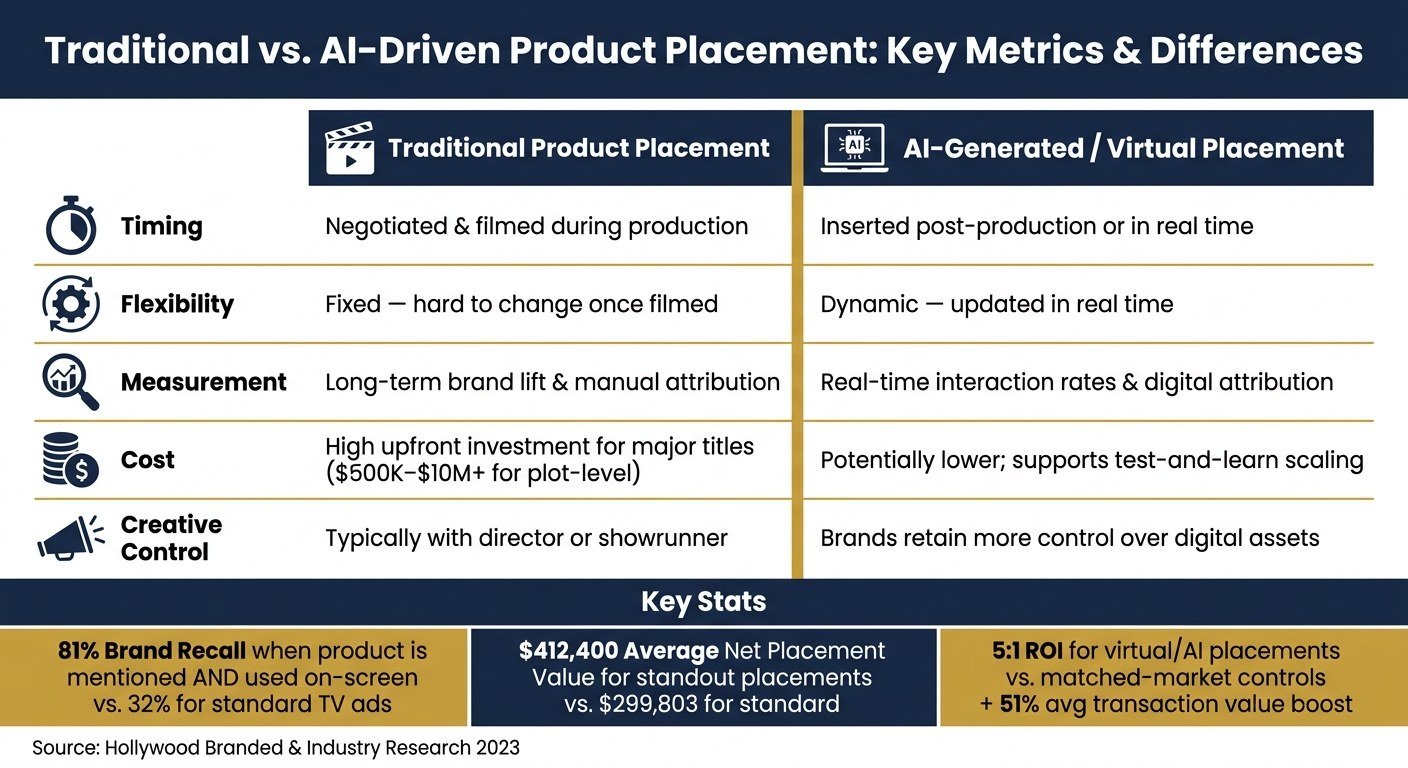
Traditional vs. AI Product Placement: Cost, Flexibility & ROI Compared
Once your campaign is live, tracking its performance is essential for gathering insights that can guide better decisions in future negotiations.
Choosing Metrics and Setting Reporting Expectations
Begin by establishing a baseline. Track metrics like current site sessions, branded search volume, and social mentions before the campaign starts. Without this initial data, it’s tough to confidently attribute any improvements to your efforts.
From there, focus on four key areas for tracking:
| Metric Category | What to Track | Why It Matters |
|---|---|---|
| Reach & Visibility | Impressions, audience size, integration level | Tracks total exposure and on-screen prominence |
| Brand Impact | Aided/unaided recall, sentiment, brand affinity | Measures how the placement influenced perception |
| Digital Action | Search spikes, website traffic, social mentions | Captures immediate consumer engagement |
| Lower Funnel | Purchase intent, conversions, UTM-tracked sales | Links the placement directly to revenue |
For example, brand recall jumps from 32% for a standard 30-second TV ad to 81% when a product is both mentioned and used on-screen. Additionally, standout product placements generate an average Net Placement Value of $412,400, compared to $299,803 for standard placements. To connect placements to actual sales, use tools like trackable links, discount codes, or partner URLs.
By having these metrics in place, you’ll also have the data needed to adjust your contracts and strategies based on performance.
Adding Optimization Clauses to Your Contract
Tracking metrics is only valuable if you can act on the insights. That’s why it’s smart to include optimization clauses in your contracts from the outset. A test-and-learn clause, for instance, allows you to tweak creative elements mid-campaign if early data shows the placement isn’t resonating. You can also negotiate re-editing rights to make changes if the initial execution underperforms.
Another valuable addition to your contract is the ability to scale successful placements into new formats. For instance, if a streaming integration generates a spike in search traffic, having the contractual right to repurpose clips or stills for social media can extend the campaign’s impact without incurring extra production costs. Tools like PyxelJam can help identify which placements are performing well, so you can put more energy into what’s working.
"Structuring deals with tiered fees and ancillary add-on budgets is for brands to secure the partnership without risking that it goes away entirely." – Stacy Jones, CEO, Hollywood Branded
These clauses also allow for comparisons between traditional placements and newer, AI-driven options.
Traditional Placements vs. AI-Generated Content: A Metrics Comparison
Understanding your metrics helps you make smarter decisions when negotiating deals. As virtual product placement (VPP) – where products are digitally added to footage during post-production – becomes more common, the way results are measured is evolving. Traditional placements typically rely on long-term brand lift studies and viewership ratings. In contrast, AI-based placements provide real-time feedback and allow for updates based on audience profiles or context.
| Feature | Traditional Product Placement | AI-Generated / Virtual Content |
|---|---|---|
| Timing | Negotiated and filmed during production | Inserted during post-production or in real time |
| Flexibility | Fixed; hard to change once filmed | Dynamic; can be updated in real time |
| Measurement | Long-term brand lift and manual attribution | Real-time interaction rates and digital attribution |
| Cost | High upfront investment for major titles | Potentially lower; supports test-and-learn scaling |
| Creative Control | Typically with the director or showrunner | Brands retain more control over digital assets |
Virtual placements have shown impressive results, including an average transaction value boost of 51% and a 5:1 ROI compared to matched-market controls. Meanwhile, traditional placements still deliver strong outcomes when done well. For example, Heineken’s placement in Skyfall led to 60% of viewers recalling the brand without any prompts.
Ultimately, the best approach is to align the placement format with your campaign goals and audience. Use each campaign’s insights to refine your strategy and strengthen future negotiations.
Conclusion: Steps to Getting Product Placement Right
Effective product placement hinges on thoughtful planning and execution. It begins with setting clear goals, carefully selecting the right partners, and securing a solid contract that safeguards your creative vision. Once in place, the focus shifts to tracking results – monitoring metrics like brand recall, search trends, and sales performance to identify what truly drives impact.
The value of product placement is backed by compelling data: global spending hit $29.63 billion in 2023, with returns on investment 38% higher than traditional TV ads. When paired with engaging content, product placements can boost brand awareness by up to 43%. These outcomes are the result of deliberate, strategic choices made at every stage of the process.
One notable trend reshaping the landscape is the increasing role of AI in planning, executing, and measuring placements. Virtual product placement, for instance, allows brands to bypass lengthy production timelines while maintaining greater control over how their products appear. Companies like PyxelJam are leading the charge with AI-driven video production tools that help brands adapt visuals quickly and efficiently, reducing costs and complexity.
"The best branded entertainment protects the story first, then lets the product earn attention." – BrandVM Insights
This principle applies across the board – from streaming platform integrations to virtual placements. Brands that excel in this space treat product placement as an evolving practice, continuously refining their strategies, nurturing partnerships, and using data to negotiate smarter deals. By applying these insights, you can optimize your approach and achieve measurable success.
FAQs
What should I ask for in a product placement contract?
Your product placement contract needs to clearly outline key elements such as scope, compensation, and brand safety measures. Be specific about the level of integration – whether the product appears subtly in the background or is actively used by a character. Include details on how long the placement will last and establish approval rights to maintain control over how your brand is portrayed.
To avoid conflicts, define exclusivity terms to ensure competitors’ products don’t appear alongside yours. Also, clarify usage rights, particularly if you plan to repurpose the placement for marketing campaigns. Termination clauses are crucial for added flexibility, allowing either party to exit the agreement if necessary.
Don’t forget to address viewer disclosure requirements to align with ethical and regulatory standards. Lastly, consider a tiered fee structure to accommodate potential creative adjustments during production. This way, both parties can adapt without unnecessary friction.
How do I know if a placement is actually worth the cost?
When assessing the cost, weigh it against the expected viewership or exposure and how effectively it connects with your target audience. To measure success, consider ROI-based metrics such as Net Placement Value (NPV), which combines reach and a Placement Quality Score. However, NPV might not tell the whole story. For a more comprehensive evaluation, incorporate tools like attribution reports, brand lift studies, or media mix modeling to capture the broader impact.
When should I choose virtual (AI) product placement instead of traditional?
When you want the freedom to adjust brand visuals during post-production – whether adding, swapping, or removing them – virtual (AI) product placement is the way to go. It’s perfect for tailoring placements to specific regions or audiences and for tracking performance metrics like screen time or the visibility of the placement. On the other hand, traditional product placement is better suited for physical, on-set integrations that need to feel seamlessly natural and can’t be effectively recreated digitally.