Streaming platforms have overtaken physical billboards as the go-to advertising medium for brands. Here’s why:
- Massive Audience Shift: By 2025, streaming made up 44.8% of U.S. TV usage, with 83% of adults using these services. Ad-supported tiers on platforms like Netflix and Amazon Prime Video now reach millions of viewers monthly.
- Precise Targeting: Unlike broad billboard messaging, streaming ads leverage data and AI to target audiences based on shopping habits, income, location, and viewing behavior.
- Measurable Results: Streaming ads offer full-funnel attribution, tracking customer actions from ad view to purchase, unlike billboards which rely on traffic estimates.
- Cost-Effective Options: Entry costs for streaming campaigns start as low as $50, making them accessible to businesses of all sizes.
- AI-Driven Production: Tools like text-to-video models cut video ad production costs by up to 95%, enabling brands to create engaging content quickly and affordably.
Streaming combines the reach of TV with the precision of digital, offering brands unmatched opportunities for visibility, engagement, and ROI.
How Advertising Shifted from Billboards to Streaming Platforms
Why Traditional Billboards Are Becoming Less Effective
The challenge with traditional billboards is simple: drivers have just three seconds to absorb their message while traveling at highway speeds of 55–70 mph. Chris Lottman, Director of Online Services at Whistler Billboards, explains it best:
"If someone cannot repeat your message after one quick glance, it is too complex. … Busy does not convert at highway speed."
This "three-second rule" imposes strict limitations. Billboards overloaded with text, multiple selling points, or complicated URLs simply don’t work. Meanwhile, modern audiences expect more interactivity – think clicking, scrolling, and engaging with content on their phones. Static billboards just can’t keep up.
There’s also the issue of audience behavior. Younger generations, like Millennials and Gen Z, have moved to digital platforms that billboards can’t reach. Even in cars, systems like Apple CarPlay and Android Auto let drivers control their audio environment, reducing the impact of traditional outdoor-radio ad pairings. As a result, the effectiveness of billboards has declined, creating an opening for streaming platforms to reshape advertising strategies.
How Streaming Has Changed the Advertising Landscape
Streaming’s rise has been dramatic. In June 2024, it made up 40.3% of total U.S. TV usage, while broadcast and cable combined fell to 47.7%. By March 2025, streaming had grown to 43.8%, a jump of 10 points in just two years. Connected TV (CTV) ad spending is projected to hit $46.89 billion by 2028, surpassing traditional linear TV for the first time. Nearly 90% of U.S. households with streaming capabilities actively watch CTV, and 46% of TV viewers now say streaming is their primary way to watch television, up from 35% in 2021.
This shift has completely changed how advertising budgets are allocated. In 2025, U.S. advertisers spent $33 billion on streaming TV ads, marking a 16% increase, while spending on linear TV dropped 7% to $55 billion. Streaming now accounts for 38% of total U.S. TV ad spending. Brian Albert, Managing Director of U.S. Video Deals and Creative Works at YouTube, highlights this shift:
"Streaming households are overtaking pay TV households for the first time in the U.S., and outpacing linear TV growth across the globe."
Brands are redirecting their budgets to streaming platforms because they offer what billboards can’t: precise targeting, measurable results, and control over ad frequency. With ad completion rates consistently above 90% on CTV platforms and tools like geofencing to track website visits, leads, and even in-store traffic, streaming takes the guesswork out of advertising. It delivers data-driven insights that traditional methods have always struggled to provide.
sbb-itb-0df1f49
What Makes Streaming Platforms as Powerful as Billboards
High-Quality Content Builds Brand Trust
Streaming platforms place ads within professionally crafted, premium content – a far cry from the randomness of digital feeds. When people settle in to watch their favorite shows or live sports, they’re already in a focused and engaged mindset. This creates a halo effect for your brand, as it becomes associated with that trusted content.
The environment matters. A streaming ad appears on a big screen in someone’s living room, during content they’ve actively chosen to watch. This lean-back, big-screen experience feels similar to traditional TV’s cultural influence while delivering the precision of digital targeting. By blending premium content with a personal viewing environment, streaming ads build trust and pave the way for stronger audience engagement.
Better Engagement and Memory Retention
Streaming ads typically run for 15–30 seconds and boast completion rates consistently above 90%. Viewers tend to stay engaged until the ad finishes, giving brands a longer window to deliver their message – something static formats can’t achieve.
The impact is clear: 77% of viewers exposed to streaming TV ads end up making a purchase. Interactive features like QR codes, "add to cart" options, and remote-click tools transform passive viewing into active shopping moments. These capabilities drive results, increasing page views by 27% and purchase rates by 28%. Streaming ads go beyond awareness – they create actionable opportunities.
Precise Targeting and Performance Tracking
Streaming platforms take engagement a step further with advanced data-driven targeting. Instead of casting a wide net, they focus on verified audiences, tailoring ads based on factors like household income, purchasing habits, ZIP code, and viewing behavior. Carl Goedjen, President of Global Overview, captures the power of this approach:
"I can now create an audience, and I can now reach that audience all the way through that first signal of them watching Thursday Night Football, all the way through down to purchase."
This full-funnel approach means advertisers can track real-time metrics like website visits, cart additions, and direct purchases – insights that traditional formats simply can’t provide. For example, Amazon Prime Video reaches more than 115 million customers monthly in the U.S. through ad-supported content. With 3.1 billion global visits per month, Amazon’s first-party data powers AI tools that analyze billions of signals to deliver ads at the perfect moment in a viewer’s shopping journey – all without relying on traditional ad IDs. These tools continue to refine how ads are personalized and delivered, making streaming platforms a game-changing option for advertisers.
How AI Changes Streaming Advertising
AI Video Production Reduces Costs and Time
Creating video ads the traditional way involves a lot – crews, cameras, actors, sets, and more. All of this adds up in terms of cost and time. AI is reshaping this process entirely. With tools like text-to-video models, brands can now produce high-quality video content at a fraction of the cost – up to 95% less – and in just a few hours instead of weeks.
Take the case of BAERSkin, an outdoor apparel company. In early 2026, they transitioned from making short 8-second clips to producing 30-second fully animated TV spots. Their AI-powered production stack included tools like Google Veo 3 for animation, ElevenLabs for voiceovers, and Google Nanobanana for storyboarding. This shift allowed them to feature "fantastical characters" and create "impossible locations" – concepts that were previously out of reach due to budget constraints. Luke de Kock, BAERSkin’s Head of Marketing, summed it up perfectly:
"Suddenly we can create scenes, characters, locations, and scenarios that would be completely out of reach for our production team’s budget and scale… AI has unlocked a creative ceiling that traditional production kept firmly in place."
AI also introduces a modular approach to video production. Instead of creating a single ad, brands can break it into components – like hooks, product demos, and calls-to-action – that can be swapped or regenerated quickly. This flexibility not only saves money but also allows brands to test multiple creative strategies without the hassle of reshooting. These innovations also set the stage for more personalized streaming ads.
Creating Personalized Content Using Data
AI isn’t just speeding up video creation – it’s making content smarter. By leveraging audience data, brands can create hundreds of video variations from a single concept, tailoring each one to specific audiences based on factors like location, industry, or where viewers are in the sales funnel. For example, data points such as household income, purchasing habits, or viewing behavior help fine-tune these variations.
The results? Personalized video ads deliver click-through rates 2x to 4x higher than generic ones. Watch completion rates also jump by 50% to 80%, and brands report a 40% to 60% reduction in cost per acquisition.
AI-powered tools also go beyond traditional ad IDs, using "authenticated signals" and shopping journey data to target viewers more effectively. These tools analyze billions of customer interactions to pinpoint where someone is in their buying process, ensuring ads are shown at just the right moment. This full-funnel approach even tracks viewers from the first ad they see all the way to their purchase.
Localization is another game-changer. AI voice synthesis and translation can generate natural, accent-specific voiceovers for multiple markets – all without hiring separate voice actors. This not only makes ads more relatable but also opens up new ways to tell stories visually.
Expanding Creative Options
AI is breaking creative boundaries in ways traditional filming never could. For instance, Levels Protein, a premium protein brand, used AI to produce a "hero" TV ad in 2025. The technology allowed them to bring their ambitious vision to life without needing a massive budget or making creative compromises. Founder Blake Niemann highlighted how AI tools enabled "visual languages that simply didn’t exist before".
The benefits extend to production teams, too. Tasks like rotoscoping – once painstakingly slow – can now be done 99% faster. This newfound efficiency lets brands experiment with bold ideas without worrying about financial risks. AI-powered Dynamic Creative Optimization (DCO) further enhances ads by adjusting elements like visuals and messaging in real-time based on individual viewer preferences.
Currently, AI-generated video ads account for about 30% of all digital video advertising, with that number expected to hit 40% by the end of 2026. Pieter de Zwart, Director of Engineering at Amazon DSP, emphasized the collaborative potential of this technology:
"If we focus on the fundamentals of digital advertising, and we all lean in a little bit together, we can create a rising tide which will lift each of our individual boats."
AI isn’t replacing human creativity – it’s enhancing it. Most brands (86%) use AI as a "co-pilot", assisting human creators rather than taking over completely. This partnership combines the efficiency and scale of AI with the strategic insights and storytelling skills that only humans can offer.
How to Build TV Ready Animated Ads With AI – Ultimate Guide
Getting Better Returns from Streaming Advertising
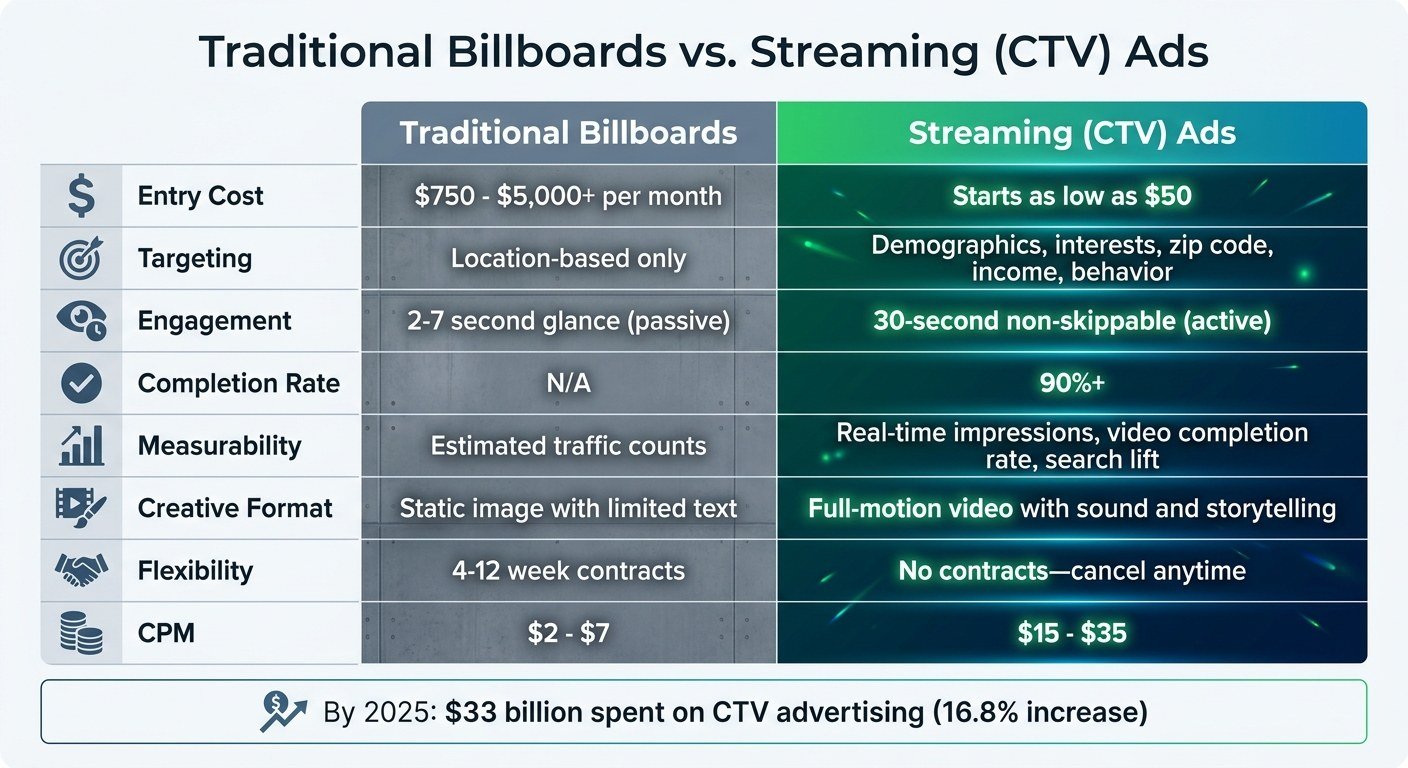
Traditional Billboards vs Streaming Ads: Cost, Targeting & ROI Comparison
Lower Entry Costs for All Business Sizes
Streaming ads open doors for businesses of all sizes, offering a much more affordable entry point compared to traditional billboards. For example, a billboard in a smaller market typically costs between $750 and $2,000 per month. In contrast, streaming platforms allow campaigns to start with as little as $50. Most local businesses find success investing between $500 and $2,500 per month – still far less than the high price of premium billboard locations. The rise of programmatic buying, which now accounts for 84% of connected TV (CTV) ad spending, has made it easier for smaller businesses to access top-tier ad placements without needing a huge budget.
Production costs further highlight the advantage. Designing and installing a billboard can cost an additional $500 to $2,000, whereas AI-powered tools can create professional-quality video ads at little to no cost. This eliminates the traditional production costs that ranged from $5,000 to $50,000. These lower costs, combined with advanced real-time tracking, make scaling campaigns much more achievable.
Tracking Results and Scaling Campaigns
One of the biggest strengths of streaming platforms is the ability to track campaign performance in real time – something traditional billboards can’t offer. Metrics like impressions, reach, frequency, and video completion rates (often exceeding 90% for non-skippable ads) provide advertisers with a clear picture of their campaign’s effectiveness. In contrast, billboard campaigns rely on rough estimates of traffic counts.
David Naffis, CEO of Adwave, summed it up perfectly:
"With CTV, you can measure whether your advertising is working and adjust accordingly. With billboards, you’re mostly guessing."
Streaming ads also provide advanced insights. For instance, brands can track branded search lift to see how campaigns drive website traffic. Interactive ad formats take this further by capturing live engagement, leading to measurable increases in page views and purchases. This level of data allows marketers to make real-time adjustments to flight dates, targeting, or frequency, rather than simply throwing more money at the campaign. Often, focusing on frequency – delivering multiple messages to a smaller, more engaged audience – proves more effective than casting a wide net. Starting with a modest budget of $200 to $500 for a two-week test can yield valuable insights before scaling up.
Traditional Billboards vs. Streaming Ads: A Comparison
| Feature | Traditional Billboards | Streaming (CTV) Ads |
|---|---|---|
| Entry Cost | $750 – $5,000+ per month | Starts as low as $50 |
| Targeting | Location-based only | Demographics, interests, zip code, income, behavior |
| Engagement | 2-7 second glance (passive) | 30-second non-skippable (active) |
| Completion Rate | N/A | 90%+ |
| Measurability | Estimated traffic counts | Real-time impressions, video completion rate, search lift |
| Creative Format | Static image with limited text | Full-motion video with sound and storytelling |
| Flexibility | 4-12 week contracts | No contracts – cancel anytime |
| CPM | $2 – $7 | $15 – $35 |
The numbers tell the story. By 2025, U.S. advertisers are expected to spend $33 billion on CTV advertising, marking a 16.8% increase from the prior year. Even more striking, programmatic CTV ad spending is forecasted to surpass traditional linear TV by 2028. Maggie Zhang from Amazon Ads captures this shift:
"Streaming TV combines television’s cultural impact with digital’s measurability, creating a powerful full-funnel marketing engine."
This comparison highlights how streaming ads offer better tracking, flexibility, and overall performance, making them an essential part of a modern marketing strategy.
Adding Streaming Ads to Your Marketing Mix
Streaming ads shine brightest when they’re part of a broader strategy rather than a standalone tactic. Today’s shoppers interact with over 20 touchpoints before making a purchase, so staying visible across multiple platforms is crucial. The goal? Deliver a consistent message that follows your audience from their TV screens to their phones, from billboards on their commute to social media during lunch breaks. This cohesive approach bridges the gap between digital and physical engagement.
Pairing Streaming with Out-of-Home Advertising
Combining streaming ads with out-of-home (OOH) advertising creates a dynamic impact throughout a consumer’s day. Imagine this: streaming ads introduce your brand story at home, while OOH placements reinforce it as people go about their daily routines. This sequential strategy keeps your brand fresh in their minds without drastically increasing your budget.
Adding OOH to your marketing mix can double your audience reach or more. Digital OOH (DOOH) campaigns, in particular, deliver impressive results – brand recall rates are 2.2 times higher compared to traditional static billboards. Even better, 74% of people who see a DOOH ad later engage with their mobile device to search for the brand or visit its website. A great example? McDonald’s in the Philippines ran a weather-responsive DOOH campaign that only activated when temperatures hit 90°F or higher. The ads encouraged viewers to claim deals via a mobile app, generating nearly 1 million impressions in just 10 days and boosting store visits by 9% among those who saw the ads.
To maximize impact, repurpose your streaming video assets for DOOH screens, especially in locations with sound capabilities, like gas stations. For muted settings, use bold captions and clear branding to grab attention. QR codes are another smart addition – they connect OOH viewers directly to streaming content or mobile offers.
Connecting Streaming with Search and Social Media
Streaming ads also work seamlessly with online search and social media, creating a fully integrated marketing experience. Major platforms like YouTube and Amazon Prime Video leverage robust data ecosystems to target users based on their recent online activity. For example, YouTube uses first-party search and browsing data, while Amazon connects streaming signals to shopping and search behavior on its marketplace.
The results speak for themselves: streaming TV ads drive 27% more page views and 28% higher purchase rates compared to standard video ads. Carl Goedjen, President of Global Overview, highlighted the power of this approach:
"I can now create an audience, and I can now reach that audience all the way through that first signal of them watching Thursday Night Football, all the way through down to purchase."
Platforms like Google/YouTube, Amazon, and Disney/Hulu excel at this because they use deep data insights to target ads based on real search and purchase intent. When someone sees your streaming ad, searches for your brand, and later encounters your social media post, each interaction reinforces the others. This cross-device continuity ensures your message follows viewers across smart TVs, smartphones, and tablets, creating a seamless brand experience wherever they engage.
Conclusion
Streaming platforms have reshaped how brands connect with their audiences, blending the broad reach of traditional billboards with the precision of targeted, real-time, and actionable advertising. As of December 2024, streaming accounts for 43.4% of total U.S. TV usage – a clear sign that the shift from physical to digital is here to stay.
What’s pushing this evolution even further? AI-driven production and targeting. Tools like PyxelJam make it easier than ever for businesses – big or small – to create professional streaming ads quickly and affordably. With AI, brands can adapt faster, testing different creative approaches, tailoring messages to viewer behavior, and keeping content fresh to avoid ad fatigue. As Alasdair McLean-Foreman, CEO of Teikametrics, explains:
"AI is no longer living at the edges of advertising as a bidding or optimization tool. It’s functioning as the operating system for full-funnel growth."
The old-school marketing funnel no longer applies. Today’s consumers move from discovery to purchase in a flash, and streaming platforms are perfectly positioned to take advantage of this. By combining verified shopping data with entertainment preferences, brands can connect with viewers at the ideal moment – whether they’re just browsing, considering options, or ready to make a purchase.
If streaming isn’t a key part of your strategy yet, it’s time to rethink. Use these platforms to test ideas, learn what works, and scale successful campaigns. The future of advertising isn’t on a billboard – it’s already streaming.
FAQs
Which streaming platforms should my brand advertise on first?
Start with platforms that offer both extensive reach and advanced targeting capabilities, such as Hulu, Roku, and Amazon Prime Video. Hulu and Roku stand out for their strong viewer engagement and precise targeting options, making it easier to connect with the right audience. Meanwhile, Amazon’s streaming ads give you access to a wide-ranging audience alongside popular shows and movies. Prioritizing these platforms can help you build a solid foothold as streaming continues to capture more viewer attention. Choose the ones that align best with your audience and marketing objectives to get the most out of your efforts.
What should I track to prove streaming ads drive sales?
Tracking key metrics like subscription sign-ups, conversions, click-through rate (CTR), and return on ad spend (ROAS) is essential when proving that streaming ads drive sales. These metrics reveal how effectively your campaigns are performing and offer valuable insights into whether your ads are translating into real, measurable outcomes.
How can I make a video ad fast with AI without hurting quality?
You can create high-quality video ads quickly by using AI-powered tools that handle scriptwriting, avatar creation, and video production. To get the best results, keep these points in mind:
- Use AI to produce multiple ad variations efficiently.
- Experiment with different formats to discover what resonates most.
- Personalize your content to connect with your audience effectively.
By following these tips, you can produce ads that are engaging, budget-friendly, and completed in a fraction of the time.