If you need sales now, ads usually win. If you want brand memory that lasts, product placement often wins.
I’d sum it up this way: product placement is better for long-term awareness, while TV, CTV, pre-roll, display, and print are better for short-term response and easier tracking. The article measures ROI as incremental revenue minus cost, divided by cost, and shows that the best choice depends on cost, reach, recall, engagement, conversion impact, time horizon, and measurement.
Here’s the short version:
- Product placement puts the brand inside the content
- Ads run as separate ad units
- Placement can drive strong recall, with some results going from about 32% for passive exposure to 80%+ when the product is mentioned and used
- Ads are easier to track with UTMs, promo codes, call tracking, CTR, CPA, and ROAS
- Combined exposure can beat either one alone, including cases like a 61% sales lift vs. 37% for ads alone
Ask BENlabs | Measuring Product Placement ROI
sbb-itb-0df1f49
Quick Comparison
| Factor | Product Placement | Advertising |
|---|---|---|
| Best for | Long-term brand memory | Fast response and sales |
| Cost | Higher upfront fee | Pay by impressions or campaign flight |
| Reach | Tied to the content audience | More predictable scale |
| Recall | Often strong when built into the story | Can be strong with a clear 30-second spot |
| Conversions | More indirect | More direct |
| Tracking | Harder to tie to one sale | Easier to measure |
| Time frame | Months or years | During the live campaign |
If I were choosing, I’d use placement to build familiarity and ads to drive action. And if budget allows, I’d use both.
Product placement ROI: where embedded brand exposure performs best
Product placement tends to deliver its best ROI when the goal is lasting awareness, not instant conversions. The brand is built into the content itself, so people don’t just scroll past it. It’s part of the scene. That’s the upside.
The downside is simple: last-click attribution is weak. So instead of judging performance by direct clicks or instant sales alone, brands usually need to look at lift, reach, and downstream sales.
Brand recall, engagement, and long-tail value
The recall data for strong placements stands out. A Nielsen study found that recognition among viewers who saw a placement was 56.6%, compared with 11.1% in a control group. Branded content also averaged 86% brand recall versus 65% for pre-roll ads, along with stronger lifts in affinity, purchase intent, and recommendation intent.
That matters for one big reason: placement can keep paying off long after launch. Streaming libraries, on-demand replays, and recommendation systems can bring old episodes and creator videos back in front of viewers months or even years later. So one integration fee can spread across lifetime impressions, which lowers the effective cost per impression over time. For brands that want staying power instead of short campaign spikes, that can make placements more efficient.
Of course, that long shelf life comes with weaker attribution. You may get more value over time, but proving exactly how each exposure led to a sale is harder.
Upfront costs and measurement limits
Placement costs hit early. In most cases, you’re paying an integration fee to a studio, producer, or creator. On top of that, there are costs tied to creative coordination, production edits, and rights agreements that spell out how the footage can be reused.
That can make placement look more expensive at the start than display or pre-roll. But once the content is live, you usually aren’t paying media costs for each extra impression.
Measuring ROI also works differently here. Since viewers can’t click on a product sitting in a scene, brands often rely on:
- Brand lift studies
- Exposed-versus-control testing
- Watch-time data
- Social conversation analysis
- Post-campaign sales analysis
The catch is that these methods are less exact than click-based reporting. So if you’re briefing stakeholders, it’s usually smarter to present ROI as a range of scenarios instead of one hard number. That reality makes the next comparison pretty clear: when speed and tight attribution matter most, standard advertising often has the edge.
How PyxelJam reduces production friction for branded integrations
Production efficiency matters because it cuts total campaign cost. One of the biggest pain points in product placement is the work around the integration itself. Teams need to script scenes where the product feels natural, build versions with different levels of visibility or dialogue mention, and reuse clips across social and owned channels.
PyxelJam’s AI video tools help speed up script-fit testing, visibility variants, and use-case concepts before brands commit larger spend.
It also helps teams make variants at scale. A single campaign can produce cuts with:
- Subtle background placement
- Mid-level visibility
- Direct script mentions
That keeps the rest of the creative fairly consistent, which makes testing cleaner. Automated editing can also turn longer integrations into short social clips and teasers, extending reach across channels with little added cost.
For brands trying to make a set placement budget go further, that kind of production efficiency can improve effective ROI by lowering the cost side of the equation without hurting creative quality.
When the goal shifts from long-tail awareness to fast, measurable response, traditional advertising usually delivers better ROI.
Traditional advertising ROI: where speed, scale, and measurability perform best
When the buying cycle is short, the ROI question changes. It stops being about long-term exposure and starts being about getting a response now. In that kind of setup, traditional advertising often does a better job than product placement because it delivers speed, scale, and measurable results.
Reach, frequency, and immediate response
For time-sensitive campaigns, local TV and CTV can hit defined ZIP code audiences again and again in a short stretch of time. That matters when a brand needs sales this week, not months from now.
A good example comes from Gen3 Marketing. Its CTV campaign for a home décor brand drove $97,400 in incremental revenue and delivered a 6x–9.6x ROAS, with a short payback window that product placement rarely matches.
Clearer attribution and tighter optimization loops
Another big edge is attribution. With digital ad formats like CTV and pre-roll, marketers can use UTMs, promo codes, and call tracking to connect impressions to actual conversions.
That makes the feedback loop much tighter. Instead of waiting until a campaign ends, teams can see what search, social, CTV, and display each contributed to the final sale while the campaign is still live. Then they can move budget away from ads that aren’t working before the money is spent.
Some CTV performance campaigns have reported 4.5x higher ROI than linear TV when active optimization is in play. Of course, that kind of fast adjustment only works if the team can turn new creative around fast enough.
How PyxelJam improves traditional ad efficiency
This is where production starts to matter a lot. Creative cost and turnaround time have a direct effect on ROI, especially for TV, CTV, pre-roll, and display campaigns.
PyxelJam’s AI video tools help brands make CTV spots and pre-roll ads faster and at a lower production cost. And the time savings aren’t small. Industry data shows AI-assisted production has cut average video timelines from about 13 days to around 27 minutes.
That changes how marketers can run campaigns. If early data shows a message isn’t landing, they can swap in a new version mid-campaign instead of riding out weak performance. It also makes audience-specific versioning much more practical. One main concept can turn into separate cuts for different demographics, regions, or offer types.
Put simply, lower production costs and faster turnaround improve the cost side of ROI. They also make fast testing much easier, which gives traditional ads a cleaner way to test, refine, and stack up against placement ROI.
Product placement vs. traditional advertising: side-by-side ROI comparison
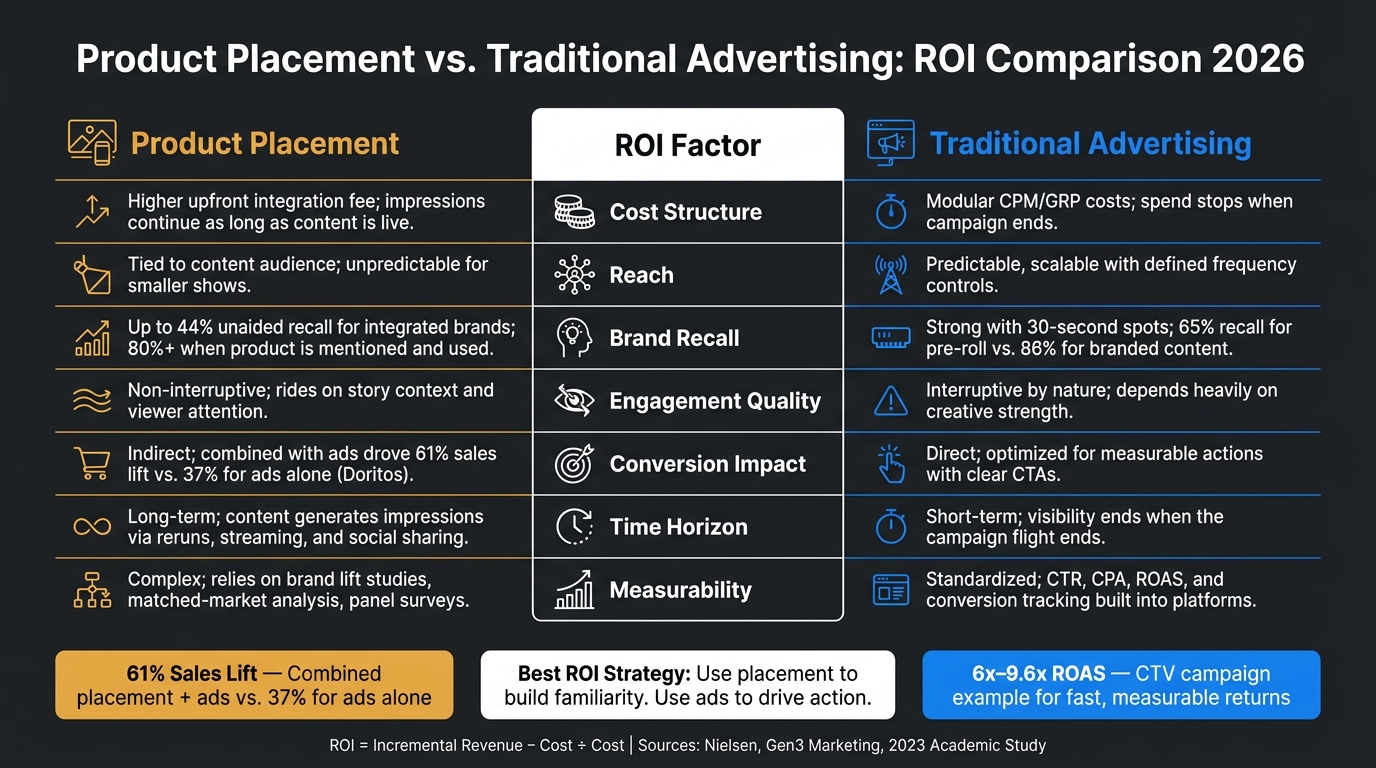
Product Placement vs. Traditional Advertising: ROI Comparison 2026
Those production gains matter even more when you put both channels next to each other. If ROI means incremental revenue for each $1 spent, the comparison below shows where product placement stands out, where ads have the edge, and where each one fits best.
| ROI Factor | Product Placement | Traditional Advertising |
|---|---|---|
| Cost structure | Higher upfront integration or licensing costs; exposure can continue as long as the content remains available | Modular, impression-based costs (CPM, GRP); spend ends when the campaign flight ends |
| Reach | Tied to content audience size; less predictable for smaller content audiences, but potentially very high for hit shows | Predictable, scalable reach with defined audience sizes and frequency controls |
| Brand recall | Prominent, integrated placements can deliver strong recall, with unaided recall reaching 44% for integrated brands in one study | Under controlled tests, 30-second commercials can outperform subtle placements on recall |
| Engagement quality | Non-interruptive; rides on story context and viewer attention | Interruptive by nature; engagement depends heavily on creative strength |
| Conversion impact | Indirect; often works best when paired with traditional ads – combined exposure drove a 61% sales lift vs. 37% for ads alone in one Doritos campaign | Direct; optimized for measurable actions with clear calls-to-action and short conversion paths |
| Time horizon | Long-term; content can keep generating impressions through reruns, streaming catalogs, clips, and social sharing | Short-term; visibility ends with the campaign flight |
| Measurability | Complex; relies on brand lift studies, matched-market analysis, and panel surveys | More standardized; impressions, CTR, CPA, ROAS, and conversion tracking are built into most platforms |
There’s no single winner here. Traditional ads tend to win when you need speed, control, and clean tracking. Product placement tends to win when you want your brand to sit inside the story and keep showing up over time.
Matching each option to your goal, budget, and buying cycle
The best channel depends on what you’re trying to do and how fast you need results. If you’re stuck between the two, this table makes the choice a lot easier.
| Campaign Scenario | Stronger Fit | Why |
|---|---|---|
| Brand awareness | Mixed strategy | Placements add depth; ads deliver breadth, and combined exposure often produces the strongest recall and purchase-intent results |
| Product launch | Traditional ads + strategic placement | Ads drive rapid reach and clear messaging; placements embed the product in culture and support discovery |
| Limited-time offer | Traditional advertising | Placements can’t be turned around fast enough and stay visible after the offer expires |
| Brand image | Product placement | Character and context alignment creates lasting associations with specific values or lifestyles |
| Long consideration cycle | Product placement | Sustained, low-resistance exposure keeps the brand familiar across a long consideration window |
A simple way to think about it: ads are better when timing is tight, while placement works better when memory and association matter more. If you need people to act this week, ads usually do the heavy lifting. If you want them to keep your brand in mind for months, placement often does more work in the background.
When a mixed strategy produces better returns
In many cases, the best ROI comes from using both. One channel sets the scene; the other pushes action.
A 2023 study found that the combination of product placement and TV commercials produced the highest impact on brand recall and purchase intention – with placement alone in second place and commercials alone delivering the lowest impact. A cereal brand running in a U.S. sitcom saw a 53% sales lift among viewers exposed to both placement and commercial, compared to just 13.5% from the commercial alone.
Placement builds context; ads close the sale.
That’s the core tradeoff in plain English. Placement can make a brand feel familiar inside a moment people already care about. Ads then give that attention a direct path, whether that means a click, a store visit, or a purchase.
Conclusion: Which delivers better ROI in 2026
ROI comes down to what you want the campaign to do.
If your main goal is brand equity, product placement usually does a better job. It puts the product in front of people in a way that can feel more natural, which helps build familiarity over time.
If your goal is faster, easier-to-track conversions, traditional advertising tends to win. It’s built to drive action now, and it’s usually simpler to measure against spend.
So the answer isn’t one-size-fits-all. If you measure ROI as incremental revenue against cost, the better option depends on the result you care about most. The same split shows up in recall, attribution, and time horizon.
The data backs this up. A 2023 study found that combining placement and TV ads produced the strongest recall and purchase intent, with placement alone outperforming commercials alone.
Choose based on your goal, timeline, budget, and measurement needs. Look at each option through the same ROI lens:
- Cost
- Speed
- Recall
- Conversion
- Measurement
That makes the decision much easier.
Use placement to build familiarity. Use ads to drive action.
FAQs
How should I measure product placement ROI?
Start by setting one primary KPI before the campaign: awareness, engagement, or sales. Then use a 30-day pre-campaign baseline for site traffic, branded searches, and sales.
That baseline matters more than people think. Without it, you’re guessing. With it, you can see whether the campaign moved the needle or if the numbers were already heading that way.
Track Net Placement Value, exposure and engagement, and conversions. The cleanest way to do that is with UTM-tagged links, unique discount codes, and landing pages built for the campaign.
For performance, calculate ROI with this formula:
ROI = (Incremental Profit ÷ Placement Spend) × 100
After that, compare the results against control groups and brand lift studies. That extra comparison helps you separate campaign impact from normal market noise.
When does a mixed strategy make more sense?
A mixed strategy often makes the most sense when you want a clear brand experience across many touchpoints. People often interact with more than 20 touchpoints before they buy, so relying on just one tactic usually isn’t enough.
Pairing product placement with streaming ads and out-of-home advertising can put your brand in front of people at home, then remind them about it as they move through their day. That way, your brand stays top of mind without a sharp jump in budget.
Which option is better for a small budget?
For small budgets, product placement is often a better fit than old-school advertising. It’s easier to get into, and it doesn’t demand the kind of money that big studio deals usually do. In many cases, small businesses can get started with flexible partnerships for $0 to $500 instead of paying for large-scale integrations.
Lower-cost options include barter or in-kind deals, micro- and nano-influencer partnerships, AI-driven placements, and niche YouTube or podcast sponsorships. That gives small brands room to test the waters without betting the farm. A low-risk test can often run on $200 to $500 over two weeks before you decide whether to put in more.