If I need control, fixed timing, and clean tracking, I’d use paid product placement. If I want trust, natural fit, and long-term brand memory, I’d lean on organic integration. That’s the whole choice.
Here’s the short version:
- Paid placement works best for launches, promos, and campaigns with a deadline.
- Organic integration works best when the product fits the content and I want it to feel like normal use.
- The trade-off is simple: control vs. natural fit.
- FTC rules matter: if there’s payment, free product, affiliate pay, or any other material connection, disclosure is required.
- Measurement differs: paid is easier to track with clicks, promo codes, and ROAS; organic is better read through search lift, engagement, sentiment, and assisted conversions.
- Many brands get the best mix by using both: paid for the first push, organic for follow-up visibility.
A few points stand out fast. Sponsored content often gets lower engagement than unpaid content, which means paid placements need stronger execution. At the same time, audience doubt around sponsorships is common, so natural product use can land better when the fit is there. And if I’m spending $5,000, $25,000, or more on a campaign, I need the format to match the goal before I spend a dollar.
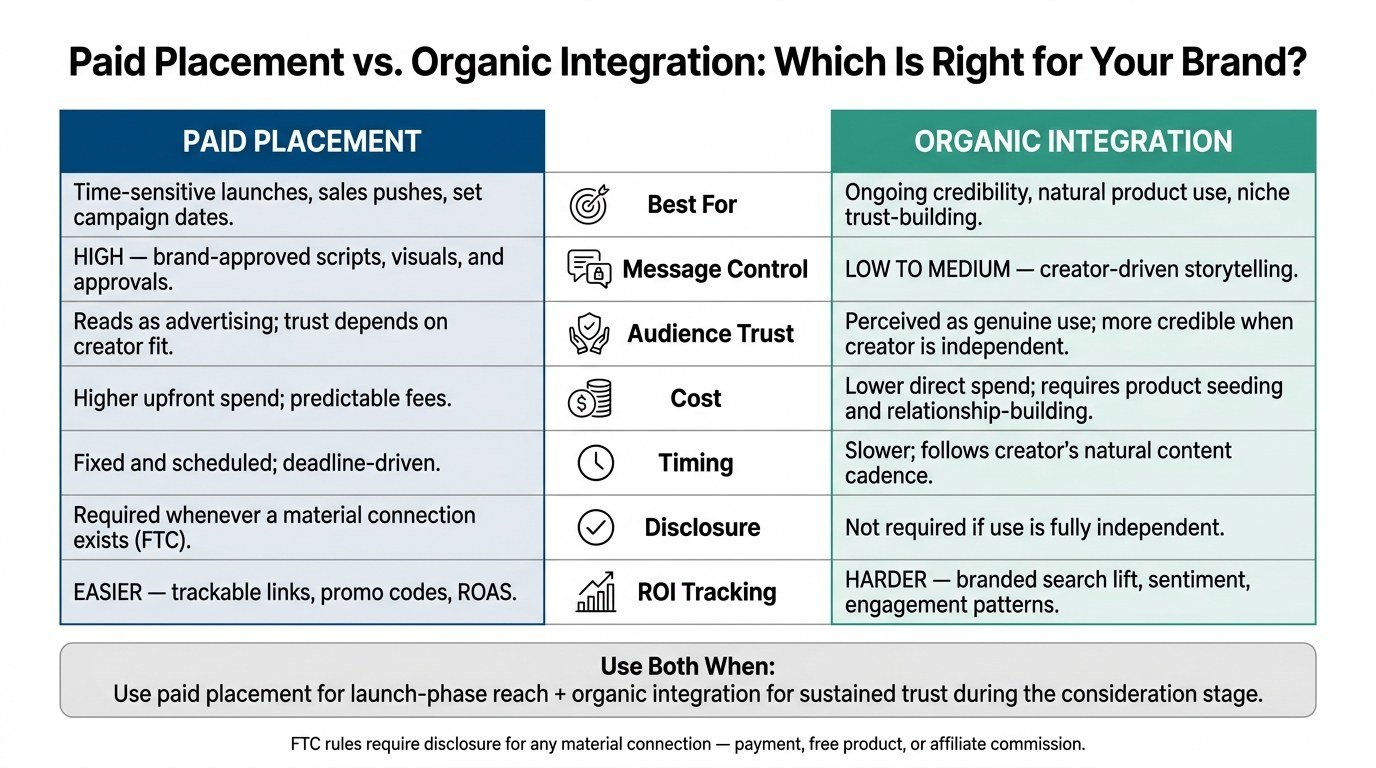
Paid Placement vs. Organic Integration: Side-by-Side Brand Strategy Comparison
Quick Comparison
| Factor | Paid Placement | Organic Integration |
|---|---|---|
| Best for | Launches, sales pushes, set campaign dates | Product fit, trust, repeat visibility |
| Control | High | Low to medium |
| Timing | Fixed and scheduled | Less predictable |
| Cost | Higher upfront spend | Lower direct spend, but more time and follow-up |
| Disclosure | Required when there’s a material connection | Not required if use is fully independent |
| Tracking | Easier | Harder |
| Main upside | Message and delivery control | Feels more natural in content |
| Main risk | Can feel forced | No guarantee of mention or timing |
My takeaway: I’d choose the format based on the job. If the campaign needs a set message on a set date, paid wins. If the goal is product fit inside normal content, organic has the edge. And if I want both reach and trust, I’d combine them.
sbb-itb-0df1f49
Paid Product Placement: More Control, More Predictability
Paid placement is the better pick when the delivery date and message need to be set ahead of time. It works well for brands that care more about control and timing than a natural feel.
Where Paid Placement Works Best
Paid placement works best when the stakes are high and the timeline can’t move. Think product launches, seasonal promotions, or awareness pushes tied to a campaign calendar. In those cases, timing isn’t a nice-to-have. It has to land on schedule.
Common formats include sponsored YouTube segments, branded creator integrations inside tutorials or reviews, and placements in streaming content. In each case, the brand has a clear place in the content instead of hoping it shows up in a more casual way.
What Brands Gain and What They Give Up
Paid placement gives brands more say over talking points, timing, and approvals. That can include negotiating which product benefits get mentioned and reviewing the creative before it goes live. It also makes planning easier. You know the creator, the audience size, and the expected deliverables before the campaign starts.
The downside is cost and a weaker natural fit. Sponsored posts often get fewer likes than organic posts, so the creative has to do a lot of heavy lifting. If the placement feels forced, it can backfire fast, especially when the product doesn’t fit the creator’s usual style.
How to Measure Paid Placement ROI
Measuring paid placement takes more than a view count. You need to connect total spend – placement fee, production, and management costs – to the campaign outcome.
| Metric | What It Measures | Best For |
|---|---|---|
| Impressions & reach | Total potential audience exposed | Awareness campaigns |
| View-through rate | How many viewers watched the segment | Engagement quality |
| Click-through rate | Traffic driven to a landing page | Interest and intent |
| Promo code usage | Direct attribution to the placement | Conversion tracking |
| Branded search lift | Increase in brand-related searches post-campaign | Demand generation |
| Sales impact / ROAS | Revenue tied to placement spend | ROI evaluation |
Match the metric to the goal:
- Reach for awareness
- CTR for traffic
- Promo codes for conversion
- ROAS for revenue
That’s why paid placement makes sense for campaigns that need predictable delivery and clear measurement.
Organic integration flips that trade-off: less message control, more natural fit.
Organic Integration: More Natural Trust, Less Message Control
Organic integration is the trust-first option: less control, more credibility. When a product fits the scene, viewers read it as part of the story, not a paid interruption. That added trust usually comes with less control over the message, and that trade-off matters.
Why Organic Integration Often Feels More Natural to Viewers
Trust starts with relevance. When a product makes sense in the moment – a video editor showing their SaaS tool during a live workflow, or a chef reaching for a branded pan while cooking – the audience sees a use case, not a pitch.
U.S. survey data shows that most viewers are skeptical of sponsored content, which helps explain why organic placements often land better.
Research points in the same direction: less obvious product appearances can improve viewer attitude, video trust, and product perception. The product feels woven into the content instead of dropped in like an ad break.
The Limits of Organic Integration for Marketers
The same thing that makes organic integration persuasive – the absence of a rigid script – is also what makes it harder for brands to manage. There is no guaranteed script, screen time, call to action, or posting timeline. Even if a brand seeds the product, the creator might mention it in passing, frame it in their own way, or skip it altogether.
It also gets harder to scale across many creators or regions on the same schedule. And measurement becomes less clean. Instead of tying credit to one post or one click, teams usually need to look at lift across the campaign.
How to Measure Organic Impact Without Overclaiming
Use broader attribution signals instead of relying on last-click alone.
| Metric | What It Captures | Why It Matters for Organic |
|---|---|---|
| Engagement rate | Likes, comments, and shares on content featuring the product | Shows whether the content connected with viewers and felt natural |
| Comment sentiment | The tone of viewer reactions around product mentions | Helps separate genuine interest from doubt or pushback |
| Saves & shares | Viewers bookmarking or sending the content to others | Suggests practical use or social value beyond a single view |
| Direct traffic | An increase in site visits after a post goes live | Links content to downstream interest without needing promo codes |
| Branded search lift | Growth in brand-related search volume after the campaign | Tracks demand driven by awareness content |
| Repeat mentions | How often the product shows up across multiple posts | Shows whether organic visibility is building over time |
| Assisted conversions | Conversions where the content influenced the path but was not the final click | Gives credit to influence without overstating direct impact |
Report organic results as campaign-level lift, not single-post ROI. Those signals give you a better read, but the best fit still comes down to how much control, disclosure, and predictability the campaign calls for.
Paid Placement vs. Organic Integration: A Direct Comparison for Decision-Making
Use this side-by-side view to pick the format that fits your goal, budget, and how much control you want. The table below makes the trade-off easy to scan.
Comparison Table: Paid Placement vs. Organic Integration
| Factor | Paid Placement | Organic Integration |
|---|---|---|
| Best for | Time-sensitive launches and conversions | Ongoing credibility and natural product use |
| Message control | High – brand-approved messaging and visuals | Low to medium – creator-driven storytelling |
| Audience trust | Reads as advertising; trust depends on creator fit | Often perceived as more genuine use, especially when the creator is known for independent opinions |
| Cost | Predictable fees; higher upfront spend | Lower direct spend; may require product seeding and relationship-building |
| Speed | Scheduled and deadline-driven | Slower; depends on the creator’s normal content cadence |
| Disclosure needs | Required whenever a material connection exists | No disclosure needed if there is no material connection |
| ROI clarity | Stronger – trackable links, promo codes, conversions | Softer – branded search, sentiment, engagement patterns |
Paid placement is stronger for recall and intent. Organic integration is stronger for trust.
How FTC Disclosure Rules Affect Each Approach
FTC rules are simple: any material connection – payment, free product, affiliate commission, or another benefit – requires clear, in-video disclosure, not something tucked away in the description. Purely independent use does not trigger disclosure.
That line matters a lot when you’re planning a campaign. If your organic-style plan includes sending free product or paying commissions, creators should disclose it. In fact, you should expect that and ask for it. Undisclosed material connections carry real regulatory risk, and they can quietly chip away at the audience trust you were trying to earn in the first place. That changes both how the campaign is built and what instructions creators need.
When to Choose One, When to Use Both
Choose paid placement when the campaign has a hard deadline, a set sales target, or messaging that needs to stay consistent across multiple creators. It works well for product launches, limited-time offers, and any case where guaranteed reach matters more than perceived spontaneity.
Choose organic integration when the goal is credibility over time – building recognition among practitioners, educators, or niche communities where the product fits naturally into day-to-day workflows. It’s slower and less predictable, but trust tends to build over time.
Use both when you need controlled awareness at launch and natural reinforcement during the consideration stage. For example, a brand might use paid placements to introduce a product to a broad audience at launch, then encourage creators who end up using it for real to mention it organically in their usual content over the next few months. Paid placement can kick things off; organic integration can keep the product in view.
Next, look at how AI video production can support either approach.
Using AI Video Production to Run Either Strategy
Once you’ve picked paid placement or organic integration, the next step is execution. That’s where AI video production changes the pace. It speeds up production, cuts costs, and makes testing a lot easier.
What it doesn’t change is the trade-off itself. You’re still choosing between control and a more natural feel. AI just changes how you produce each one.
How PyxelJam Supports Paid Brand Integrations

For paid placements, consistency comes first. PyxelJam lets brands lock in scripts, brand assets, and disclosure language before anything is generated. From that approved setup, the platform can create multiple versions of the same sponsored segment, like a 15-second, 30-second, and 60-second cut, or different hooks for different audience groups, without any reshoots.
That template-based setup is a strong fit for direct-response campaigns. Instead of waiting weeks for a production house to send revisions, brands can test different CTAs or offer angles in days. AI workflows lower production costs and open up more creative tests without adding much extra work. That kind of speed matters most for launches and limited-time offers.
When natural fit matters more than control, the brief needs to shift.
How PyxelJam Supports Organic-Style Video Content
Organic content works best when the product feels like part of the workflow, not dropped in from the outside. PyxelJam can produce tutorials, explainers, and demo videos where the product shows up in context, like a screen recording during a task or an interface shown right in the middle of the work.
The script stays focused on the problem being solved. The product appears as part of the answer.
AI voice tools can also be tuned for conversational pacing instead of ad-style narration. That helps the finished video feel more like a creator recommendation and less like a polished ad. For brands putting out a steady series, like weekly tips or repeat how-to videos, AI production makes that cadence much easier to keep up. PyxelJam delivers completed videos in 7 to 21 business days, which lines up well with the pace of repeat content programs.
Once the production model is set, the decision comes back to campaign goal.
Conclusion: Match the Format to the Goal
Use paid placement when you want control and measurable results. Use organic integration when you want trust and a natural fit. Many brands see the best results when they use both.
FAQs
How do I choose between paid placement and organic integration?
Choose paid product placement if you want broad, long-term visibility and can put money in upfront while working around production timelines. It can build strong brand recall over time, but you’ll usually have less control over how the product appears.
Choose organic integration if you want a more natural fit and faster impact through creators their audience already trusts. If you want both, pair organic creator content for near-term engagement with a longer-term placement plan.
What counts as a material connection under FTC rules?
Under FTC guidance, a material connection is any relationship between a brand and an influencer or creator that could shape how people view an endorsement.
That can include direct payment, as well as free or discounted products. If viewers wouldn’t reasonably expect that connection, the creator needs to disclose it.
Can I use both strategies in one campaign?
Yes. Using both strategies can strengthen campaign results by pairing fast social media buzz with long-term brand recognition.
Product placement gives your brand steady visibility inside story-driven content. Influencer marketing adds trust that can help drive faster sales and build a stronger connection with the audience. Put them together, and you can reach more people in a way that feels natural and relatable.