If I had to sum it up in one line: Netflix and Disney+ are best for premium image, Prime Video and Hulu balance reach with targeting, and Roku and Tubi are best when I want lower-cost scale or trackable action.
Streaming now accounts for 47.5% of U.S. TV viewing, and CTV ad spend is set to reach $37.95 billion in 2026. So if I’m choosing where to place a product, I’m not just buying impressions. I’m choosing between prestige, reach, targeting, ad format, and cost.
Here’s the short version:
- Netflix: best for big-name shows, title sponsorships, and high-budget brand deals
- Prime Video: best for shoppable ads, Amazon data, and sales tracking
- Hulu: best all-around mix of ad-supported reach, targeting, and format options
- Disney+: best for family-safe inventory and franchise tie-ins
- Roku: best for home-screen visibility before viewers even pick a show
- Tubi: best for low-CPM reach, younger viewers, and multicultural audiences
What I’d look at first:
- Goal: awareness, consideration, or performance
- Audience: age, family status, viewing habits, and buying behavior
- Placement type: in-show, sponsorship, pause ad, interactive ad, or home-screen unit
- Measurement: reach, search lift, visits, conversions, or sales
- Budget: from self-serve buys around $500 to custom deals at $1 million+
Bottom line: if I want status and show-level association, I’d start with Netflix or Disney+. If I want a mix of scale and control, I’d look at Hulu or Prime Video. If I care most about efficient reach or response, I’d lean toward Roku or Tubi.
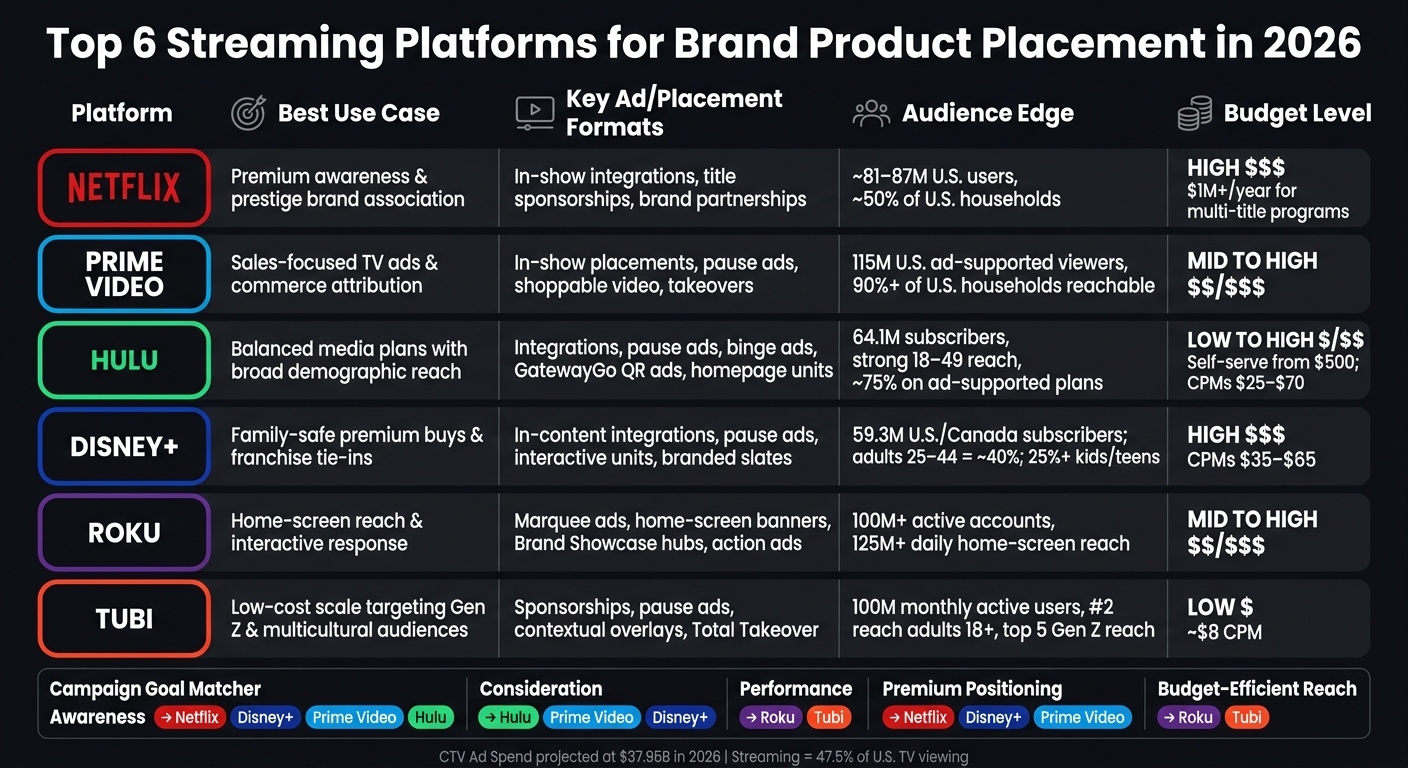
Top 6 Streaming Platforms for Brand Product Placement in 2026
Netflix Shows Are Full of Brands – But Is It Product Placement? | Movies Insider
sbb-itb-0df1f49
Quick Comparison
| Platform | Best Use | Main Ad/Placement Types | Audience Edge | Budget Level |
|---|---|---|---|---|
| Netflix | Premium awareness | In-show integrations, title sponsorships, brand partnerships | Large premium streaming audience | High |
| Prime Video | Sales-focused TV ads | In-show placements, pause ads, shoppable video, takeovers | 115 million U.S. ad-supported viewers | Mid to high |
| Hulu | Balanced media plans | Integrations, pause ads, binge ads, homepage units, QR ads | Strong 18–49 reach | Low to high |
| Disney+ | Family-safe premium buys | In-content placements, pause ads, interactive units | Franchise-led, family-heavy audience | High |
| Roku | Home-screen reach and response | Marquee ads, banners, branded hubs, action ads | 100 million active accounts, home-screen access | Mid to high |
| Tubi | Low-cost scale | Sponsorships, pause ads, contextual overlays, takeovers | 100 million monthly active users, strong Gen Z reach | Low |
If I’m building a simple plan, I’d usually mix one premium platform, one scaled ad-supported platform, and one performance-focused platform to cover brand image, reach, and results.
1. Netflix
Audience Reach
Netflix offers the biggest premium-scale play in streaming. By mid-2026, the platform had passed 90 million paid subscribers in the U.S. and Canada. In the U.S., estimates put usage at about 81 million to 87 million users – roughly half of American households.
That kind of scale makes Netflix a strong fit for top-of-funnel awareness. It also gives brands room to stretch one integration across multiple markets.
Placement Formats
Of course, that reach comes with high-end, custom placements.
Netflix now offers in-show product integrations, title-level sponsorships, and long-term brand partnerships. A clear example is AB InBev’s three-year global deal from 2025 to 2028. It gives Budweiser, Bud Light, Stella Artois, and Corona access to placements across multiple Netflix originals, co-marketing tied to live events, and limited-edition packaging linked to Netflix content.
On the sponsorship side, brands such as SmartFood (Love is Blind), T-Mobile (Squid Game: The Challenge), and Lancôme (The Crown) have used title-level sponsorships to own the pre-roll and sponsor messaging.
Targeting and Measurement
These deals get much stronger when measurement is built in from the start.
Brands can track reach and demographics with Nielsen Digital Ad Ratings, check viewability and brand safety through DoubleVerify and Integral Ad Science, and measure outcomes like search lift and conversions with EDO. Programmatic access is also growing. Audience segments are now available through Amazon DSP and Yahoo DSP, while first-party data onboarding runs through LiveRamp.
For placement deals, ask for exposure logs by episode, region, and air date. Then line that data up with search and sales results.
Brand Fit and Budget
Netflix tends to work best for brands that want premium reach and strong pop-culture alignment. CPG, QSR, auto, tech, and lifestyle brands all fit across the platform’s slate.
Some pairings are a natural match:
- Snack and beverage brands often fit well with reality and competition shows
- Luxury and beauty brands usually sit better with prestige drama
Budget-wise, this is enterprise territory. Expect $1M+ per year for multi-title or multi-region programs. More focused title sponsorships tied to major tentpole releases usually land in the mid- to high-six-figure range, depending on reach and exclusivity. Custom partnerships use bespoke pricing rather than standard rate cards.
2. Prime Video
Audience Reach
Prime Video stands out for brands that want big reach, commerce data, and action you can track in one system. Its ad-supported tier now reaches more than 115 million monthly ad-supported viewers in the U.S.. That gives brands broad national reach and strong repeat exposure across premium originals, licensed shows and movies, and live sports.
Placement Formats
Prime Video offers both on-screen integrations and interactive ad units. Brands can run in-show integrations inside originals like Reacher and Jack Ryan, including Virtual Product Placement that can be added after production.
It also includes:
- AI-powered pause ads
- Interactive video ads with shoppable features and CTAs like "get a quote", "book an appointment", "subscribe now", and "send information to phone"
- Branded bumpers, sponsorship moments, and first-impression takeovers for major launches
These options tend to work best for product launches, retail pushes, and local response campaigns.
Targeting and Measurement
Prime Video taps Amazon’s first-party shopping, streaming, and device data, which allows household-level targeting across over 90% of U.S. households. Marketers can line up campaigns by behavior, content, and location, including in-market categories with up to a 30-day lookback window. For local campaigns, location-based activation can tailor offers down to the ZIP code level.
Measurement includes reach, frequency, completions, branded searches, add-to-cart actions, and purchase conversions. Amazon Marketing Cloud also supports attribution windows of up to 12.5 months. EDO has also found strong search lift for Prime Video live sports placements.
Brand Fit and Budget
Prime Video is a strong match for CPG and retail brands that want shoppable ad experiences tied to Amazon cart activity. It also fits automotive and local service brands that need geo-targeting and action-driven CTAs such as "Book a test drive" or "Find a dealer".
One VPP campaign delivered a 6.9% lift in brand favorability and a 14.7% lift in purchase intent.
Most brands buy Prime Video inventory through Amazon DSP.
For brands that want similar scale but with a lighter entertainment focus in their integrations, the next platform brings a different balance of reach and control.
3. Hulu
Audience Reach
As of September 2025, Hulu had about 64.1 million subscribers. About three-quarters were on ad-supported plans, which gave Hulu roughly 24% of all U.S. ad-supported streaming subscriptions.
That kind of scale matters. If a brand wants broad reach and solid ad-supported inventory, Hulu is very much in the mix.
Its audience also leans younger. Hulu has a strong concentration in the 18–44 and 18–49 age groups, and Millennials plus Gen Z make up about half of the subscriber base. In many reports, Millennials show up as the single biggest group.
Placement Formats
Hulu gives brands two main routes: content integrations and ad inventory.
On the content side, Hulu’s integrated storytelling team works with producers early in the process to find natural ways to place brands into scripts, sets, and character habits. This isn’t a last-minute logo drop. It’s built into the show’s world. Hulu has said brand integrations grew by around 200% year-over-year at one point, which shows how much this part of the business has grown.
On the ad side, Hulu offers a wide mix of formats, including:
- Pre-roll and mid-roll video
- Pause ads
- Binge ads
- Interactive units
- GatewayGo, which lets viewers send an offer to their phone through a QR code or push notification while watching on TV
Brands can also buy Sponsored Brand Placements on the Hulu homepage. These include Cover Story, Collection, and Hub formats built around certain shows or themed content groupings. Paired with :15- or :30-second spots in ad breaks, these placements can create a multi-touch path from discovery to watch session.
Targeting and Measurement
Hulu sells its ad inventory through Disney Advertising, so brands can tap into first-party data across the Disney+ and ESPN+ ecosystem.
Targeting options include demographics, geography down to the ZIP code level, behavioral signals such as binge patterns and content affinity, device type, and contextual targeting at the genre or show level. That gives marketers a lot of control without making the buy feel overly rigid.
Measurement includes brand lift studies, geo-testing, and attribution tied to site visits or conversions. Completion rates often top 90% because many Hulu placements are non-skippable.
For in-content integrations, brands often look beyond direct ad metrics too. They may track social buzz and branded search volume around the show itself.
Brand Fit and Budget
Hulu works across a broad set of categories. CPG and retail brands often fit well in family and lifestyle programming, while tech brands can slot into prestige dramas where devices and apps show up as part of daily life. Financial services brands often use Hulu’s ad-supported video inventory to reach the 25–54 segment with demographic and income-based targeting. Entertainment brands can lean on homepage sponsorships and curated hubs to support launches with high-visibility placements tied to related content.
On budget, Hulu has options at more than one level:
- Self-serve starts at about $500 per campaign
- Self-serve CPMs usually land around $25–$35
- Hulu + Live TV placements tend to run at $35–$70 CPM
Custom in-show integrations and homepage sponsorships take bigger, negotiated budgets and are usually a better fit for mid-market and enterprise brands. Hulu sits in an interesting middle ground: big audience, strong targeting, and room for both standard media buys and custom brand deals.
4. Disney+
Audience Reach
Disney+ blends broad family reach with premium franchise inventory. As of Q4 2025, Disney+ had 59.3 million subscribers in the U.S. and Canada and 131.6 million globally. Across Disney’s streaming portfolio, it also had 112 million monthly ad-supported users. That kind of scale matters. Disney+ doesn’t just reach a lot of people; it reaches them in a setting tied to major franchises.
The audience skews slightly male, at about 55% male and 45% female, and adults ages 25–44 make up the biggest single segment, at roughly 40% of U.S. viewers. Families are a big part of the story too. In some datasets, kids and teens together account for more than 25% of users, and homes with young children show strong penetration. For brands trying to reach millennial parents or household decision-makers, that’s a strong mix of reach and fit.
Placement Formats
Disney+ offers more than standard pre-roll and mid-roll video. Brands can work with Disney Advertising on in-content integrations, like a character using a product naturally within the story, across Disney, Pixar, Marvel, Star Wars, or National Geographic programming. In plain English: the product shows up inside the content instead of sitting only in an ad break.
Disney+ is also rolling out ad formats based on Hulu’s ad tech, including pause ads, ad selectors, and interactive units. That gives brands a way to pair story-led placement with measurable ad exposure. UI banners, branded slates, and interactive ads can help hold attention during a pause or break.
Targeting and Measurement
Disney+ uses Disney’s Audience Graph to support targeting by age, gender, household composition, geography, and behavior segments shaped by content preferences and franchise affinity. That makes category alignment pretty straightforward:
- Family animation for household goods
- Marvel or Star Wars for youth-leaning tech and apparel
- National Geographic for travel or outdoor brands
Measurement lines up well with what most product placement buyers care about. Disney+ supports brand lift through Kantar, foot traffic through Cuebiq and Foursquare, and web or app conversions through InnovidXP. The best setup is usually to pair an in-content integration with trackable ad units, then compare branded search, site visits, or conversions between exposed and unexposed audiences.
Brand Fit and Budget
Disney+ is a highly brand-safe platform. Its content and ad setup revolve around Disney-owned brands and tight ad rules, which makes it a good fit for packaged foods, household goods, consumer healthcare, family travel, kids’ products, and mainstream tech or automotive brands.
Pricing sits at the premium end, especially around tentpole releases. Standard CPMs usually range from $35 to $65. Custom in-content integrations are sold as premium packages and negotiated directly. Programmatic buying runs through Disney’s Real-Time Ad Exchange (DRAX), which connects with major DSPs such as Google Display & Video 360, The Trade Desk, and Amazon DSP. For brands that want broader household reach and a simpler buying path, Roku is the next platform to look at.
5. Roku
Audience Reach
Roku is the TV operating system in a lot of U.S. homes. That gives it one big edge: your brand can appear before someone picks an app, show, or movie.
In Q1 2026, Roku passed 100 million active accounts, and its home screen reaches more than 125 million people every day in the U.S. For product placement, that matters. It puts brands in front of viewers the moment the TV turns on.
Placement Formats
Roku’s ad setup is built around four main formats: native ads, destinations, video ads, and action ads.
On the native side, Marquee ads, Spotlight ads, home-screen banners, and branded tiles work like digital billboards right at the front door of the TV experience. Roku City, the animated screensaver cityscape, also allows brand integrations, so advertisers can stay visible even when the screen saver kicks in.
If a brand wants more than a quick impression, Brand Showcase destinations offer a branded hub linked from the home screen. These hubs can include product videos, offers, and interactive units. Neutrogena used this format for Hydro Boost: a Marquee ad sent viewers to a custom destination, where an OK-to-text Action Ad let them request product info by SMS.
Targeting and Measurement
Roku’s buying platform, OneView, supports audience targeting based on demographics, interests, and streaming behavior. It was also the first ad buying platform to enable Nielsen Digital Ad Ratings (DAR) audience guarantees across TV streaming.
Roku also offers contextual targeting. That means placements can line up with the setting or content area, like food and kitchen products in Roku City Food Showrooms or sports gear in Sports Zones. Retail media targeting adds another layer by tying ad exposure to shopping behavior, which helps brands track purchase lift.
On the measurement side, Roku supports closed-loop attribution across home-screen visits, destination clicks, and conversions. Its Nielsen integration also supports measurement across TV, CTV, desktop, and mobile.
Brand Fit and Budget
Roku tends to work best for CPG, beauty, household, DTC, and entertainment brands that want broad U.S. streaming reach plus interactive ad formats. It’s a strong fit for brands that want TV-scale reach but still care about response, whether that response comes through shoppable ads, QR-code overlays, or SMS-based actions tied to a TV placement.
Premium home-screen placements like Interactive Marquee and Brand Showcase are sold through Roku’s sales team, and they usually come with higher price tags because of how visible they are. If your budget sits more in the middle, a smart play is to run standard video ads across Roku inventory for scale, then add a limited home-screen or destination placement for extra visibility and interaction.
For big seasonal launches, some brands may want a larger Roku presence across the home screen, Roku City, Brand Showcase, and action ads as part of one push built to increase share of voice.
If your campaign needs lower-cost reach rather than a premium home-screen placement, the next platform moves toward broader ad-supported inventory.
6. Tubi
Audience Reach
As of May 2025, Tubi passed 100 million monthly active users, recorded more than 1 billion streaming hours in a single month, and accounted for 2.2% of total U.S. TV viewing. It ranks #2 in reach among adults 18+ across free AVOD platforms, lands in the top 5 for Gen Z reach, and sits at #3 in multicultural viewing time among adults 18–49.
That gives Tubi a pretty clear role in a media plan: broad scale with strong younger and multicultural reach. If a campaign needs a lot of impressions without drifting too far from those audiences, Tubi deserves a close look.
Placement Formats
Tubi works best for contextual and sponsored placements, not deep in-show brand tie-ins. Sponsorships can give a brand ownership of a content category, a seasonal hub, or a specific title. Total Takeover campaigns offer exclusive ownership during the selected window, which makes them a strong fit for launches and big promo pushes.
For product placement, the play here is less about scripted integration and more about ad units that sit around the viewing experience. That includes:
- Sponsorships
- Pause ads
- Contextual overlays
Pause Ads are one of Tubi’s better-known formats because they appear when a viewer pauses content. Tubi has also expanded this area with Animated Pause Ads, Interactive Pause Ads, and Scene Sense, its scene-level contextual tool that uses scene cues to match ads with what is happening on screen.
That mix tends to work best when paired with contextual targeting and conversion measurement, especially if you want more than simple reach.
Targeting and Measurement
Tubi uses first-party viewership data along with Fox data, and it works with IRIS.TV for scene-level contextual targeting. On measurement, it supports third-party partners such as Nielsen, Comscore, VideoAmp, InMarket, and Kochava.
Its tie-in with Amazon DSP adds closed-loop shopper measurement, linking CTV exposure to e-commerce and retail results. That matters if you’re trying to answer the usual question: did the ad just run, or did it move someone to act?
A practical way to use this setup is to compare exposed and unexposed audiences across:
- Title
- Genre
- Device
Brand Fit and Budget
Tubi fits best when the goal is scale plus context at a lower CPM. It tends to work well for CPG, retail, restaurant, entertainment, and app-driven brands that want to reach cord-cutters, Gen Z, and multicultural households.
With an estimated CPM of about $8, Tubi is one of the more accessible large-scale streaming options for upper-funnel awareness. A simple way in is to start with standard buys, then layer in sponsorships, Total Takeovers, or contextual targeting when you need more control.
Put plainly, Tubi is the clearest low-cost choice when the brief is about reach first, not premium exclusivity.
How to Choose the Right Platform for Your Campaign
Start with the goal. Pick the platform based on whether you want awareness, consideration, or performance. Then compare the platform profiles by reach, ad format, and buying model before you cut the list down.
Some platforms win on attention. Others win on pure reach. Hulu sits in the middle, blending premium inventory with broad reach.
Audience fit matters just as much as scale. Look at age, household makeup, income, interests, and viewing habits. Then line that up with the brand:
- Family-focused brands often fit Disney+
- Mass-market brands often fit Hulu, Prime Video, or Netflix
- Efficiency-driven campaigns often fit Roku or Tubi
Budget can narrow the shortlist fast. Premium platforms tend to work well for brand lift. Lower-cost platforms tend to work better when you want more reach and frequency for the money.
The ad format should also match the message. Scripted integrations are better when you need room for storytelling. High-frequency ad units are better when the goal is product clarity and repetition.
Turn those tradeoffs into a simple decision grid:
| Campaign Goal | Best Fits | Why |
|---|---|---|
| Awareness | Netflix, Disney+, Prime Video, Hulu | Premium content, high attention, brand-safe environments |
| Consideration | Hulu, Prime Video, Disney+ | Genre variety, audience depth, strong integration options |
| Performance | Roku, Tubi | Broad addressability, measurable outcomes, efficient reach |
| Premium brand positioning | Netflix, Disney+, Prime Video | Prestige content, premium association, scripted placements |
| Budget-efficient reach | Roku, Tubi | Large FAST audiences, lower CPMs, strong scale |
Once you have a shortlist, weigh each platform’s pros and cons against your KPI and budget.
Define the KPI first. Product placement needs a clear KPI, so choose the platform whose measurement model lines up with that target.
Pros and Cons of Each Platform
The summary below compares each platform through the trade-offs that tend to drive the decision: prestige, control, reach, and cost. Think of it as a fast buying guide for matching platform fit to campaign goals.
| Platform | Biggest Pro | Key Limitation | Best For |
|---|---|---|---|
| Netflix | Premium-scale reach with scripted in-show integrations tied to major cultural moments | Deep integrations are usually reserved for large strategic partners, and the buy-in is expensive | Enterprise brands seeking brand equity through prestige content association |
| Prime Video | Commerce-linked targeting and shoppable ad formats connected directly to Amazon purchase behavior | Can be tougher to buy and manage, and retail data signals do not help every category the same way | Retail and CPG brands wanting measurable sales lift tied to Amazon cart activity |
| Hulu | First-party Disney data with ZIP-code-level targeting and non-skippable ad inventory | Inventory access can change based on Disney’s broader ad strategy | CPG, QSR, and financial services brands running U.S.-focused demographic buys |
| Disney+ | Iconic franchise IP with strict brand safety across Disney, Marvel, Star Wars, and National Geographic | Tight creative controls can limit who gets in, and production timelines often mean longer lead times | Family, travel, and food and beverage brands seeking prestige association |
| Roku | Home-screen placement before content selection, plus closed-loop attribution across visits and conversions | In an aggregated environment, you get less control over the exact placement context | DTC and mid-market brands that want TV-scale reach with interactive response formats |
| Tubi | 100 million monthly active users at one of the lowest CPMs in streaming, with scene-level contextual targeting via IRIS.TV | The catalog leans older and library-heavy, with fewer deep integrations in flagship originals | Cost-conscious brands targeting cord-cutters, Gen Z, and multicultural households |
These trade-offs make more sense when you line them up against your goal and budget. If you want status and big-title association, Netflix and Disney+ sit in one lane. If you care more about sales signals and response, Prime Video and Roku start to look a lot more attractive. And if low CPM efficiency matters most, Tubi is hard to ignore.
Conclusion
The best platform comes down to four things: your audience, where the ad appears, how you’ll measure results, and how much you can spend. From there, the practical question is simple: how do brands put these options together?
A straightforward approach is a three-part mix: one premium platform like Netflix or Disney+, one scaled ad-supported platform like Hulu or Roku, and one performance platform like Prime Video, Roku, or Tubi that can connect ad exposure to sales, sign-ups, or site visits.
Here’s what that can look like in practice. A national consumer goods brand launching a new product might use Netflix for premium brand association, Hulu for broad U.S. reach and non-skippable inventory, and Prime Video for commerce-linked attribution tied to Amazon purchase behavior.
Before you lock in that mix, do a quick gut check:
- Does the premium option match the shows your audience watches?
- Does the ad-supported platform give you enough reach and frequency at a CPM your budget can handle?
- Does the performance platform offer the measurement tools you need to show impact in terms you can report?
If any answer is no, go back and trim the shortlist before spending dollars.
Looking ahead, it also makes sense to leave some room for testing new ad units without tearing up the core plan.
FAQs
How do I choose the right platform for my goal?
Start with one main marketing goal: awareness, engagement, or sales. Then turn that goal into a SMART goal and judge each platform by how well it helps you hit that mark.
Here’s the basic idea: not every platform does the same job.
For example, Netflix suits storytelling, Hulu supports engagement and emotional targeting, and Amazon fits direct purchases and precise attribution.
That’s why platform choice should come after the goal, not before it.
Check whether the audience is a match. Then score how well the platform lines up with both your audience and your content. On top of that, make sure the platform can track the KPIs tied to your goal. If you can’t measure the outcome you care about, it’s hard to know if the spend is paying off.
A simple way to think about it:
- Awareness: Look for reach, attention, and brand lift
- Engagement: Look for interaction, completion, and emotional response
- Sales: Look for purchases, conversion data, and clear attribution
Keep the process tight: goal first, platform second, measurement always.
What budget do I need for streaming product placement?
Streaming product placement budgets can be surprisingly flexible.
If you’re just testing the waters, an initial two-week campaign can start at $200 to $500. AI-powered or virtual placement tools often fall in the $100 to $1,000 per spot range, which makes them a lower-cost way to get started.
Once a campaign gets bigger, prices move up fast. Standard visual or background placements usually cost $5,000 to $50,000. If the integration is more involved, say a character actively uses the product or the product becomes part of the plot, costs can climb to $250,000 to $1,000,000+.
What drives that jump? Mostly three things: visibility, how deeply the product is woven into the content, and how many people are expected to see it.
Can I measure sales or conversions from these placements?
Yes. You can measure sales and conversions from product placements with attribution methods like unique discount codes, dedicated landing pages, and UTM-tagged URLs.
These tools let you track things like click-through rates, add-to-cart rates, and completed checkouts.
You can also measure sales lift by comparing pre-campaign baseline revenue with revenue during the placement window, then adjusting for other marketing activities.