Yes – I can get product placement without a Hollywood budget. In many cases, I can start with $0 to $500 per placement, use gifted product or barter deals, and test channels like nano creators, micro-influencers, niche YouTube, podcasts, and indie productions.
Here’s the short version:
- Big studio placements are out of reach for most small businesses. Some TV integrations can run $100,000 to $500,000, and film deals can start around $1 million.
- Lower-cost placements are easier to access through smaller creators, local shows, and indie projects.
- Nano-influencers may post for free product, while micro-influencer deals often fall around $100 to $500.
- Podcasts and niche YouTube channels can offer tight audience fit without huge spend.
- Indie films and web series may accept products, wardrobe, or location access instead of cash.
- AI-made video and audio assets can cut setup work for creators, which may help me get lower fees or test deals.
- Tracking matters. Promo codes, UTMs, and custom links help me see what leads to sales, traffic, or inquiries.
If I want product placement on a small-business budget, the play is simple: start small, stay niche, prep my assets, and repeat only what works.
| Channel | Usual cost | Best use |
|---|---|---|
| Nano-influencer | $0–$100 | Local or niche reach |
| Micro-influencer | $100–$500 | Sales-focused tests |
| Niche YouTube | $100–$500 | Product demos in context |
| Podcast | $100–$1,000+ | Trust and repeat mentions |
| Indie film / web series | $0–$500+ | Barter, props, locations |
Below, I break down where small businesses can place products, what those deals often look like, and how I’d keep costs low while still tracking results.
This AI Creates Perfect Product Placements in 2 Seconds (Designers HATE This Trick)
sbb-itb-0df1f49
Why Standard Product Placement Is Out of Reach for Most Small Businesses
Traditional product placement is usually priced, timed, and controlled for brands with big budgets.
The Actual Cost Barriers Small Businesses Face
Most small businesses assume price is the only problem. It isn’t. The main issues are cost, timing, and control.
A visible prop in a mid-tier streaming series can cost about $50,000. Network TV integrations often run $100,000 to $500,000 per integration, and that’s before the media buy, which can add another $500,000 to $1 million+. Blockbuster film placements start at $1 million and can climb into eight figures.
And money is only part of it.
Even if a small business had that kind of budget, the timeline usually doesn’t work. Securing a standard placement deal takes at least six months, and production can run nine months to two years from shooting to premiere. If you’re trying to line up with a seasonal launch, that kind of delay can kill the plan.
Then there’s the legal side. Even barter deals need formal contracts, usage rights agreements, and chain-of-title clearances. Productions also expect brands to move fast and deliver the right product quantities on a tight schedule. If approvals drag or the brand wants to control every detail, production can stall.
There’s another catch that makes many owners pause: the brand doesn’t control the final cut. Scenes can be trimmed, and logos can be shifted in editing without approval. So even after the spend, the wait, and the paperwork, the end result may not look the way the brand expected.
That’s why standard placements often don’t make sense for small businesses. The better route is usually direct, flexible placements instead of old-school brand deals.
How to Think About Product Placement Differently
The better opportunity is often with direct, flexible placements through creators and indie productions, where access is more direct and pricing can be negotiated. That’s the shift that puts product placement into a range small businesses can actually work with.
Instead of chasing Hollywood-scale deals, small businesses should focus on faster, smaller, and more flexible placements.
Placement Channels Small Businesses Can Actually Afford
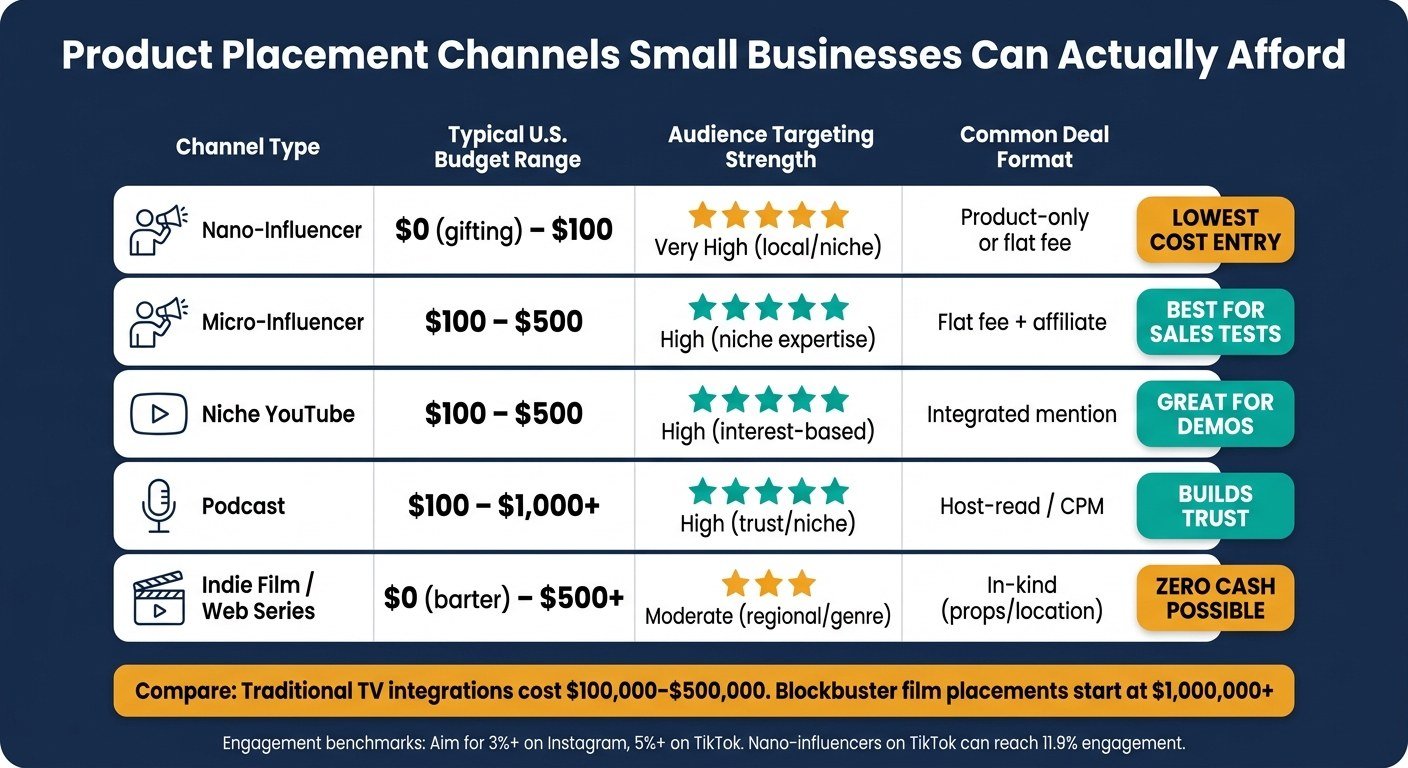
Product Placement Costs for Small Businesses: Channel-by-Channel Breakdown
The best placements for small businesses are usually the ones you can set up yourself, without a giant approval process or studio-level budget.
Micro-Influencer Videos and Niche YouTube Integrations
For most small businesses, nano and micro-influencer partnerships are the lowest-cost place to start. Nano-influencers, with 1,000–10,000 followers, often work in exchange for free products or very small fees. Micro-influencers, with 10,000–100,000 followers, usually charge $50–$500 per post.
What matters most here isn’t raw follower count. It’s engagement. Nano-influencers on TikTok can see engagement rates as high as 11.9%. That’s a big deal if you’re trying to get in front of people who might buy, not just scroll past.
Reels, Shorts, and integrated YouTube mentions tend to work well because the product shows up inside the creator’s usual content. It feels more natural and less like a hard pitch. When you’re checking creators, aim for engagement rates of 3%+ on Instagram and 5%+ on TikTok. Also look at the comments. Real conversations beat a pile of generic reactions every time.
If your product depends on trust and word-of-mouth, audio placements are often the next step.
Podcasts, Host-Read Mentions, and Local Audio Placements
Podcast and local audio placements work a lot like spoken product placement. A host-read mention, where the host recommends your product in their own voice, can land in a way a standard ad often doesn’t.
For a small business, the smart move is usually to target niche shows with loyal listeners instead of chasing the biggest audience possible. A 3-to-5 episode run can help people hear your name more than once, which builds familiarity. It may also help you get a 15%–20% discount compared with one-off rates.
Independent Films, Web Series, and Local Productions
If you can swap products, space, or access for screen time, indie productions are often the lowest-cash option.
Independent films and local web series are open to small-business partnerships, and plenty of these deals involve no cash at all. A local café, boutique, or food brand might offer a location or free product in exchange for a scene feature or an end-credit mention. Student films and micro-budget web series are often open to this because saving money on production matters at every step. The timing matters too. Reach out during pre-production so your product can be worked into the story in a natural way.
Here’s how these channels compare for small-business budgets:
| Channel Type | Typical U.S. Budget Range | Audience Targeting Strength | Common Deal Format |
|---|---|---|---|
| Nano-Influencer | $0 (gifting) – $100 | Very high (local/niche) | Product-only or flat fee |
| Micro-Influencer | $100 – $500 | High (niche expertise) | Flat fee + affiliate |
| Niche YouTube | $100 – $500 | High (interest-based) | Integrated mention |
| Podcast | $100 – $1,000+ | High (trust/niche) | Host-read / CPM |
| Indie Film / Web Series | $0 (barter) – $500+ | Moderate (regional/genre) | In-kind (props/location) |
Cut Production Costs With AI and Get Better Deal Terms
Getting a placement is only half the job. The other half is showing up with assets a creator or producer can actually use. A simple integration kit – product shots, a one-page spec sheet, and plain-language brand do’s and don’ts – makes it easier for creators to say yes.
Use AI Video to Build Placement-Ready Brand Assets
AI video tools can help you make short product demos, logo animations, and branded visuals without cameras, actors, or a physical set. For outreach, a 30–45 second demo works well. When creators can see your product in action, they’re more likely to reply. In fact, reply rates can climb to 15%–25%, compared with about 2% for text-only cold messages.
The big win here is simple: you cut the creator’s workload.
If a YouTuber or indie producer can drop your asset straight into their edit without hiring a crew or reshooting anything, you become an easier partner to work with. That lower friction gives you more room when you talk about fees or pitch a barter deal. You can also make the same asset in several aspect ratios:
- 16:9 for YouTube
- 9:16 for Reels and TikTok
- 1:1 for X and LinkedIn
That way, one asset can work across several channels.
Once you have a usable demo, outreach gets easier and less expensive to convert.
Use AI Voice Assets for Podcasts and Creator Collaborations
For podcast placements, a ready-to-use audio file can save hosts a lot of work. Instead of asking them to write and record an ad read from scratch, you can hand over a finished voiceover, alternate scripts, or a short audio intro they can drop into the episode. You can also create alternate script reads and ready-to-use audio intros, which cuts recording time and revision overhead.
Those files do more than save time. They also put you in a better spot when you ask for a test placement or a barter deal.
How to Reach Out, Set Deal Terms, and Negotiate on a Small Budget
Once your assets are ready, move from production to outreach. Your best angle is straightforward: you’ve already done the prep. When you show up with a polished demo, a one-page brand brief, voiceover samples, and clear usage notes, you’re not asking a creator to gamble on an unknown brand. You’re making their job easier. And the more polished your materials are, the more room you usually have on price and format.
Start with a shortlist of creators or shows that fit your product for real. Before you talk numbers, ask for recent performance data: average views or listens, audience demographics, engagement rate, completion rate, and how past sponsor integrations performed. Then pitch a one-off test instead of a multi-episode commitment. That’s a much easier yes, and it gives both sides a chance to see whether the fit is there.
When it comes to payment, the structure matters just as much as the amount. Here’s a simple way to compare your options:
| Deal Type | Pros | Limitations | Best-Fit Situation |
|---|---|---|---|
| Cash-Only | Clear deliverables; strong control over how the product appears | Highest upfront cost; higher risk if the content underperforms | High-stakes launches or specific promotional windows |
| Cash-Plus-Product | Reduces total cash outlay; creator gets hands-on experience with the product | Requires shipping logistics; still needs some liquid budget | Mid-tier creators who want a fee but genuinely connect with the product |
| In-Kind / Barter | Lowest cash risk; offsets production costs for indie creators and producers | Less control over the final edit; no guaranteed post if seeding | Nano-influencer seeding, indie films, student projects, and micro-budget web series |
Because AI assets cut the creator’s effort, you have a stronger case for asking for a trial placement, a cash-plus-product deal, or a barter arrangement. Put the deliverables in writing and be specific: number of placements, platform, length, revision rounds, approval timeline, usage rights, and whether the creator can edit your AI assets. Vague terms lead to vague results, and those are hard to measure or repeat.
Track Results and Repeat What Works
The Signals Worth Tracking After a Placement
Once a placement goes live, measurement turns a small test into a budget call you can repeat with confidence. Before anything runs, note a simple baseline: site sessions, branded search volume, social mentions, orders, and inquiries. That gives you something solid to compare against after the content is live. Without that snapshot, you’re not measuring lift. You’re just taking a guess.
Give each placement a trackable code or link. A promo code like BRAND20, a UTM-tagged custom URL, or a dedicated email address can connect activity to a specific creator or production. If you have a physical store or take phone orders, ask your team to log how people heard about you in a basic spreadsheet. That helps you catch the offline signal that digital tracking can miss.
Check results 24 to 72 hours after a creator or podcast placement. For a web series or indie film release, track results for one to two weeks. During that window, watch for search spikes, referral traffic, and conversions, then compare those numbers with your baseline. Use the same code format and UTM naming setup for the next test so you can compare results side by side. If one channel brings traffic and another brings promo code redemptions, that tells you what each one is good at, and where your budget should go.
Conclusion: Start Small, Stay Targeted, and Use Better Assets
Use those results to pick the next placement channel, and scale only what performs. Micro-influencers can drive direct sales. Podcasts can build trust. Indie productions can build prestige. Start with one low-cost channel, use AI-made assets to cut setup costs, and repeat only the placements that lead to sales or qualified leads.
FAQs
How do I find the right creators for my product?
Start with people who already know your niche or brand. Check your customer list and social media followers for creators. People who already like what you do often turn into the best partners.
You can also search niche hashtags on Instagram, TikTok, and YouTube. Another solid move is to review tagged posts from similar brands. Focus on creators with 1,000 to 100,000 followers, strong engagement, steady growth, and professional, genuine interactions with their audience.
What should be included in a simple placement agreement?
A simple placement agreement should spell out the terms clearly, so both sides know what they’re responsible for and what to expect.
It should cover the placement type, whether the deal is exclusive, how much screen time the product or brand gets, and how visible it will be. It should also lay out any promotional support, along with the legal side of the deal, including who owns the footage and who has permission to use it in future advertising.
If it applies, include any agreed performance metrics too, such as audience data or viewership stats.
How can I tell if a placement actually worked?
Skip the vanity metrics. Focus on performance data that shows what happened.
Ask the production team for viewership numbers, audience demographics, and engagement metrics so you can gauge reach.
Then look at your own results: traffic spikes to your store or landing page, plus any lift in sales tied to the placement. If you have a clear conversion path, it’s much easier to track results and confirm them in real time.