You do not need a $100,000+ budget to get on screen. If I were a small or midsize U.S. brand, I’d start with indie films, film schools, local shoots, short-form series, and in-kind deals. In many cases, placements can start with $0 to $5,000 in product, location use, or small fees, while bigger indie deals may land in the $2,000 to $15,000 range.
Here’s the short version:
- I’d use scene-ready brand assets first, so a film team can use them at once
- I’d pitch indie films and microbudget features before going near studio projects
- I’d test placements with student films
- I’d contact prop masters and production designers, not just producers
- I’d trade products, services, or space instead of paying full cash fees
- I’d look at regional productions, shorts, web series, and streaming-first shows
- I’d put usage, credit, damage, and promo rights in writing
A few numbers stand out:
- Studio placements can cost $100,000 to $500,000+
- Indie and microbudget placements often fall around $0 to $5,000
- AI-built mock assets can cost about $300 to $1,500 for a small asset kit
- Short films may cost up to $50,000, and web series can run $1,000 to $25,000 per episode
The main idea is simple: go where budgets are tight and your product solves a filming need. That usually means props, set dressing, signage, crew support, or locations.
Quick Comparison
| Option | Best for | Typical cost | Who I’d contact | What I’d offer |
|---|---|---|---|---|
| AI-built brand assets | Screen loops, signs, UI | $300–$1,500 | Art director, production designer, post team | Ready-made visuals |
| Indie films | Background or hero placement | $0–$15,000 | Producer, line producer | Product, props, small fee |
| Film schools | Low-risk testing | $0–$5,000 | Student producer, director | Product, support |
| Prop/art department outreach | Set use without big deals | $0–$5,000 | Prop master, production designer | Product, packaging files |
| Regional productions | Local screen exposure | Varies | Producer, production manager | Meals, space, transport, product |
| Shorts/web series | Repeat exposure | Low to mid-$ | Producer, showrunner, director | Product, service, location |
| In-kind swaps | Brands with physical assets | Often $0 cash | Line producer, location manager | Store, restaurant, rooms, vehicles |
If I wanted the lowest-cost path, I’d start small, spread my budget across a few projects, and treat each placement like a test I can learn from and build on.
3 Product‑Placement Plays That Fund Indie Films Without the Legal Headache
Why Smaller Brands Can Still Land Film Placements
Before you pitch, it helps to know why smaller productions tend to say yes more often. Independent films, student projects, regional shoots, and streaming-first content usually have shorter approval chains and tighter budgets than studio films. That changes the game.
These productions often need real products, locations, and services to make scenes feel natural. And that gives smaller brands a real shot at getting in the door.
Short films and web series can also put your brand on screen more than once. You may get repeat exposure through episodes, trailers, stills, and social clips.
Common low-cost deal structures include:
- Product loans
- Product gifts
- In-kind sponsorship
- Co-promotion
- Modest cash fees
That edge matters most when you make things easy for producers. Give them clean assets, clear usage terms, and a fast yes. Once you have that part dialed in, the next move is packaging brand assets that indie productions can use right away.
1. Use PyxelJam to Build Placement-Ready Brand Assets for Indie Productions
Once you’ve picked an indie production, the fastest way in is simple: bring something the team can use right away.
That’s usually the hard part with indie film placement. It’s not just finding a good fit. It’s showing up with assets filmmakers can drop into a scene without extra work. PyxelJam’s AI video-production workflow helps you make scene-ready assets that feel like they belong in the film’s world instead of looking like an ad shoved into the frame. That can mean short looping ads for background TVs, digital signage styled for a storefront or venue, and branded UI overlays for phones, kiosks, or dashboard screens – all without building custom props from scratch.
That makes outreach a lot easier. Instead of pitching an idea, you can send the right asset to the right person.
Typical Budget Range in USD
A basic kit – one 10- to 20-second loop plus two or three signage versions – usually runs $300 to $600 in DIY mode. More custom packages tend to fall between $800 and $1,500. Either way, that’s still far below the five-figure budgets often linked to old-school placement work.
Best Production Contact
Start with the production designer or art director. On smaller crews, that job often lands with the producer or writer-director. If the asset will be swapped in or composited during post, reach out to the VFX supervisor or post producer instead.
Keep the pitch focused on scene-ready visuals, not advertising. A short note works best. Offer looping ads and signage shaped to match the production’s visual style, delivered as standard 1080p or 4K video files. It should feel less like a sales push and more like, “Here’s something your team can use this week.”
Expected Brand Visibility
Placements built this way are usually visual, not spoken. Your brand shows up on screens and signage, and it can appear across more than one scene if the production uses your signage as part of a recurring set.
There’s another upside here: the assets are reusable. Build one kit for a production, then tweak it for the next one at a much lower cost. That’s where this approach starts to snowball a bit – you do the heavy lift once, then keep reworking the same core pieces as new chances come up.
2. Partner With Independent Films and Microbudget Features
Once you have placement-ready assets, microbudget features are a smart next move. Independent films and microbudget productions need actual products, locations, and services to make scenes feel real on screen.
Microbudget features often come in under $250,000, while many indie features land between $250,000 and $2 million. At that level, gifted products or loaned goods can matter more than cash.
Typical Deal Range in USD
A lot of indie placement deals involve no cash at all. That’s common when a brand is supplying props, set dressing, or other on-set help. If there is a cash piece, it’s often modest – around $2,000 to $15,000 – and can help lock in more visible placement or even a spoken line.
Best Production Contact
Start with the producer or line producer. For set placement, reach out to the production designer or props master. For wardrobe, the costume designer is usually the right person.
Local brands often have an edge here. Why? They can cut shipping, pickup, and other logistics costs, which makes life easier for the production team.
Placement Format
The most common options are background placement and hero placement.
Background placement means your product appears in a scene without becoming the focus. It’s usually the easiest deal to make. A simple offer can go a long way:
- Free product
- Any duplicates the production may need
- Flexibility on packaging
From there, you can ask for screen time in places like kitchens, offices, or storefronts.
Hero placement puts your product front and center. That usually takes more alignment with the director and the story, but it can work well when the product fits the world of the film in a natural way.
Expected Brand Visibility
Indie films can keep paying off after the shoot wraps. Your brand may show up through festivals, streaming releases, and promo clips, which gives you a longer shelf life than a one-day production placement.
If your budget is even tighter, film schools and student productions are the next place to look.
3. Work With Film Schools and Student Filmmakers
Film schools are one of the lowest-cost ways to get product placement. Student productions need real products, and they often move fast. That makes even small in-kind offers worth considering. It’s also a smart way to see how your product looks on camera before you pitch bigger productions.
Typical Budget Range in USD
Most deals fall in the $0–$5,000 range: $0–$500 for product or props, $500–$2,000 for support costs, and $2,000–$5,000 for thesis films with clearer placement terms.
Best Production Contact
Start with the student producer or director. If it’s a school-run project, loop in the faculty adviser or production coordinator too.
Placement Format
The best fit here is usually organic product placement or simple set dressing. Think a beverage on a dorm desk, a device being used in a scene, or signage in an exterior shot. Close-ups can work, but they’re usually best saved for scenes that already need the product.
Expected Brand Visibility
The reach is usually more targeted than massive. Still, that doesn’t mean it’s short-lived. Campus screenings, online uploads, social clips, and festival runs can keep the film – and your product – in circulation long after production wraps.
A short written agreement helps keep things simple. Cover product use, logo visibility, and rights to share stills or clips.
These school contacts can also help you spot the crew roles that shape on-screen placement on pro sets, especially prop masters and production designers.
4. Connect With Prop Masters and Production Designers
Student films can show you the basics. On pro sets, though, the people you want are prop masters and production designers.
Prop masters handle the items that appear on camera. Production designers shape the look of the set and decide how those items fit the scene. In many cases, both can work your product into a shot without a formal placement deal. That’s why it helps to know who controls what on set – and what they can get into a scene fast, without blowing the budget.
Typical Budget Range in USD
On microbudget shoots, a placement may cost nothing beyond free product and shipping. On larger indie productions, expect $500 to $5,000 for product, shipping, packaging, and light art-department support.
Best Production Contact
If you want a specific item placed on camera – like your brand’s water bottle sitting on a character’s desk – start with the prop master or assistant prop master.
If the goal is broader scene branding, like signage or the look of a store interior, reach out to the production designer or art director.
A simple way in is to find prop masters and production designers in film credits, then contact them through LinkedIn or industry groups. Keep the message short:
- one line about your product
- one line about the scene need it can fill
If they can see right away that your product solves a set problem, the conversation moves much faster. From there, the choice usually becomes: should it live in the background, or should it be used as a hero prop?
Placement Format
The formats that tend to work best are background use, hero props, and set dressing.
Make the product easy for the art department to use. That usually means:
- matte finishes that cut glare
- clean logos that read from a mid-distance shot
- print-ready packaging files they can tweak if needed
Expected Brand Visibility
The type of placement affects how much screen time you get. Most products appear in wide or medium shots.
Your chances tend to improve when the product makes sense in the scene, the packaging stands out on camera, and the item is easy to source in multiples.
5. Support Regional and Local Productions Through In-Kind Sponsorship
When a production needs more than a simple prop, in-kind sponsorship can put your product, space, or service on screen in a way that has clear value. The idea is pretty simple: you trade products, services, or access to a space for placement and credits. That exchange can cut real production costs and make your offer much more appealing.
Take a two-week shoot. If you cover meals, you may help remove a major budget line. In return, that support can lead to branded cups on screen, use of your location in a scene, or an end-credit thank-you.
Typical Budget Range in USD
These deals tend to work best with productions that are trying to stretch every dollar. Regional and local shoots that lean on in-kind support often need help with meals, transportation, lodging, or locations. If your brand can fill one of those gaps, you usually have strong negotiating leverage.
Best Production Contact
Go straight to the producer, line producer, or production manager. On smaller shoots, the writer-director may be the person handling these talks.
Keep the outreach short and clear:
- Introduce your brand
- State the in-kind offer
- Connect it to a specific production need
- Ask for a short call
A one-page sponsorship deck with product images and estimated retail value makes it easier for the team to review the proposal fast.
Placement Format
Common formats in these deals include featured locations, hero product use, and background dressing. Featured locations usually give you stronger visibility, while background dressing is often easier to get approved.
Expected Brand Visibility
The reach is often local at first. The value gets better when the placement shows up in more than one scene or plays a role in the story. That can help drive local awareness, trust, and practical on-screen exposure, especially if the film makes the rounds at regional festivals or lands on a streaming platform.
Short films and web series can be even easier to work with. They often need the same kind of support, but with less red tape.
sbb-itb-0df1f49
6. Target Short Films, Web Series, and Streaming-First Content
When microbudget features feel a bit boxed in, short-form content can open more doors. These projects usually move faster, approvals are simpler, and your brand can show up more than once. Short films and web series are often easier to approach because the teams are small and the need for support is direct. Streaming-first productions are also a strong fit, since many of them already lean on brand deals as part of how they get made.
Typical Budget Range in USD
Short films often cost anywhere from a few thousand dollars up to about $50,000. Web series tend to land around $1,000 to $25,000 per episode. Smaller streaming-first seasons can range from under $10,000 to $250,000. At that level, even modest in-kind support can matter. A product trade, service swap, or location deal can turn into actual screen time instead of being ignored.
Best Production Contact
For short films, go straight to the writer-director or producer. In many cases, they wear several hats and can say yes without much red tape. For web series or streaming-first projects, you can also reach out to the showrunner.
Good places to find them include:
- Creator websites
- YouTube About pages
- Direct production email addresses
Placement Format
The simplest options are often the ones that work best. That can mean:
- Set dressing
- Hero props
- Branded spaces like a café, gym, or store that appears again and again in the story
If the brand fits the plot, story-led dialogue can work too. But it has to feel natural. If it sounds forced, it sticks out for all the wrong reasons.
When cash is still tight, the next step is often to trade value directly.
Expected Brand Visibility
Short films and web series now reach viewers on YouTube, Vimeo, Tubi, and the Roku Channel. That matters because even if total reach is smaller, the same audience may see your product again and again across multiple episodes. A web series with a niche but loyal fan base can deliver repeat exposure that’s hard to get from a one-off appearance.
The tradeoff is pretty simple: less scale, more repetition. And for brands trying to match with a specific audience, that can be a smart deal.
If the production still needs more support, trade product, space, or services instead of cash.
7. Offer Locations, Services, or Products Instead of Cash Fees
When a production needs extra help, you don’t always have to write a check. You can trade something you already have.
If your brand owns a restaurant, gym, vehicle fleet, office, or retail space, that asset can help cover production costs. In-kind deals let you swap locations, services, or products for screen exposure, credit, or both.
The main idea is simple: price what you’re giving in a realistic way, then trade that value for screen exposure the production can actually use.
Typical Budget Range in USD
The cash outlay is often $0, but your contribution still needs a price tag. A restaurant that closes for a crew day may give up $3,000 to $8,000 in food and lost revenue. A hotel that comps five to 10 rooms for a week may contribute $5,000 to $15,000.
That number matters. It gives you leverage in the deal. Treat the contribution like a media buy, and ask for placement terms that match what you’re putting on the table.
Best Production Contact
Start with the line producer, location manager, or production coordinator. If you want your brand built into specific scenes, bring in the producer or director early too.
A short pitch email is usually enough to open the door. Include:
- Photos of your space
- A clear note on what you’re offering
- Your location
- Available dates
- An estimated dollar value
Placement Format
The strongest deals turn your space into a repeat story location, like a bar, hotel, diner, or retail shop that shows up more than once.
To improve the odds, keep your exterior signage and interior branding visible. Then work with the production designer early so your space fits the film’s visual style.
For product deals, send enough product for both on-camera use and crew use. Shots where the product is used in a natural way usually land better than setups that feel staged.
Expected Brand Visibility
Most in-kind deals lead to visible signage, packaging, or a named location. That visibility tends to go up when the asset plays a central role in the story.
Put the scene use, signage, credit, and promo rights in writing.
Once you know what you can trade, the next move is shaping the ask.
Outreach and Deal Structures That Keep Costs Down
Start with the contact list. Reach out to the person who controls the prop, set, or location you want. For smaller brands, going direct is usually the cheaper path. After that, the job is simple: turn your request into a deal that’s easy to say yes to.
Your pitch should feel light, clear, and specific. Open with one line that shows you know their work. Then add a short two-sentence intro to your brand. After that, spell out exactly what you’re offering: free product, a location, a service, or a small cash fee. Include one or two placement ideas tied to actual scenes. End with a simple next step, like a 15-minute call or approval to send a one-page deck.
Attach a one-page deck and a short mock placement clip made with PyxelJam. That gives the production team something they can react to right away instead of guessing what you mean.
Keep the deck to five to eight slides. It should cover:
- Your brand snapshot
- High-resolution product shots
- Realistic placement ideas tied to specific scene types
- Your deal structure
- The logistics help you can provide
Make the last slide simple and easy to act on.
The structure of your offer matters just as much as the pitch. Go with the lowest-cost model that still fits the production.
| Deal Type | Offer | Typical Budget Range (USD) | Return |
|---|---|---|---|
| In-kind product sponsorship | Products for props and crew use | Typically $0–$2,500; up to $5,000 for larger indie projects | On-screen use, possible credit |
| Location exchange | Your space for shoot days | $0–$5,000 in forgone rental value | Visible signage, named location |
| Prop loan | Branded items loaned for shoot duration | $250–$1,000 handling fee | Screen exposure, item returned |
| Small paid placement | Modest cash fee for guaranteed visibility | $500–$5,000 | Specific scene placement, logo visible |
| Featured integration | Cash plus in-kind, multi-scene or multi-episode | $5,000–$25,000 | Repeated appearances, marketing rights |
You also want to size the ask to the business. Tyler M. Reid’s sponsor guidance says to match the offer to company size – $500 to $1,000 for a small local business and $5,000 to $10,000 for a larger regional company. That keeps the request grounded in what the business can handle, which makes approval more likely.
Before the shoot, put the terms in writing. A short two- to three-page agreement should cover scope, contribution value in USD, placement expectations, credit language, logistics, liability, and compensation. For prop loans, add an inventory list with photos and a clear replacement value for each item. That way, if something gets damaged on set, there’s less room for confusion.
If you can, have an entertainment attorney draft or review the agreement. Then use those terms as the baseline when you compare placement options later in the process.
Comparing Your Placement Options: A Quick Reference
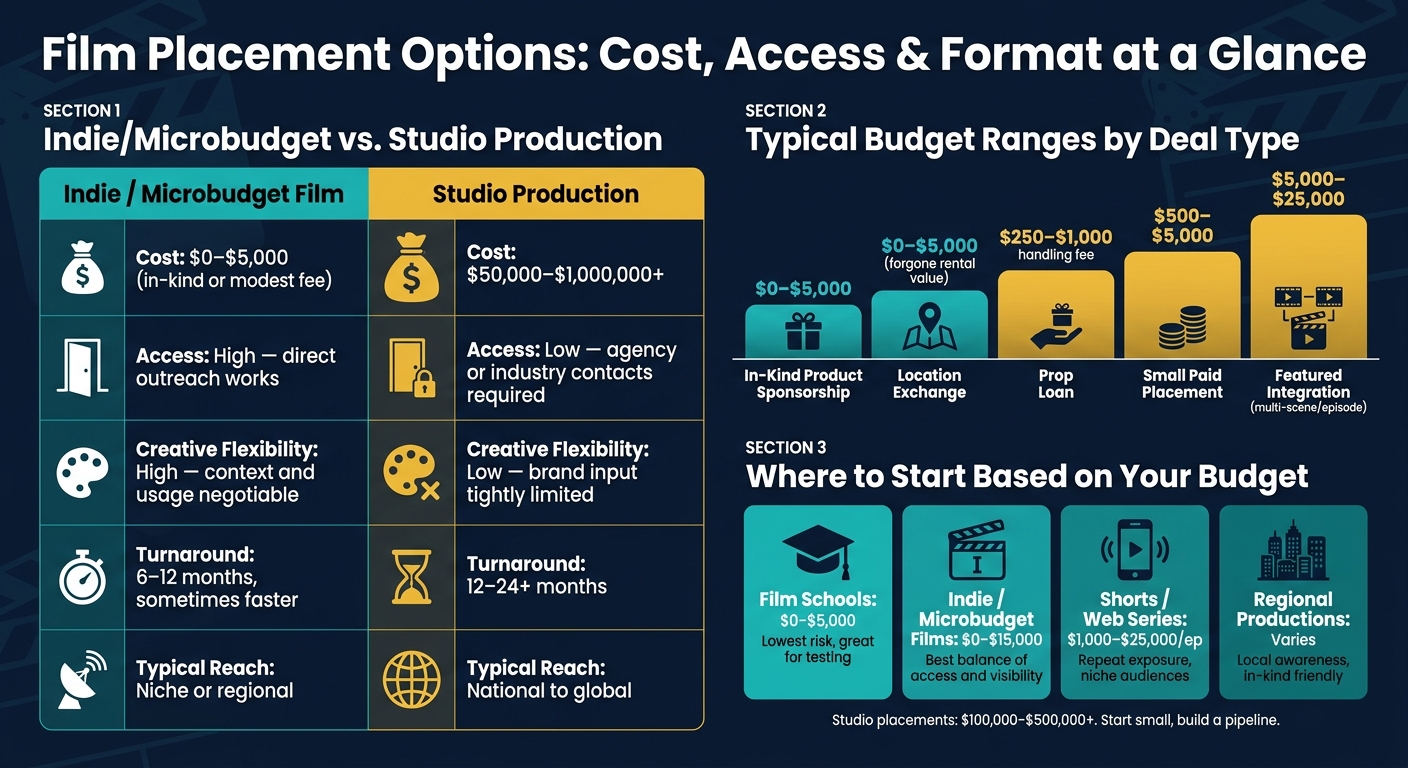
Film Placement Options by Budget: Indie vs. Studio & All Deal Types
Once your pitch and offer are ready, use this reference to pick the lowest-friction placement path. The goal is simple: match your budget, access, and level of control to the option that fits best.
The first call is indie films vs. studio productions. Indie and microbudget projects usually mean lower costs and more room to shape how your brand appears. Studio productions can put you in front of a much larger audience, but they leave far less room for input.
| Dimension | Indie / Microbudget Film | Studio Production |
|---|---|---|
| Cost | $0–$5,000 (in-kind or modest fee) | $50,000–$1,000,000+ |
| Access | High – direct outreach works | Low – agency or industry contacts required |
| Creative flexibility | High – context and usage negotiable | Low – brand input tightly limited |
| Turnaround | 6–12 months, sometimes faster | 12–24+ months |
| Typical reach | Niche or regional | National to global |
Film schools vs. professional shoots is another useful split. Film schools are often the easiest and cheapest place to start. They work well for testing ideas, building relationships, and trying low-risk placements before you spend more.
In-kind vs. cash placement mostly depends on what your business can part with. Go with in-kind if you can trade products, space, or services. Use cash when you need set deliverables and can take on the risk that comes with paying for them.
Then there’s traditional production vs. AI-assisted mockups. This choice affects how fast you can get your pitch in front of people. Standard production takes more time and more money. AI-assisted mockups move much faster and cost far less, which can help you get buy-in before filming starts. PyxelJam cuts asset creation to about $0.50–$30 per finished minute, with turnaround measured in hours, not days or weeks.
| Dimension | Standard Video Production | AI-Assisted (e.g., PyxelJam) |
|---|---|---|
| Cost per finished minute | $1,000–$50,000+ | $0.50–$30 |
| Access | Requires crew, studio, or agency | Web-based; no production skills needed |
| Creative flexibility | High but constrained by physical logistics | Rapid iteration – settings, lighting, branding |
| Turnaround | Days to weeks | Hours |
| Impact on placement | Final footage, reusable in ads | Speeds pitch approval; increases selection odds |
After you choose the best fit, the next move is less flashy but just as important: confirm rights, usage, and liability. Before you commit, get the terms and usage rights in writing.
Legal and Practical Considerations for U.S. Brands
Once placement terms are in place, get the legal pieces sorted before filming begins. Even on a microbudget or student project, a short written agreement can save a lot of trouble later. It should spell out what may appear on screen – the product, logo, packaging, or signage – where the film may be distributed, how long the rights run, what credit or visibility the brand receives, and who covers damage if the product gets broken on set.
Brand-use permissions need close attention. When you provide products for filming, you’re giving a limited license to use your trademark, logo, and packaging design. Put clear limits in writing: what the production may do with your logo or packaging, whether use is limited to the film itself or also covers trailers, posters, and social posts, and whether packaging may be changed in any way. It’s fine to allow on-screen use, but require separate written approval before anyone suggests endorsement.
The biggest legal line is the one between passive appearance and explicit endorsement. A product sitting on a table or being used casually in a scene is not the same as a character recommending it out loud. Under FTC guidance, a material connection can include free or discounted products, and that connection should be disclosed when viewers would not expect it. In most cases, it makes sense to keep that disclosure out of the scene itself and handle it in related promo materials when needed. Passive or lightly woven-in placements usually make low-budget deals easier and lower-risk.
Product safety matters too, and it’s one of those things people often skip until there’s a problem. If your product falls into a higher-risk category, confirm that it meets the U.S. safety rules that apply before it appears on camera. Give the production team written use instructions. If the item will be handled a lot, think about sending non-working props or empty packaging instead. For products like tools, vehicles, or electrical equipment, ask for proof of insurance and add indemnification language to the agreement. Those terms should live right alongside the rest of the paperwork.
On the admin side, keep every placement in one internal file. Include:
- Project title
- Producer contact
- Agreement date
- The value of what you provided in USD
- The main rights granted
Keep the signed agreement, approvals, and product specs together. That way, if distribution changes later, you’re not digging through old emails trying to piece things back together. This gets even more important if the project grows into trailers, streaming, or other deliverables.
Conclusion
Film placement doesn’t need a six-figure budget. A lot of solid deals are built around product, space, or service value instead of cash. The next move is simple: match that lower-cost path to the kind of project that fits it best.
Match the project to your budget. Student films and shorts often line up well with offers under $1,000, while microbudget indies and regional shoots are a better fit for deals in the $1,000 to $10,000 range. Just as important, maybe more so, is scene fit. A product that feels natural in a scene will beat one that looks shoved in every time. After you know your budget range, it’s usually smarter to spread it across several smaller placements instead of putting everything into one pricey deal.
Think of placements as a pipeline, not a one-time shot. Build that pipeline across a handful of indies, shorts, and streaming-first projects during the year. That spreads risk, keeps your brand learning, and builds stronger ties with filmmakers who may later lead to bigger openings. And this works a lot better when your pitch shows up with assets the production team can use right away.
Tools like PyxelJam help you come across as polished at almost any budget level. Placement-ready mock signage, packaging, and screen graphics give indie directors and production designers something they can use on day one. That cuts friction and makes your pitch easier and faster to approve. With the right assets and outreach, one placement can lead into the next.
Start small, stay steady, and treat each filmmaker relationship like the start of a long-term partnership. Repeated placements that fit well help build trust and can improve future deal flow over time.
FAQs
How do I know which film projects are worth pitching?
Use a steady framework that links each project to your brand goals. Check that the audience lines up with your target market, the product fits into the story in a natural way, and the distribution reach is big enough to make an impact.
You should also confirm that the partner can grant usage rights for marketing assets and share performance data. That way, you can track ROI with clear numbers, including brand recall and conversion metrics.
What should I include in a simple placement agreement?
Include clear terms for brand protection and control: how deeply the product is worked into the content, the setting around the appearance, and how long it stays on screen.
Also block any link to antagonists or negative storylines, lock in rights to use behind-the-scenes footage or stills in your own marketing, and spell out your creative approval rights before the content airs.
How can I measure whether a low-budget placement worked?
Track three key signals: brand recall, search spikes, and direct sales.
Placements can keep driving visibility through streaming and reruns, so it helps to compare audience reach and engagement against your initial investment. You should also watch for lifts in awareness or sales right after release.
When possible, work with partners who can share reach and engagement data. That gives you a clearer read on what the placement is doing beyond the first wave of views.