I’d judge product placement by what it achieves – not just whether the product appears. Before signing, I’d choose one measurable goal, set the total budget, and put deliverables, rights, and disclosure duties in writing.
Here are the eight mistakes I’d check for, with a fix for each:
- Wrong audience: Check buying habits, purchase authority, and where viewers can buy your product – not just audience size.
- Forced placement: Give the product a role that fits the scene instead of scripting praise.
- Poor brand fit: Review the story, character, and tone before paying for exposure.
- Unclear goals: Choose one main outcome, a target, and a deadline.
- Hidden costs: Include shipping, legal review, rights, promotion, and measurement.
- Loose contract terms: Specify appearances, approvals, reuse rights, and what happens if the placement gets cut.
- No promotional support: Prepare your landing page, channel plan, and tracking before release.
- Weak measurement: Compare results with your baseline and separate measured gains from estimates.
My rule: <u>plan the whole campaign before buying the appearance</u>. For U.S. creator endorsements, that includes clear disclosure of payment, free products, or other material connections. Exposure alone isn’t proof of sales or profit.
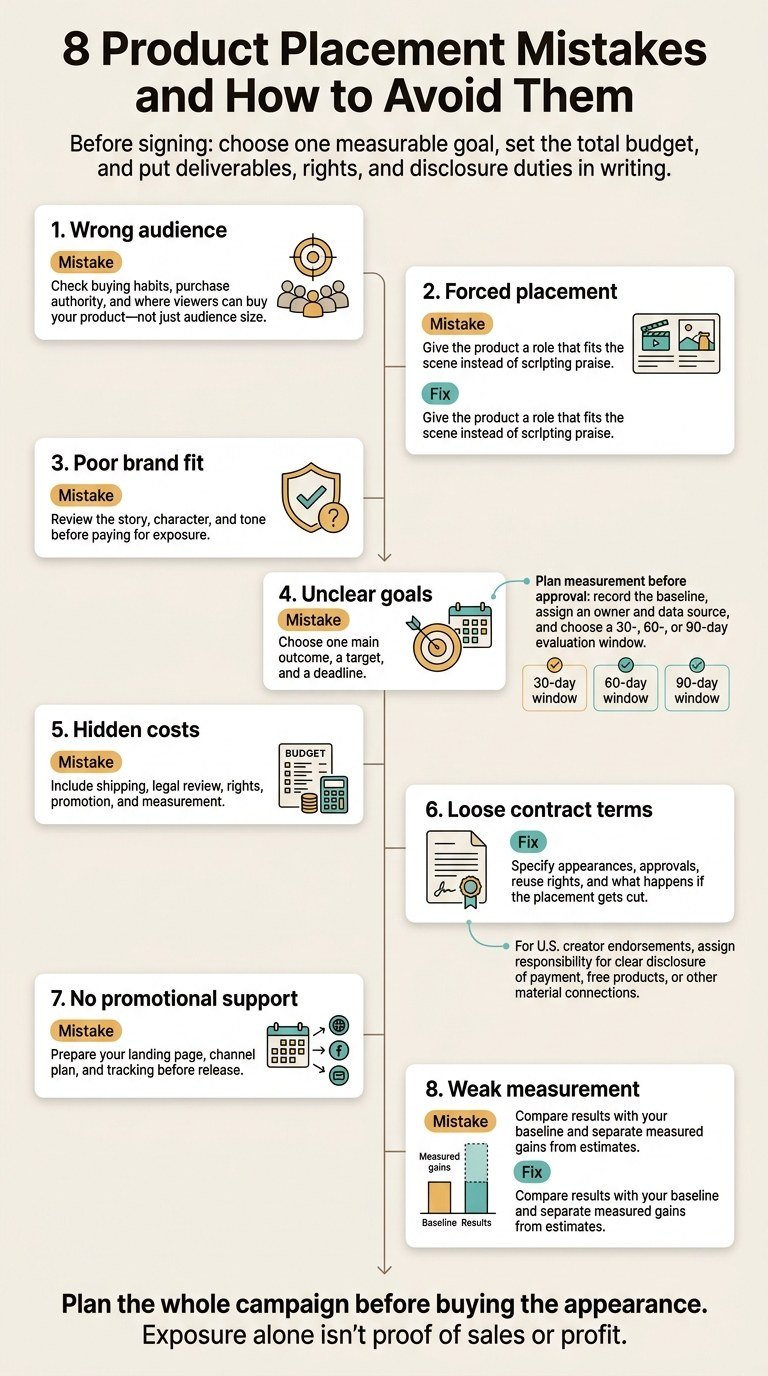
8 Product Placement Mistakes and How to Avoid Them
Awful Product Placements That Ruined The Whole Scene
sbb-itb-0df1f49
What to Define Before Seeking Product Placement
Separate product placement from owned content. Product placement appears in content another party controls. Content you commission doesn’t guarantee placement. Get a separate written agreement that covers distribution, timing, deliverables, and usage rights.
Before reaching out, create a one-page placement brief to screen opportunities before negotiations. Define your target audience, their media habits, and one numeric success threshold. Ask partners for audience composition and viewing or engagement data – not just total reach. Setting these criteria helps you avoid the common placement mistakes covered next.
Spell out acceptable content environments, exclusions, and brand-fit risks so integrations don’t feel forced or off-brand. Before discussing an integration, review the partner’s past content, audience comments, and release schedule.
Set an all-in budget ceiling that covers fees, product, shipping, legal review, licensing, promotion, and measurement. Give in-kind contributions a dollar value and set a walk-away limit. Choose your measurement method before approval, then record the baseline, who owns measurement, and the attribution window.
Have counsel review the format and relationship for disclosure obligations. Put disclosure responsibility, wording, and placement in writing. Once the brief, budget, and disclosure plan are set, the first mistake to watch for is choosing the wrong audience.
1. Choosing the Wrong Audience
A placement works only when viewers can become buyers. A large audience can still be the wrong audience. People may notice your product but have no need for it, no authority to buy it, or no way to purchase it in their market. High reach doesn’t always translate into sales.
More than half of sales for average consumer packaged-goods brands came from households outside the demographic groups advertisers typically targeted. Demographics alone can miss buyers. Compare a partner’s audience with your buyer profile, checking category purchase rate, purchase authority, market availability, and location.
Use estimated relevant reach to screen potential partners – not as the sole reason to approve a deal.
Check audience claims before approval. If you’re unsure about audience overlap, negotiate a limited pilot. If the claims lack support, pause the deal rather than paying for exposure without confirmed audience fit.
2. Forcing the Product Into the Content
A product needs a reason to be in the scene. Repeated logo shots, over-the-top praise, or dialogue that sounds like an ad can interrupt the story and make viewers resist the message. Placements connected to the plot usually work better than those that feel disconnected.
Once you’ve checked audience fit, start with the scene, not a screen-time quota. Does the product fit the character’s habits, the setting, and the emotional tone? If it makes the character act unlike themselves, revise the placement.
Give producers a brief that covers product accuracy, safety, approved claims, and banned uses. Then let them work the product into the scene naturally. Don’t script praise.
Before production, test a script excerpt, storyboard, or rough cut with a small group of viewers. If the placement feels distracting, scale it back, move it to a better scene, or cut the scripted mention.
3. Choosing Exposure Over Brand Fit
A placement can work in a scene without working for your brand. Reach tells you how many people will see it. Brand fit tells you whether that exposure supports your positioning. The wrong placement can link your product to values, characters, or emotions that weaken your brand.
Research shows that placements produce more favorable brand attitudes when they fit naturally into the story and the tone supports the brand. Enjoyment of the content helps explain that effect.
Require a written brand-fit assessment before negotiations. Use it to filter out paid exposure that could work against your brand. Score each opportunity from 1 to 5 on positioning, contextual fit, emotional fit, and risk fit, giving audience overlap the highest weight. Set a minimum acceptable score. Reject placements that conflict with your values – more reach won’t fix a mismatch.
Request U.S. audience composition and interests, along with brand-safety details. Look beyond the product’s appearance: review the surrounding storyline and the character’s behavior. Have marketing, legal, and brand-safety stakeholders review the assessment.
Once an opportunity passes the fit check, specify which brand association it should strengthen. Then compare reach, frequency, and cost.
4. Setting Unclear Goals
Once a placement passes brand-fit screening, spell out what it should achieve. A goal like “increase brand awareness” is too vague. It doesn’t say whose awareness should change, by how much, or by when.
Choose one primary objective, then set the target audience, baseline, desired change, deadline, and measurement method. Match the KPI to that objective: aided recall for awareness, purchase intent for consideration, or conversions for acquisition. Don’t default to impressions just because they’re easy to report.
Put the measurement plan in the contract. Give each KPI an owner and a data source, record pre-release benchmarks, and choose a 30-, 60-, or 90-day evaluation window. During negotiations, confirm who will provide audience and performance data – and when.
Keep brand lift separate from direct response. Don’t judge a placement meant to improve recall solely by immediate sales. If sales are the priority, use a dedicated landing page or promo code, then follow up with marketing. Before approval, define the result that would justify more spending. That target also sets the bar for cost.
5. Overlooking the Total Cost
Once you’ve set the goal, price the whole package – not just the placement. The quoted fee is only the starting point. A placement that looks cheap can get expensive when you add support, rights, and activation. Even a free product loan can come with inventory, shipping, customization, and labor costs.
Look for costs that may be missing from the quote, such as product prep, replacement inventory, and insurance. Ask whether talent, usage rights, or exclusivity carry separate fees. Keep promotion as a separate line item, but count it in the total. Request an itemized quote that clearly separates required commitments from optional extras.
Build in a contingency reserve for reshoots, rush shipping, packaging changes, or release delays. Set a spending ceiling and decide who approves overruns. Base affordability on the full campaign cost, not the quoted fee. If there’s no budget left to activate or measure the placement, renegotiate. Before moving to contract terms, confirm in writing exactly what the fee covers.
6. Leaving Contract Terms Unclear
Once the budget is set, put the details on paper. Get every placement detail in writing. Attach a placement schedule that names the exact product, brand name, logo, or trademark; the production and episode or film; the scene or context; the number of appearances; and any required dialogue, screen time, or camera visibility. Specify the release window, platforms, and territories. State whether the appearance is guaranteed or subject to editorial, production, or schedule changes.
Keep brand approval rights separate from control over the production. Cover trademark use, product accuracy, packaging, safety claims, and major placement changes – not casting, storylines, or the final cut. Set review deadlines and spell out whether silence counts as approval.
Agree on what happens if the placement gets cut or changed: a replacement placement, fee reduction, or refund. Include notice requirements and deadlines. Define category exclusivity by scene, episode, or full production, with exceptions for incidental background products.
Reuse rights need their own terms. Have entertainment counsel review licenses for clips, stills, and performer likeness rights. Address use in ads, platforms, territories, duration, approval procedures, and talent permissions.
If the placement is an endorsement, assign responsibility for clear and conspicuous disclosure of the material connection, including in accompanying promotional posts.
7. Failing to Plan Promotional Support
Once the placement is approved, plan the launch around it. An on-screen appearance can build awareness, but it needs support to drive action. Viewers might spot your product without knowing where to buy it.
Make product placement part of a larger launch plan, backed by paid media, email, social, and retail messaging.
Build the activation calendar before release. Prepare the landing page, brief retailers and customer service, coordinate campaign assets, and account for embargoes or release-date changes.
Give each channel an owner and a budget. Make sure someone handles assets, approvals, media, posts, and customer questions.
Before launch, decide where each channel will send viewers. Use channel-specific URLs, retailer-specific links, or a promo code to track responses. Use those same tracked links when you review results.
8. Failing to Measure Results
Screen time after launch isn’t proof of success. A placement can reach a large audience without improving brand recall, purchase consideration, or sales. Measure results against the goal you set before approval, not just how often the product appeared.
Before release, record baseline awareness, search volume, traffic, and sales. Then compare viewers who saw the placement with a similar group who didn’t over a defined period. Treat any measured lift as specific to that campaign – not as a benchmark for every placement.
Check whether viewers remember the brand without prompting and whether the placement feels natural. Strong recall can mask a placement that felt forced or hurt brand favorability.
Calculate ROI using the incremental profit attributable to the placement and the full campaign cost. Include fees, production, legal, travel, promotion, measurement, and required media spend.
If attribution is uncertain, keep verified results separate from modeled estimates. Media value can help put exposure in context, but it isn’t proof of sales or profit.
Conclusion: Treat Product Placement as a Campaign
Treat product placement as a campaign, not a scene.
Before signing, get all stakeholders to agree in writing on how the product will appear, what each partner will deliver, which costs are included, usage rights, and how success will be measured.
Make promotional commitments clear, too: specify the channels, publication windows, asset owners, and approval deadlines.
Planning reduces risk. It doesn’t guarantee reach, sales, or ROI.
FAQs
Can product placement work on a small budget?
Yes, product placement can work well on a small budget. Focus on indie films, student projects, short-form series, and micro-influencer partnerships. Offer products, props, location access, or services in exchange for exposure. These deals often cost $0 to $5,000.
Prepare polished assets and reach out to creators who serve your niche. Test placements, measure results, and scale only the approaches that deliver meaningful marketing value.
How do I isolate sales driven by a placement?
Before the campaign starts, set a baseline using at least 30 days of site sessions, branded search volume, and weekly revenue. Track conversions from the placement with UTM-tagged URLs, dedicated landing pages, or specific discount codes.
Compare campaign revenue against that baseline. Then subtract the expected impact of other marketing activities to estimate incremental revenue – the extra revenue the campaign generated. If possible, compare sales growth in markets or audiences exposed to the campaign with similar groups that weren’t exposed.
When does product placement require a disclosure?
Product placement requires disclosure when a brand and a production have a material connection, such as free or discounted products, especially if viewers wouldn’t reasonably expect that connection. FTC guidance calls for transparency to support viewer trust.
Disclosure is also considered necessary for all AI-generated placements. To meet ethical and regulatory standards, disclosures typically appear in related promotional materials rather than in the scene itself.
Related Blog Posts
- How to Negotiate Product Placement Deals That Actually Benefit Your Brand
- How Small Businesses Can Afford Product Placement (Yes, Really)
- Product Placement vs. Traditional Advertising: Which Delivers Better ROI in 2026?
- 10-Point Checklist for Evaluating Product Placement Agencies