I’d choose a product placement agency based on written proof – not promises of exposure. Start with your target U.S. audience, one measurable goal, campaign dates, and a total budget in U.S. dollars.
Here are the 10 checks I’d use before signing:
- Experience: Recent results for products and campaigns like yours.
- Media access: Proof of current production relationships.
- Audience fit: Data showing who you’ll reach and where.
- Placement quality: Clear terms for product visibility and story fit.
- Campaign fit: A plan tied to your brand, goal, and approvals.
- Costs: Itemized fees, extras, payment dates, and cancellation terms.
- Contracts and rights: Written delivery terms and permission to reuse content.
- Brand safety: Content checks, disclosure rules, and a correction process.
- Reporting: Proof of delivery, measurement methods, and reporting deadlines.
- Client support: Recent references, a named account lead, and escalation contacts.
I’d score each agency from 1–5, giving more weight to the checks that matter most to your goal. But a high average doesn’t erase a contract or safety gap: <u>resolve those gaps before paying or shipping products.</u>
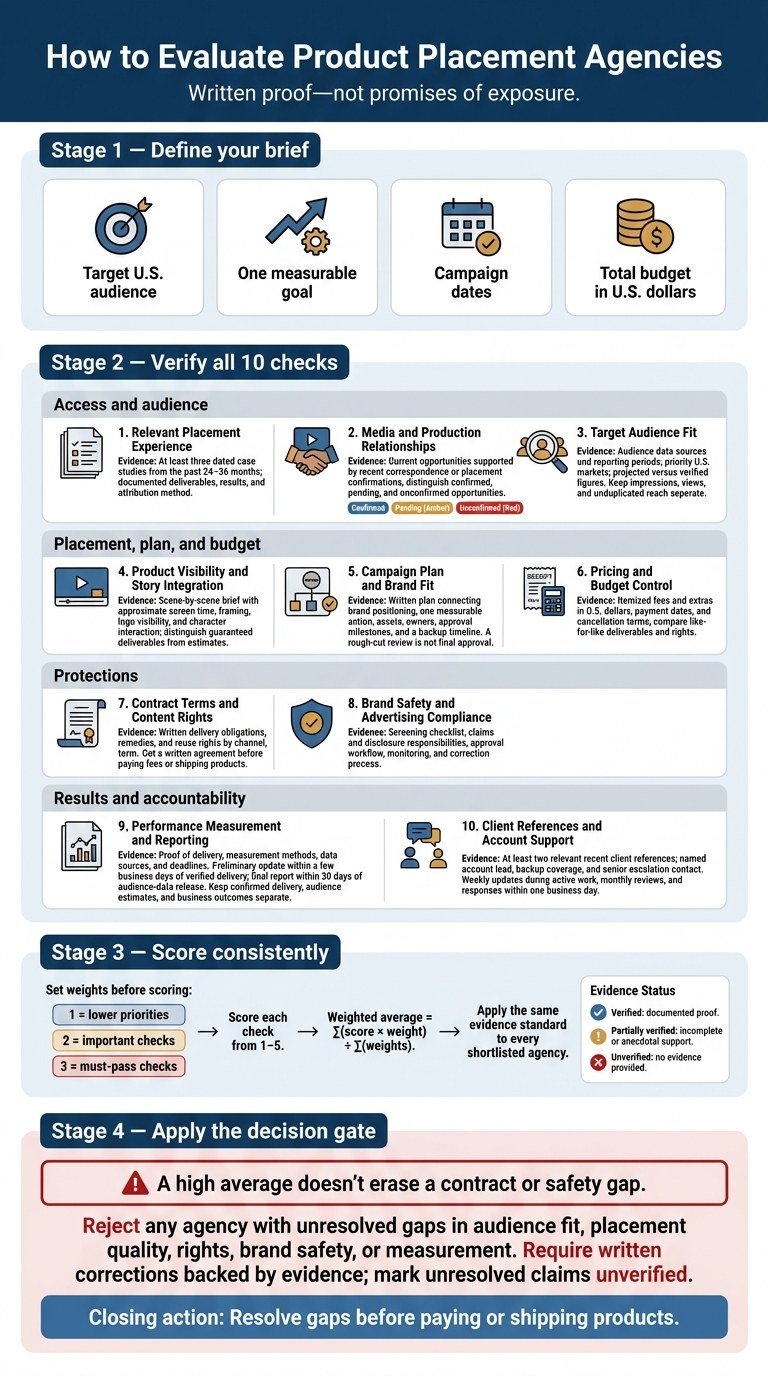
How to Evaluate Product Placement Agencies
Product Placement in Movies and TV – The Three Big Questions Answered | Ask BENlabs
sbb-itb-0df1f49
Review Experience, Media Access, and Audience Fit
Use your brief to check each agency’s access, audience fit, and results – and the proof behind its claims.
1. Relevant Placement Experience
Ask for at least three dated case studies from the past 24–36 months featuring products similar to yours in category, target customer, and content format. Each should spell out the agency’s role, placement type, distribution channel, campaign dates, contracted deliverables, and measurable results. Request placement screenshots, episode or post details, and redacted campaign reports. Client logos alone aren’t enough.
Get a written explanation of how the agency attributed results. A placement that aired or published proves delivery – not sales impact. Ask for an attribution method, such as campaign-specific URLs, promo codes, matched-market tests, or sales data tied to the campaign window. Check whether paid media, promotions, retail distribution changes, or seasonality also affected results.
Past results are only part of the picture. Next, verify whether the agency can still reach relevant productions today.
2. Media and Production Relationships
Ask which relationships employees manage directly and which depend on third parties. Request a list of current opportunities covering the title or format, platform, category, placement type, release window, geography, and status. Status labels should clearly separate confirmed, pending, and unconfirmed opportunities. Claims of active access should have support from recent redacted production correspondence or placement confirmations.
Find out who approves the product’s use, how much lead time production needs, and what happens if a placement gets cut, delayed, or limited to select markets. A contact list provides background; it doesn’t prove access.
Then check whether those opportunities match the audience in your brief.
3. Target Audience Fit
Ask for a written explanation linking each opportunity to your target audience and priority U.S. markets. Audience profiles and reach estimates should name the data source and reporting period, and state whether the figures are projected or verified.
Separate local, regional, and national exposure. Include international exposure only when it matters to a cross-border campaign. National viewership doesn’t prove reach in your service area. Keep impressions, views, and unduplicated reach separate so the largest number doesn’t drive the decision.
Assess Placement Quality, Campaign Plans, and Costs
4. Product Visibility and Story Integration
Once you’ve confirmed audience fit, assess whether the placement will feel natural, get seen, and justify its cost.
Ask for a scene-by-scene brief explaining whether the product will appear, be used, get mentioned, or play a role in the story. The brief should include the production title, scene description, approximate screen time, framing, logo visibility, and character interaction. Look beyond screen time: judge how naturally the product fits the story.
Separate guaranteed deliverables from estimates and opportunities that aren’t guaranteed. Get minimum delivery requirements and change-notice terms in writing.
Then check how the placement fits your broader campaign plan.
5. Campaign Plan and Brand Fit
Ask for a written plan that connects each placement to your brand positioning, one measurable action, and linked video, social, and digital campaigns. It should name the required assets, responsible owners, approval milestones, and a backup timeline for production delays.
Make clear which approvals are binding and which are advisory. A rough-cut review is not final approval.
If you intend to reuse placement footage or stills, secure written reuse rights before production starts.
6. Pricing and Budget Control
Once you’ve checked brand and story fit, compare the total cost with the rights and deliverables included.
Request a fee schedule in U.S. dollars with separate charges for retainers, commissions, placement fees, production fees, promotion, reporting, and taxes. Get separate estimates for shipping, storage, product replacement, licensing, and talent. Each charge should state its amount, quantity, assumptions, and due date. Ask vendors to disclose markups and referral commissions.
Compare like-for-like deliverables and rights – not just headline fees. Tie payments to documented milestones, such as strategy approval, a contractually secured placement, and delivery with reporting.
Require written approval for added expenses and scope changes. Spell out whether unused funds can be refunded or transferred, along with the refund or replacement terms if a placement is canceled, reduced, or delivered without the agreed rights.
Review Contract Protections and Brand Safety
7. Contract Terms and Content Rights
Get a written agreement before paying fees or shipping products. Request a sample contract and turn every verbal promise into a measurable obligation – not a nonbinding assurance. Define deliverables, placement targets, timing, approvals, ownership, and remedies. Spell out whether placement is guaranteed and what counts as a breach if the production is canceled, delayed, edited, or released without the agreed placement.
Clarify who owns footage, photos, screenshots, reports, and audience data. Set reuse rights by channel, territory, and term, and confirm permissions from all other rights holders. Address exclusivity, substitutions, and product loss. Have counsel review intellectual-property rights, indemnities, insurance, governing law, and liability caps. Settle these rights before any product ships.
8. Brand Safety and Advertising Compliance
Once contract terms are set, screen for brand safety. Request a screening checklist, approval workflow, and sample incident report covering the production, script, cast or creator, distribution, and later cutdowns and promotional edits. Distinguish prohibited contexts from sensitive subjects that need approval.
Assign responsibility for reviewing product claims and disclosures in each format. For paid or gifted endorsements, disclosures generally must be clear and conspicuous and appear with the endorsement. Ask for sample disclosure language and records identifying who approves claims.
Name contacts, set response deadlines, and identify who has final decision authority for edits made without approval, unsuitable content, or missing disclosures. Require post-publication monitoring, preserved approval records, and a process to pause or remove assets within the agency’s control. Assign responsibility for corrections, replacement content, and regulatory costs caused by agency errors.
Next, verify how the agency measures and reports results.
Verify Reporting and Client Support
9. Performance Measurement and Reporting
Compare agencies based on verified delivery and measurable results. Request a sample report, measurement plan, raw or exportable data, source names, reporting periods, and an explanation of any differences from the proposal. Keep confirmed delivery, audience estimates, and business outcomes separate.
For each placement, the report should identify the title/platform, release date, scene or segment, timestamp, screen time when available, prominence, market, and delivery status. Request screenshots or approved stills where permitted. Results should be labeled confirmed, estimated, projected, or modeled.
Agree on these definitions before work starts: reach means the number of distinct people exposed; impressions means total exposure opportunities; and media value means estimated equivalent ad value – not revenue. Confirm whether reach removes duplicate viewers across platforms, devices, or episodes.
For sales or traffic goals, request trackable links, promotional codes, or surveys. Also ask for the attribution window, comparison group, conversion definition, and measurement limits. A sales increase alone does not prove causation.
Put reporting deadlines in writing before work begins: a preliminary update within a few business days of verified delivery and a final report within 30 days of audience-data release. Ask how the agency handles delayed, edited, missed, or canceled placements, including any replacement, credit, or make-good.
10. Client References and Account Support
Once the reporting plan is set, confirm who will manage your account and how issues will move up the chain.
Speak with at least two relevant client references from recent campaigns with similar audiences, budgets, or placement goals. Ask whether the agency delivered promised placements and kept costs transparent. Find out how it handled missed or changed placements, whether the remedy matched the agreement, and who managed the account day to day.
Request the proposed team’s names, roles, availability, and backup coverage. Agree on weekly updates during active work, monthly reviews, and responses within one business day. Name a senior escalation contact and require a documented resolution plan for unresolved issues.
Conclusion: Compare Scores and Choose an Agency
Set weights before you score: use 1 for lower priorities, 2 for important checks, and 3 for must-pass checks. Match the weights to your goals. Sales campaigns should put more weight on measurement; premium brands should prioritize integration and brand safety.
Score each check from 1–5, then calculate Σ(score × weight) ÷ Σ(weights). Rank agencies by their weighted average, but review any low score on a critical item before making your choice.
Apply the same evidence standard to every shortlisted agency. Replace the dashes with weights and scores, and record each agency’s proof status: verified means documented proof, partially verified means incomplete or anecdotal support, and unverified means no evidence provided. Use these labels consistently.
| Check | Weight | Agency A: score / status | Agency B: score / status | Key risk to assess | Follow-up question |
|---|---|---|---|---|---|
| 1. Relevant Placement Experience | – | – | – | Niche mismatch | Have you run programs in our specific category? |
| 2. Media and Production Relationships | – | – | – | Weak network | Which relationships produced placements in the past 12 months? |
| 3. Target Audience Fit | – | – | – | Demographic drift | What supports the proposed audience match? |
| 4. Product Visibility and Story Integration | – | – | – | Forced placement | How do you ensure the product feels natural in the script? |
| 5. Campaign Plan and Brand Fit | – | – | – | Lack of strategy | Is paid amplification part of the service or an add-on? |
| 6. Pricing and Budget Control | – | – | – | Hidden fees | Is pricing flat, per-creator, or a hybrid model? |
| 7. Contract Terms and Content Rights | – | – | – | No usage rights | Are content usage rights negotiated by default? |
| 8. Brand Safety and Advertising Compliance | – | – | – | Compliance gaps | What is your process for verifying brand safety rules? |
| 9. Performance Measurement and Reporting | – | – | – | Vanity metrics | Do you tie reporting to sales or leads, or just reach? |
| 10. Client References and Account Support | – | – | – | Unclear accountability | Can you provide recent client references, and who will be the day-to-day point of contact? |
Add a proposal summary for each agency covering committed cost, scope, extras, contract status, and unresolved terms. Choose one reporting unit – title, scene, or deliverable – and use it across all proposals.
Reject any agency with unresolved gaps in audience fit, placement quality, rights, brand safety, or measurement. Require written corrections backed by evidence, and mark unresolved claims unverified.
FAQs
What budget do I need for product placement?
Costs depend on the content type and how closely your brand is woven into it. Small-business placements through barter, nano-influencers, or indie productions can start at $0–$500. Background or visual placements in streaming series typically cost $50,000–$250,000. Feature film placements central to the plot can range from $1 million to $45 million.
Set a tiered fee structure and secure internal budget approval before contacting partners. This helps keep spending aligned with your brand goals.
How early should I hire a product placement agency?
Bring in a product placement agency early, ideally during pre-production. This gives the agency time to review scripts and storylines, find natural ways to work your product into the story, and flag content that clashes with your brand values.
Film and television production can take 3 to 15 months or longer. Starting early helps you secure your placement, negotiate favorable contract terms, and set brand safety protocols before filming begins.
What placement guarantees can I realistically expect?
You can’t expect total control over the final cut. Editors may trim scenes or move logos. Get guarantees in writing rather than relying on verbal promises.
Your contract should spell out:
- Minimum on-screen visibility, foreground placement, talent use, portrayal approval rights, and brand safety restrictions.
- Marketing usage rights and timeframes, plus termination rights if the production or talent damages your reputation.
- Payments tied to production milestones to reduce your financial risk.
Related Blog Posts
- How to Negotiate Product Placement Deals That Actually Benefit Your Brand
- How Small Businesses Can Afford Product Placement (Yes, Really)
- The Ultimate Checklist for Measuring Product Placement Success
- Product Placement vs. Traditional Advertising: Which Delivers Better ROI in 2026?